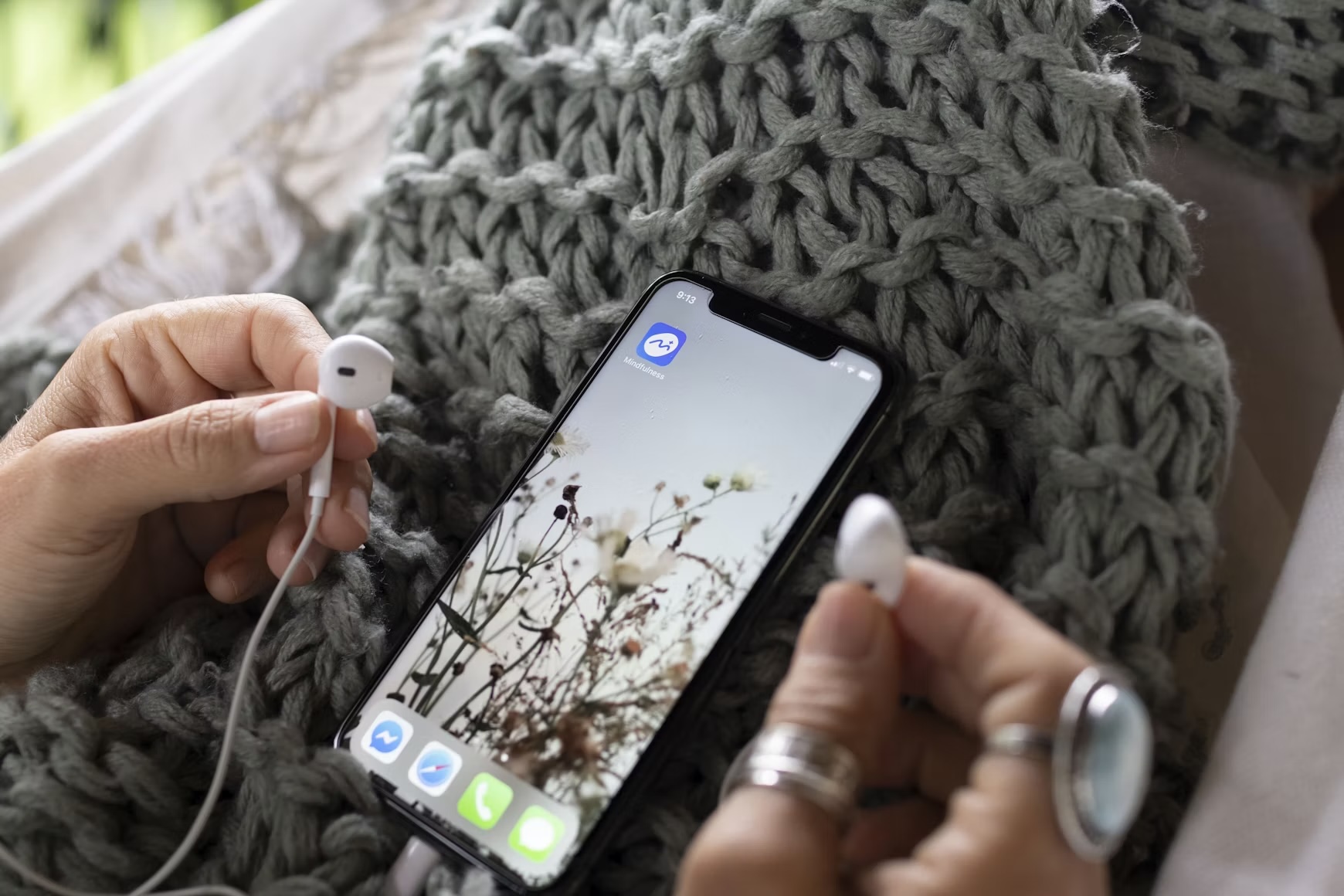
There is something funny about reaching for your phone to disconnect from stress. Our phones are often part of the noise in the first place.
And yet, for millions of people, they have also become a way to find a few minutes of calm. Mindfulness and sleep apps offer guided meditations, breathing exercises, sleep stories and other practices designed to fit into ordinary life.
The useful question is whether these tools can actually help—and which one fits the way you want to use it.
Do Mindfulness Apps Actually Work?
The evidence is encouraging, although it comes with some important qualifications.
A recent randomized controlled trial of the meditation app Headspace assigned 138 university employees to either eight weeks of Headspace meditation or a wait-list control. Participants in the meditation group were asked to practice for 10 minutes each day. By the second week, they reported lower subjective stress and less repetitive negative thinking, with benefits continuing through the eight-week study.
Research on Calm has produced similarly encouraging findings. In a randomized controlled trial involving 88 college students with elevated stress, participants who used Calm for at least 10 minutes a day for eight weeks experienced improvements in perceived stress, mindfulness and self-compassion compared with a wait-list control. Most of these effects remained at the 12-week follow-up.
Other research has found benefits from app-based mindfulness programs as well. A randomized controlled trial of the Healthy Minds Program found improvements in psychological distress among participants who completed an eight-week self-guided program.
The important point is that these studies tested specific programs with specific groups of people. They show that app-based mindfulness can be a useful tool for some people; they do not establish that every meditation app will work equally well for everyone.
READ: Building Resilience: Practical Strategies for Mental Strength
The Best Mindfulness Apps to Consider
Rather than ranking apps as though there is one universal winner, it is more useful to match the app to what you actually want from it.
Headspace — Best for a Structured Introduction
Headspace is designed around guided courses and progressive lessons, making it a natural starting point for someone who wants a clear introduction to meditation. Its approach is structured and approachable, with short practices that can fit into a busy day.
Its research record is also one of the more substantial among commercial mindfulness apps. Recent randomized trials have found reductions in perceived stress among users practicing with Headspace for about 10 minutes a day, while another trial found improvements in several measures of sleep.
The main consideration is cost. Much of the app’s content sits behind a subscription, so check the current price and available trial before committing.
Calm — A Strong Choice for Sleep and Relaxation
Calm places particular emphasis on sleep, relaxation and accessible meditation. Its library includes guided meditations, breathing exercises, music, soundscapes and Sleep Stories.
Its effectiveness has also been studied in randomized trials. Research among college students found improvements in stress, mindfulness and self-compassion after eight weeks of use, with most effects persisting at 12 weeks. A separate workplace study found improvements across several measures, including stress and insomnia, although completion rates and results varied across the participants.
For someone whose main goal is creating a calmer bedtime routine, Calm’s emphasis on sleep may make it particularly appealing.
Insight Timer — Best for a Large Range of Free Content
Insight Timer takes a different approach. It offers a large library of guided meditations, talks, music and meditation-timer functions, with substantial free content alongside paid features.
That breadth can be useful for people who already know what they enjoy. Beginners, however, may find the sheer number of choices overwhelming.
A good strategy is to choose one short practice and use it consistently for several days rather than downloading the app and immediately exploring hundreds of options.
Healthy Minds Program — Best for a Free, Research-Based Approach
The Healthy Minds Program stands out because it was developed around research on well-being and contemplative practice and offers its core program without the subscription model used by many commercial apps.
Its approach goes beyond simple relaxation. The program includes practices focused on awareness, connection, insight and purpose. Randomized trials have found improvements in psychological distress and other aspects of well-being among people using the program.
For someone who wants a structured, research-informed practice without paying for a subscription, it is one of the strongest options to consider.
Waking Up — Best for a More Analytical Approach
Waking Up, created by Sam Harris, takes a more philosophical and analytical approach to meditation. Its lessons explore mindfulness alongside ideas about consciousness, attention and the mind.
That style can appeal to people who prefer understanding the reasoning behind a practice rather than simply following relaxation exercises. The fit is highly personal, so it is worth sampling the teaching style before subscribing.
How to Choose a Mindfulness App You Will Actually Use
Start with the reason you want one.
If you want a structured introduction to meditation, a guided program such as Headspace may suit you. If sleep and relaxation are your priorities, Calm offers a broad collection of sleep-focused material. If cost matters most, Insight Timer and the Healthy Minds Program provide substantial free options.
Then make the practice small enough to fit your actual life.
The research on app-based mindfulness has tested many different schedules, but 10-minute daily practices are common in clinical trials. Studies have demonstrated benefits from brief daily sessions, while research has not established one universally optimal meditation “dose.”
So rather than promising yourself a 45-minute meditation every Sunday, start with something you can realistically repeat. Five or 10 minutes may be enough to establish the practice.
Give yourself a reasonable trial period, pay attention to how you feel and decide based on your own experience. A useful app should make mindfulness easier to practice, not turn it into another obligation.
A Caveat Worth Remembering
Meditation apps are wellness tools rather than substitutes for professional mental-health care.
They may help with everyday stress and support practices related to mindfulness and well-being, but people experiencing persistent anxiety, depression, severe insomnia or significant distress may need assessment and treatment from a qualified professional.
Meditation can also occasionally feel uncomfortable or increase distress for some people. If a practice consistently leaves you feeling worse, pause and consider discussing your experience with a mental-health professional rather than simply pushing through it.
The goal is to find a tool that supports your well-being.
The Best App Is the One That Fits Your Life
The best mindfulness app is the one that matches what you need and makes it easier to return to the practice.
Choose one clear purpose. Start with a manageable amount of time. Give yourself room to learn what works for you.
Your phone may be one of the sources of the noise.
Used thoughtfully, it can also help you create a little quiet.
*Photo by Mindfulness Com mindfulness_com
References
Huberty, J., Green, J., Glissmann, C., Larkey, L., Puzia, M., & Vlisides-Henry, R. (2019). Efficacy of the mindfulness meditation mobile app Calm to reduce stress among college students: Randomized controlled trial. JMIR mHealth and uHealth, 7(6), e14273. https://doi.org/10.2196/14273
Bostock, S., Crosswell, A. D., Prather, A. A., & Steptoe, A. (2019). Mindfulness on-the-go: Effects of a mindfulness meditation app on work stress and well-being. Journal of Medical Internet Research, 21(1), e12450. https://doi.org/10.2196/12450
Huberty, J., Puzia, M., Green, J., Vlisides-Henry, R., Larkey, L., Vranceanu, A.-M., & Irwin, M. R. (2021). Testing a mindfulness meditation mobile app for the treatment of sleep disturbance in cancer patients: A randomized controlled trial. Supportive Care in Cancer, 29, 1911–1920. https://doi.org/10.1007/s00520-020-05644-1
Huberty, J., Vranceanu, A.-M., Carney, C., Breus, M., Gordon, M., & Puzia, M. (2021). Characteristics and outcomes of a mindfulness meditation mobile app among breast cancer survivors: A randomized controlled trial. JMIR mHealth and uHealth, 9(10), e27449. https://doi.org/10.2196/27449