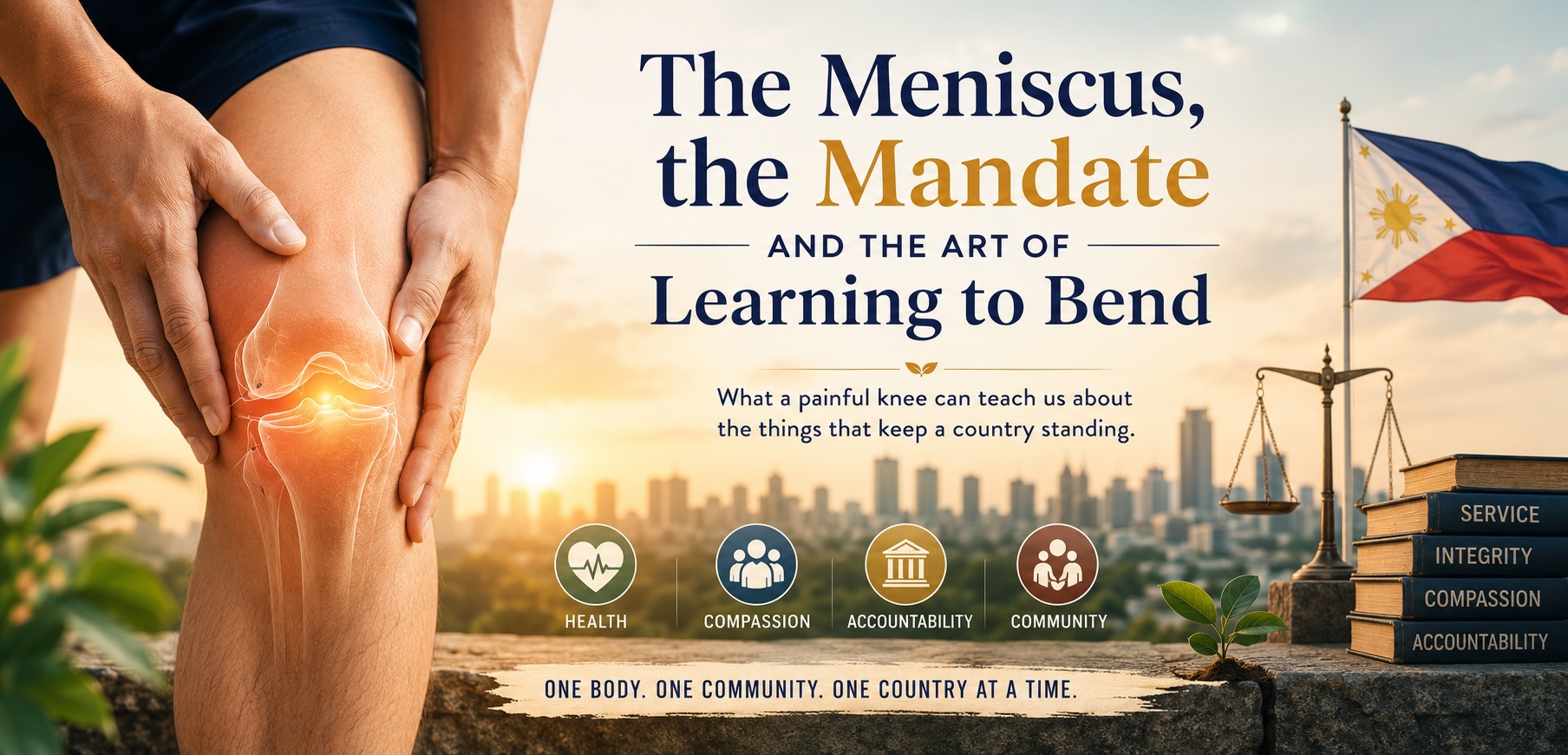
What a painful knee can teach us about the things that keep a country standing
We glean something almost too Filipino about the latest national conversation surrounding a knee.
Senator Jinggoy Estrada recently developed a serious tear in the meniscus of his left knee while preparing to leave his detention cell for a scheduled medical examination. His doctors subsequently recommended surgery. The senator already had osteoarthritis and longstanding problems affecting both knees.
Naturally, the country has opinions.
We have opinions about the senator. We have opinions about the charges he faces. We have opinions about detention, public officials, medical privileges, flood-control projects, government spending and the apparently inexhaustible capacity of Philippine politics to produce one more thing to discuss over coffee.
And we know that beneath all that noise sits a rather ordinary piece of human anatomy.
A meniscus.
And the meniscus has something interesting to teach us.
First, What Exactly Is a Meniscus?
Each knee contains two menisci: crescent-shaped pieces of tough cartilage that sit between the thighbone and shinbone. They help distribute weight, absorb shock and contribute to the stability and smooth movement of the joint.
A tear can happen through a twisting injury, sometimes during sports or a fall. It can also occur through degenerative changes that become more common with age. Pain, swelling, stiffness, clicking, catching or difficulty fully bending or straightening the knee can occur, although symptoms vary considerably.
And here is the first lesson worth keeping:
A knee can fail during something remarkably ordinary.
You do not need to be running a marathon.
Sometimes the body is simply doing what it has done thousands of times before—standing, turning, walking—and something gives way.
That is not uniquely political.
That is human.
What Is a Meniscus Tear? The Small Structure That Helps Everything Carry Its Weight
A meniscus tear is an injury to one of the two crescent-shaped pieces of cartilage in the knee. Tears can result from twisting injuries or develop gradually through age-related changes in the joint.
The meniscus is not the most glamorous part of the human body.
It does not get photographed on Instagram. Nobody writes poems about it. It does not make us feel powerful.
Yet it quietly distributes pressure so the larger structures around it can function.
That sounds suspiciously like good governance.
A functioning society depends on thousands of structures most citizens rarely think about: public hospitals, drainage systems, courts, schools, roads, barangays, sanitation systems, emergency services, social workers, teachers, nurses, engineers, caregivers and public servants who simply show up and do their jobs.
When those structures work, most of us barely notice them.
When one fails, everybody feels the weight.
And suddenly we discover that the small, unglamorous things were carrying much more than we realized.
A Country Can Have a Meniscus Problem Too
The Philippines has become painfully familiar with the consequences of systems that struggle under pressure.
We have seen roads buckle, floods overwhelm communities, hospitals stretch beyond capacity and families spend hours traveling for services that should be closer to home.
The point is not to compare a government institution to a piece of cartilage.
The point is more interesting.
Healthy systems distribute pressure.
Poor systems concentrate it.
When too much weight falls on one structure, something eventually hurts. This is true inside the body and, in a different way, inside a country. A family carrying the entire burden of healthcare costs eventually feels it, so does a teacher carrying too many responsibilities. A local government expected to solve problems without sufficient resources eventually feels it.
A public hospital carrying patients beyond its capacity eventually feels it.
And when citizens themselves carry too much—rising prices, long commutes, unstable employment, disasters, caregiving and uncertainty—the strain becomes personal.
Sometimes the problem is not that people are weak.
Sometimes the load has been distributed badly.
The Knee Does Not Care Who You Are
This may be the humbling part.
Cartilage does not recognize political parties.
Bones do not distinguish between senators and street vendors.
Osteoarthritis does not ask whether someone voted for you.
Pain does not check your résumé.
The human body has a wonderfully democratic way of reminding us that underneath our titles, arguments and identities, we remain vulnerable creatures who need sleep, food, movement, medical care and other people.
A senator can become frightened by a knee injury.
So can a jeepney driver or a mother who cannot afford to miss work.
So can an elderly person whose knees have begun making stairs feel like mountains.
That common vulnerability deserves more attention than we sometimes give it.
And About That Word: Bend
There is an almost irresistible metaphor here.
We use the word bend constantly in public life.
We talk about bending rules.
Bending the truth, the institutions, principles.
And yet the healthy human knee is designed to bend.
It bends because flexibility allows movement.
But the knee does not bend without limits.
Push the joint beyond what its structures can tolerate and something can tear.
That distinction may be useful far beyond anatomy.
Healthy flexibility allows a system to adapt. Unprincipled flexibility allows a system to break.
A democratic society needs room for disagreement, compromise and changing circumstances. It also needs structures that hold when pressure becomes intense.
The trick is knowing what can bend and what must remain intact.
We Need to Stop Treating Pain as a Political Identity
There is another lesson here for the way we talk about health.
A person’s medical condition should not become a political weapon.
At the same time, a medical condition does not erase legitimate questions about public accountability.
Those two ideas can coexist.
We can wish a person well while continuing to expect due process.
We can respect someone’s illness while allowing courts to make decisions according to law.
Let us discuss the healthcare needs of someone in detention while remembering that millions of other Filipinos also need access to timely, affordable medical care.
That is a more mature conversation.
And that is precisely what wellness means when it enters public life: learning to hold compassion and accountability in the same hand.
What Ordinary Filipinos Can Learn From a Senator’s Knee
For readers, the most useful part of this story may actually have nothing to do with politics.
If your knee hurts, swells, catches or repeatedly gives way, have it assessed rather than assuming it is simply part of getting older. A meniscus tear can sometimes improve with conservative treatment such as activity modification and physical therapy, while some tears require surgery depending on the type of tear, symptoms and other factors. Not every meniscus tear needs an operation.
If a knee injury leaves you unable to bear weight, prevents you from fully moving the joint, causes significant swelling or produces severe pain, medical assessment becomes particularly important.
And for older adults, persistent knee pain deserves attention because osteoarthritis and degenerative meniscal changes can occur together. A scan alone does not determine whether surgery is necessary; doctors consider symptoms, physical examination, the type and location of the tear and the person’s overall function.
In other words, listen to the knee.
That is good advice for joints.
It is probably good advice for countries, too.
A Healthier Way to Think About Public Service
The most useful metaphor is the simplest one.
A healthy knee helps a person move forward.
A healthy public institution should help a society move forward.
Both depend on structures that quietly distribute pressure, absorb shocks and maintain stability.
When something goes wrong, the answer is to diagnose it.
We understand what happened.
We determine what can heal, what can be repaired.
Then, we strengthen what has weakened.
And we change the conditions that made the injury more likely in the first place.
That is how rehabilitation works.
It is also how good institutions should work.
The Country Needs Strong Knees
We have become remarkably good at arguing about who is responsible for the pain.
Maybe we could become equally interested in understanding what keeps producing it.
A knee injury can be caused by an awkward movement, accumulated wear, trauma or several factors working together.
A national problem is the same.
There are immediate causes, underlying weaknesses, and warning signs.
And there are moments when somebody finally says: We need to do something about this.
That is where the metaphor ends and the responsibility begins.
The Filipino people need a country whose essential structures can carry the weight placed upon them.
We need institutions that can bend without breaking, systems that distribute pressure fairly, public servants who understand that power is a responsibility rather than a privilege, and citizens who remain sufficiently engaged to notice when something is hurting.
Joyful Wellness Takeaway
A torn meniscus is a medical problem, not a political metaphor. But the moment it entered our national conversation, it gave us an unexpected reminder: everything that carries weight needs care.
Our bodies, our families and communities do.
And so do the institutions entrusted with carrying a nation’s hopes.
Maybe wellness, at its most expansive, is learning to care for all of them.
One body. One community. One country at a time.
References
American Academy of Orthopaedic Surgeons. Meniscus Tears. OrthoInfo.
American Academy of Orthopaedic Surgeons — Meniscus Tears
National Health Service. Meniscus tear. NHS.
NHS — Meniscus Tear
Mayo Clinic. Torn meniscus — Symptoms and causes.
Mayo Clinic — Torn Meniscus
American Academy of Orthopaedic Surgeons. Osteoarthritis of the Knee. OrthoInfo.
AAOS — Osteoarthritis of the Knee
For the current Philippine event:
GMA News. UCPI pioneers PH telesurgery using robotic arm.
GMA News report