
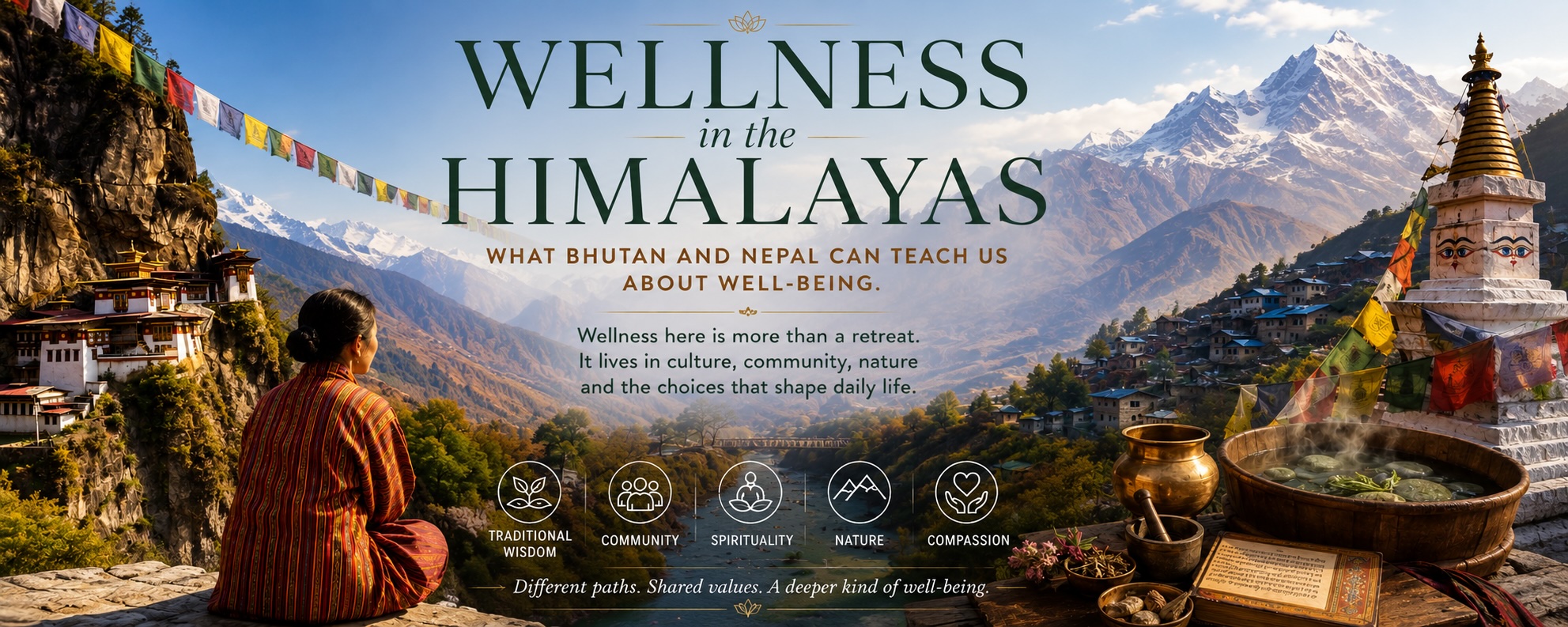
Saying the word “wellness” almost anywhere in the world, a second word often follows: spa. A fairly predictable image of a robe, diffuser, cucumber eye masks, and maybe green juices forms when we think of wellness. High in the Himalayas, however, the idea can mean something much broader. In Bhutan and Nepal, well-being is not a service purchased for a few hours. It is a worldview embedded into how medicine is practiced, how government policy is written, and how communities live out their days, how spirituality shapes daily life, and, in Bhutan’s case, how the government thinks about national development.
This distinction is worth sitting with, because it changes what these countries might actually have to teach the rest of the world.
Bhutan: Measuring What Matters Beyond GDP
Bhutan does something unusual with the idea of national progress. Alongside conventional economic measures such as Gross Domestic Product (GDP), it uses Gross National Happiness (GNH), a development framework that considers psychological well-being, health, education, community vitality, cultural resilience, good governance, ecological diversity and living standards.
GNH does not replace GDP
GNH does not replace GDP. Bhutan continues to measure and report economic growth, while using GNH as a broader framework for thinking about development. The distinction is important: a country’s economic output can tell us how much its economy produces, while a broader measure of well-being asks what that growth means for people’s lives. Bhutan’s own economic statistics continue to track GDP, while its national planning framework incorporates wider measures of well-being.
The practical results are visible in several areas of public policy. Bhutan’s Constitution guarantees free access to basic public health services, including modern and traditional medicine, and the government continues to operate a predominantly public healthcare system. Bhutan integrated Sowa Rigpa, its traditional medical system, into the national health system in 1967, giving citizens access to both traditional and modern approaches to care.
The country’s relationship with the environment is equally distinctive.
Bhutan is widely recognized as a carbon-negative country and has maintained forest cover across more than 70 percent of its territory. Bhutan makes environmental protection a national priority, while its protected areas and biological corridors cover substantial portions of the country.
Tourism follows the same broader philosophy. Visitors currently pay a Sustainable Development Fee of US$100 per night, with the revenue supporting areas that include healthcare, education, infrastructure, environmental conservation, cultural preservation and local economic development. The policy reflects Bhutan’s long-standing effort to pursue a high-value, lower-impact tourism model rather than simply maximize visitor numbers.
Traditions
Wellness shows up in daily texture, too. The dotsho, or traditional hot-stone bath, remains a genuine Bhutanese practice rather than simply a spa invention. River stones are heated over an open fire until glowing, then dropped into wooden tubs of water, often infused with medicinal plants such as wormwood, warming the body and, practitioners say, easing everything from joint pain to poor circulation. The practice has deep cultural roots and is associated with relaxation and traditional healing.
Bhutan is also bringing Sowa Rigpa, its traditional medical system, into a modern institutional framework.In 2025, Bhutan’s Ministry of Health established the National Center for Traditional Medicine Services and launched a 2025–2034 strategy emphasizing service delivery, education, research, medicinal-resource management and wellness initiatives. The strategy increasingly emphasizes evidence-based, patient-centered care, showing how traditional knowledge can remain culturally meaningful while also evolving through research and quality standards.
Nepal: Where Healing Comes From the Mountains
If Bhutan has given well-being a place within national policy, Nepal offers another perspective, shaped by geography, community traditions, spirituality and a remarkable range of ecosystems.
The same Sowa Rigpa tradition practiced in Bhutan runs deep through Nepal’s Himalayan communities, where practitioners known as amchis diagnose patients by pulse, tongue, and eye, then prepare remedies from an intricate local pharmacopeia, maintaining a traditional medical system with a long history in the region. The practice forms part of a broader Himalayan heritage of medicinal knowledge that has developed alongside the landscape itself.
Nepal’s medicinal resources are closely connected to mountain livelihoods.
Yarsagumba, the highly valued, rare caterpillar fungus Ophiocordyceps sinensis, grows naturally in alpine meadows and is traditionally used as an energy tonic, has become so prized that its annual harvest reshapes entire mountain communities’ calendars and an important source of seasonal income for those people in Nepal. Lower down, Nepal’s version of Ayurveda draws on lowland herbs like ashwagandha and holy basil, giving the country a rare medicinal range that spans from tropical Terai lowlands to some of the highest inhabited elevations on Earth. The commercial value, however, has also brought concerns about overharvesting, habitat degradation and conflicts over access to collection areas. Researchers and conservation organizations have worked with local communities and government authorities to develop more sustainable management practices.
Buddha’s Birthplace
Nepal also holds a distinction that gives its contemplative traditions a particularly deep cultural context that no marketing campaign can manufacture. Lumbini, in the southern Terai plains, is recognized by UNESCO as the birthplace of Siddhartha Gautama, the Buddha, which makes meditation and mindfulness practices here feel less like imported techniques and more like a return to origin. It has been a pilgrimage site since ancient times. The archaeological remains of monasteries and stupas provide evidence of Buddhist pilgrimage at the site from as early as the third century BCE. Meditation retreats, monastery stays and Vipassana centers draw visitors from around the world, while many Nepalis experience these practices as part of an ongoing cultural and spiritual tradition rather than as retreat experiences booked for a few days. They’re a continuous, lived thread running through ordinary community life.
Even trekking, often marketed abroad as an “adventure” product, functions locally as something closer to moving meditation: hours of quiet, repetitive walking through thin, clean mountain air, punctuated by monasteries and prayer flags rather than smoothie bars.
Even trekking, often marketed abroad as an adventure experience, can become a form of contemplative practice: hours of repetitive walking through thin, clean mountain air, long stretches of quiet, punctuated by monasteries and prayer flags, landscapes that naturally slow the pace of ordinary life, rather than smoothie bars.
DISCOVER: The Eight Dimensions of Wellness You Should Know
What Sets Bhutan and Nepal Apart From Mainstream Wellness Culture
Line these two countries up against a typical wellness retreat brochure and the differences become interesting.
Mainstream wellness culture, especially the version exported globally, often emphasizes the individual: a personal practice, purchased for oneself and scheduled around the rest of life. Himalayan wellness, at least as practiced in Bhutan and Nepal, tends to run in the opposite direction on all three counts. It’s communal, woven into festivals, monastery life, and family structure rather than practiced solo. It’s frequently free or low-cost, embedded in public healthcare systems and inherited herbal knowledge rather than sold as a premium tier. And it’s inseparable from geography and spirituality: a specific herb from a specific altitude, a specific bath ritual tied to a specific medical philosophy, a walking practice that only really makes sense against the backdrop of the mountains themselves.
That does not make Himalayan traditions automatically healthier, more effective or more authentic than modern wellness practices. It simply reveals another way of thinking about well-being.
Himalayan Wellness Lesson
A hot-stone bath can be a cultural ritual as well as a relaxing experience. A traditional medical system can carry generations of knowledge while still requiring research, regulation and careful evaluation. A walk through the mountains can provide physical movement and quiet reflection without becoming a commercial wellness program.
The important lesson may be the relationship between these practices and the lives surrounding them.
Wellness becomes less of an activity we schedule and more of a way of understanding how people live.
These traditions are also far from static museum pieces. In Bhutan, Sowa Rigpa is undergoing institutional development, with current health policy emphasizing research, education, quality and evidence-based care. In Nepal, traditional knowledge and valuable medicinal resources face pressures from commercialization, environmental degradation and changing livelihoods. The challenge is to preserve knowledge without romanticizing it, and to protect the communities and ecosystems that sustain it. The tradition is alive, which also means it’s vulnerable, a point that becomes painfully relevant in the final part of this story.
When the Mountains Become Dangerous
It is difficult to write about wellness in this region right now without acknowledging what happened in Nepal on August 26, 2026.
The Flash Flood
A devastating flash flood struck the Himalayan border region between Nepal and Tibet after an ice-and-rock collapse in the high mountains sent enormous quantities of water, mud, rock and debris into the Bhotekoshi and Trishuli river valleys. Preliminary scientific assessments indicate that a glacier collapse or glacial avalanche likely triggered the event, although researchers continue to examine the precise sequence of events. Scientists monitoring the event estimated the flood wave moved at roughly 193 kilometers per hour in its initial descent, covering nearly 14 miles in under seven minutes. Water levels on the Trishuli River reportedly rose by as much as nine meters in just thirty minutes. Entire villages in Nepal’s Rasuwa district, along with communities further downstream in Nuwakot and Dhading, were swept away with little to no warning.
The Loss of Lives
The human toll has continued to change as search and rescue operations progress. By August 28, Nepalese authorities had confirmed hundreds of deaths, while hundreds more people remained missing. Reports from Nepal and China have placed the combined toll at more than 500 deaths, with more than 1,500 people missing, although figures continue to change as authorities reach isolated areas. Across the border, Chinese authorities reported additional deaths and hundreds more missing near the Gyirong border crossing in Tibet. More than 600 of Nepal’s missing are foreign nationals, including trekkers and pilgrims from dozens of countries, a reflection of just how central this exact region is to the Himalayan wellness and trekking economy described above. Rasuwa sits along popular routes toward Langtang and the Tibet border crossing, a corridor ordinarily filled with the same trekkers seeking the “moving meditation” of Himalayan trails.
Beyond Lives
The damage extends well beyond the immediate loss of life. Bridges, roads, and at least six hydropower and transmission facilities were destroyed, cutting power and access to already-remote communities. Rescue operations have been complicated by difficult terrain and continuing hazards. Twenty schools across three districts were damaged. UNICEF has appealed for over $17 million to support emergency response, warning that more than 17,000 children in the affected region urgently need humanitarian assistance, and that displaced children face heightened risk of disease and malnutrition in the disaster’s aftermath. In Kathmandu, some survivors evacuated from the flood zone have taken shelter in Buddhist monasteries, the same institutions so central to the region’s spiritual and wellness traditions, now serving their oldest function as places of refuge.
Climate Change
The disaster has also renewed attention to a larger Himalayan risk. Scientists have warned that rising temperatures are contributing to glacier loss, permafrost thaw and increasing instability in high-mountain environments. These changes can increase the risk of avalanches, floods and debris flows, although scientists continue to study how much climate change contributed to this particular event.
This creates a difficult truth at the heart of the story.
The same mountains that shape the region’s ecology, medicinal traditions, spiritual practices and livelihoods can also become sources of extraordinary danger.
That is why the places where people live, work and grow shape their well-being in profound ways.
What Bhutan and Nepal Can Really Teach Us About Wellness
Bhutan and Nepal offer a version of wellness that has little to do with a weekend package or a subscription app: it’s public policy, inherited medicine, and daily practice, built directly into the mountains that surround it. That same geography is also, right now, a source of real and devastating danger for the people who call it home. If you want to support the response to this week’s flooding, UNICEF and established humanitarian organizations operating in Nepal are accepting donations toward emergency relief and recovery. Keeping both truths in view, the depth of these traditions and the real vulnerability of the communities holding them, is the most honest way to understand wellness in the Himalayas right now.
This is a stark reminder that well-being exists within real conditions.
A traditional practice can be meaningful while still requiring evidence and responsible regulation. A beautiful landscape can nourish the spirit while remaining vulnerable to climate change. A community can possess generations of knowledge while facing economic pressures that threaten the very resources on which that knowledge depends.
Maybe the lesson from the Himalayas is not that we should all learn to live like Bhutan or Nepal.
It is that wellness becomes more meaningful when we stop treating it as something we purchase for ourselves and begin asking what kind of communities, environments and systems allow people to live well in the first place.
The Himalayas offer no simple prescription.
They offer something more useful: a reminder that well-being has many layers, and that our health is deeply shaped by the world in which we live.
And right now, the most honest way to understand wellness in the Himalayas is to hold both truths together: the extraordinary depth of the traditions that have grown there, and the real vulnerability of the communities and landscapes that carry them forward.
References:
BBC News — “Hundreds missing and 98 dead as flash flood hits Nepal-Tibet border”
Reuters — “Rescuers search for survivors after devastating Nepal flood”
Al Jazeera — “Death toll from Nepal-Tibet flood surpasses 470 as barrier lake threatens”
CNN — “Nepal-China flooding latest: Rescue efforts resume after newly formed lake threatens fresh deluge”
The Kathmandu Post — “Nepal flood death toll reaches 469 as hundreds remain missing and search widens downstream”
NBC News — “Massive flash flood on Nepal-Tibet border leaves more than 1,000 missing, including U.S. tourists”
UNICEF USA — “Deadly Flash Flooding Hits Nepal”
Wikipedia — “2026 Nepal floods”
Mongabay — “Traditional healers push for recognition and licensing of age-old Himalayan practice”
World Economic Forum — “What Bhutan got right about Gross National Happiness”
CNN — “Meet the country that passes no law unless it improves citizens’ well-being”
PMC/NCBI — “Perceptions and attitudes of Bhutanese people on Sowa Rigpa, traditional Bhutanese medicine”
The Wonder Nepal — “Nepali Medicinal Herbs: Traditional Healing, Sacred Plants, and Preserving Ancient Wisdom”