
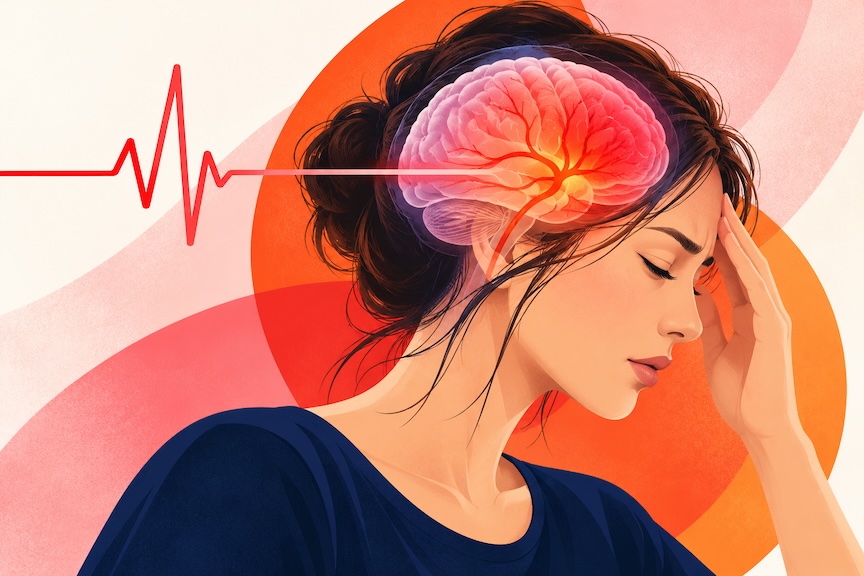
Ask most people to picture a stroke, and they can probably name some of the symptoms, explain how it happens, and describe its effects. But more often than not, they will imagine someone’s grandparent.
It’s an understandable view, but it is an incomplete one. Strokes are still far more common with age. However, doctors are seeing strokes in younger adults, too, and the instinct to think, “I’m way too young for that,” can cost precious time.
Rare, But Still Real
First, some perspective: having a stroke in your twenties is uncommon. Global Burden of Disease estimates for Southeast Asia put the annual incidence of ischemic stroke (caused by blocked blood vessels) at roughly 10 per 100,000 people aged 20 to 24 and about 13 per 100,000 among those aged 25 to 29 in 2021. These are modelled estimates, and rates were stable or slightly lower than in 1990.
As age increases, the trend begins to look different. A study published in September 2026 tracked first strokes among adults aged 20 to 54 in the Greater Cincinnati area. The rate rose from 33.9 to 62.2 per 100,000 person-years between 1993–94 and 2020, with ischemic strokes nearly doubling.
Survival also improved, with deaths within 30 days falling from 11.7% to 9.4%. This means more people are surviving strokes, although some are left with lasting effects. One important caveat: the study covered people up to age 54, so its findings do not isolate those in their twenties.
DISCOVER: Science Links Happiness, Social Connection to Better Health
What About the Philippines?
Stroke is already a major cause of death in the Philippines. The Philippine Statistics Authority recorded 44,593 deaths from cerebrovascular diseases between January and September 2025, accounting for about 9.9% of all deaths and making it the country’s third-leading cause of death.
Local data specifically on younger patients are limited. However, a Global Burden of Disease analysis of people aged 15 to 39 found that the Philippines had the largest increase in ischemic stroke incidence among Southeast Asian countries between 1990 and 2021.
Why Is It Happening?
There is no single answer. In the Greater Cincinnati study, high blood pressure, diabetes, atrial fibrillation (an irregular heartbeat), and substance use all became more common among younger stroke patients.
Documented substance use, mostly involving marijuana, rose from 4.6% to 40.2%. However, the researchers could not establish that these changes caused the increase in strokes because they did not have a comparison group of people who had not experienced a stroke.
Other possible contributors include pregnancy-related complications, blood-clotting disorders, and cancer-related clotting. A meaningful proportion of strokes in younger people also have no clearly identified cause.
READ: How Healthy Are You, Really? A Science-Based Guide
Knowing the Signs: B.E. F.A.S.T.
These are the warning signs that you or someone around you may be having a stroke:
- Balance: Sudden loss of balance or coordination.
- Eyes: Sudden trouble seeing in one or both eyes.
- Face: One side of the face droops or feels numb.
- Arm: Weakness or numbness in one arm.
- Speech: Slurred speech or difficulty speaking or understanding others.
- Time: Call emergency services immediately if you suspect a stroke—911 in the Philippines—even if symptoms disappear.
Don’t talk yourself out of seeking help because of your age. Faster treatment can improve the chances of recovery.
What You Can Do
- Know your numbers: Keep track of your blood pressure, blood sugar, cholesterol, and weight. It is easy to skip routine checks when you feel fine.
- Ask about your family history: Find out whether close relatives have had a stroke or early heart disease.
- Avoid smoking and recreational drugs: These can increase stroke risk, including in younger people.
- Stay active: Make regular physical activity part of your routine, and work with your healthcare provider to manage conditions such as diabetes and high blood pressure.
Stroke at a young age is rare, but it is not a myth. In some places, rates among adults under 55 are climbing. More people are surviving strokes, too, but some must live with their long-term effects for decades.
In a country where stroke is already a leading cause of death, age should never be the reason someone waits to seek help.
You cannot control everything, but you can get your health checked, learn B.E. F.A.S.T., and treat sudden symptoms as an emergency rather than an inconvenience. Share the warning signs with the people around you, too. Someone else may be the first to notice.
*Illustration created for Joyful Wellness
References
- Fisher, E. R., et al. (2026). “Stroke in the Young: Incidence, 30-Day Case Fatality Rates, and Risk Factors Over Time in a Population-Based Study.” Neurology, 107(8), e218622. https://doi.org/10.1212/WNL.0000000000218622
- Satapathy, P., et al. (2025). “Burden of Stroke in Adolescents and Young Adults (Aged 15–39 Years) in South East Asia: A Trend Analysis from 1990 to 2021 Based on the Global Burden of Disease Study 2021.” Frontiers in Stroke, 4, 1503574. https://doi.org/10.3389/fstro.2025.1503574
- Rasing, A., Hilkens, N. A., & de Leeuw, F.-E. (2026). “Young Stroke: An Update on Epidemiology, Emerging Risk Factors, and Future Research Directions.” International Journal of Stroke, 21(1), 6–13. https://doi.org/10.1177/17474930251400524
- Philippine Statistics Authority. Provisional data on registered deaths, January–September 2025. See the PSA’s official mortality statistics and the corresponding release on causes of death.
- American Stroke Association. “Stroke Symptoms and Warning Signs.” https://www.stroke.org/en/about-stroke/stroke-symptoms