
The Health Story of a Nation, Told One Front Page at a Time
Four Decades of Health Journalism in the Philippines
On July 28, 1986, The Philippine STAR entered a newly restored democracy with eight pages, no advertisements, and a promise printed beneath its masthead: Truth Shall Prevail. Its first banner headline, “Wear Yellow and Die,” chronicled the fatal attack on 23-year-old Stephen Salcedo, whose killing during a Marcos loyalist rally became one of the defining stories of that historic day.
Forty years later, those words continue to guide every edition.
The history of a newspaper often unfolds through elections, revolutions, and defining political moments. Yet another story has quietly filled its pages across four decades, a story measured through epidemics and breakthroughs, scientific discoveries and public health campaigns, personal resilience and collective hope. Read from beginning to end, The Philippine STAR offers a paper trail of the nation’s health.
Every generation carries its own vocabulary of wellness.
From Epidemics to Prevention
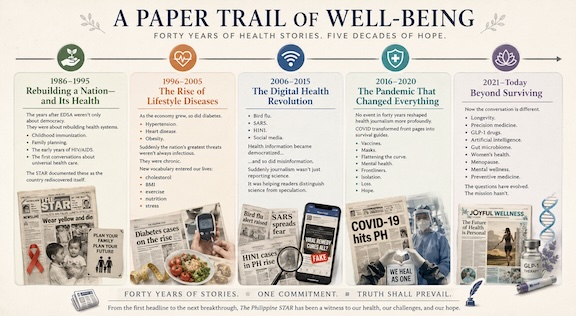
By the late 1980s, HIV/AIDS had become an urgent public health conversation around the world, and Philippine newspapers played an important role in helping readers understand a disease surrounded by fear, uncertainty, and stigma. Newspapers became among the country’s earliest classrooms, translating medical language into public understanding and reminding readers that compassion belonged beside caution. In time, scientific progress transformed HIV from a frightening diagnosis into a manageable chronic condition for many people with access to treatment, while the work of education continues in the face of one of the fastest-growing HIV epidemics in the Western Pacific.
The decades that followed shifted the national conversation.
As infectious diseases gradually shared the stage with longer life expectancies and changing lifestyles, health acquired a broader definition. Diabetes, hypertension, heart disease, cancer, nutrition, and mental health entered everyday conversations with greater urgency. Medical research expanded rapidly. Prevention became as valuable as cure. Annual physical examinations, vaccinations, balanced diets, exercise, and emotional well-being found their place alongside the day’s headlines because they shaped the lives unfolding beyond them.
Then came outbreaks that reminded the world how closely connected every nation had become. SARS. H1N1 influenza. Ebola abroad. COVID-19. Each crisis challenged science, governments, and communities in different ways. Through every uncertainty, responsible journalism served as an essential public health tool, carrying verified information into homes where every decision mattered. Facts became a form of protection. Clarity became a public service.
READ: The Small Habits That Keep a Nation Healthy
A Nation’s Health, One Headline at a Time
Today, the vocabulary continues to evolve.
Artificial intelligence is entering medicine. Precision diagnostics are reshaping treatment. The gut microbiome has become part of mainstream scientific discussion. Longevity research explores how people might live longer while preserving vitality. Women’s health has finally begun receiving the sustained attention it deserves, with menopause, reproductive health, and hormonal wellness moving from whispered conversations into informed public discourse. Mental health stands where it belongs, at the center of whole-person care rather than at its margins.
Each chapter reflects a simple truth: a nation’s health grows with science, experience, and understanding.
That journey finds a natural continuation in Joyful Wellness.
Its pages rest upon the same editorial foundation that has guided The Philippine STAR for forty years. Evidence before assumption. Science before speculation. Expertise before opinion. In an era where wellness advice travels faster than peer review, credibility has become one of the most valuable forms of care. Every carefully reported article carries the potential to help a reader schedule a screening, understand a diagnosis, improve a meal, recognize the signs of depression, or embrace healthier habits long before illness arrives.
Viewed through forty years of archives, the newspaper reveals something remarkable. The headlines document more than events. They chronicle longer lives, stronger medicine, healthier families, and a society that has steadily expanded its understanding of what it means to live well.
Joyful Wellness: The Next Chapter
The newspaper itself has evolved with every generation of readers. Under the stewardship of leaders who recognized that journalism must remain rooted in enduring values while embracing new conversations, The Philippine STAR continues to grow without losing sight of its original promise. Joyful Wellness reflects that same spirit of renewal—a belief that the health of a nation deserves the same depth, rigor, and credibility as every other story that shapes our lives.
Forty years ago, a newspaper began with eight pages and an unwavering commitment to truth. Today, every edition adds another page to a living archive of the Filipino experience.
Some headlines capture a single day. Others illuminate an entire generation.
Together, they form a paper trail leading toward a healthier, wiser, and more hopeful nation.
References
- World Health Organization (WHO)
- Department of Health (Philippines)
- Philippine Statistics Authority
- Centers for Disease Control and Prevention (CDC) for historical outbreak context
- UNAIDS
- The Philippine STAR archives