
Are long waits at clinics and hospitals quietly making older patients sicker?
By the time an older patient finally reaches the doctor’s desk, something invisible may already have happened.
Blood pressure has climbed.
Back pain has stiffened.
Anxiety has deepened.
A diabetic patient has skipped lunch because fasting instructions collided with a delayed laboratory schedule.
A senior citizen with arthritis has already spent three hours sitting in a hard plastic chair under fluorescent lights while trying not to look exhausted.
Healthcare systems often measure success through diagnosis, treatment, surgery, survival, and discharge.
But longevity experts increasingly ask a different question: what happens to people physically and emotionally before care even begins?
In countries like the Philippines, where overcrowding, understaffing, traffic congestion, and uneven healthcare access remain common realities, waiting itself may quietly be becoming a health issue.
And for older adults, that burden may be far heavier than it appears.
The stress nobody counts
Long waiting times are often treated as minor inconveniences, frustrating but normal.
Nevertheless, research increasingly shows that prolonged uncertainty, stress, and perceived loss of control can trigger measurable physiological effects, especially among older adults.
According to the American Psychological Association, chronic stress is associated with elevated cortisol levels, inflammation, cardiovascular strain, sleep disruption, weakened immunity, and cognitive burden over time.
Meanwhile, studies on aging and stress suggest that older adults may recover more slowly from stressful experiences because aging bodies often become less physiologically resilient.
In practical terms, a stressful five-hour hospital visit may not affect a 28-year-old the same way it affects a 74-year-old with hypertension, diabetes, mobility limitations, or heart disease.
What appears to healthcare systems as “waiting” may feel to patients more like physical depletion.
The waiting room as a health environment
Modern longevity science increasingly focuses on something medicine once overlooked: environment.
With medication and surgery, the surroundings also deserve attention.
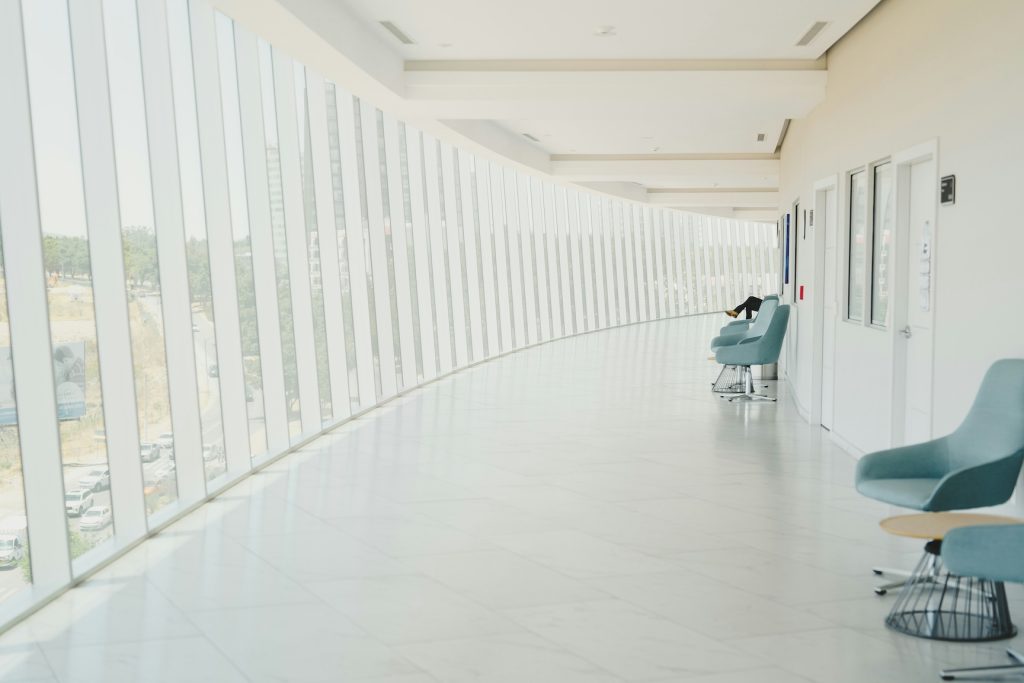
Photo by Arturo Esparza on Unsplash
Researchers now recognize that noise, crowding, heat, poor seating, uncertainty, lack of movement, and emotional stress all influence health outcomes.
Many waiting rooms unintentionally combine all of them at once.
Older patients often face:
- prolonged sitting
- dehydration
- delayed meals
- overstimulation
- mobility strain
- poor ventilation
- unclear scheduling
- fear of diagnosis
- financial anxiety
- sensory fatigue
For seniors already managing chronic illness, the clinic visit itself can become physiologically taxing before any treatment begins.
And yet healthcare systems rarely measure waiting-room stress as part of care quality.
Longevity is more than just adding years
One of the biggest shifts in modern health science is the move from lifespan to health span.
Longevity researchers increasingly argue that healthy aging depends on surviving disease, as well as on reducing cumulative physical and emotional strain over time.
That includes:
- chronic stress
- sleep disruption
- social isolation
- environmental overload
- healthcare exhaustion
According to the World Health Organization, healthy aging involves maintaining functional ability and well-being throughout later life.
That definition matters because older adults experience healthcare through the surrounding care.
There is the commute, the queue, and paperwork.
Then the waiting, the uncertainty.
The exhaustion afterward.
In many ways, healthcare systems reveal their humanity through medical expertise and in how much unnecessary suffering they prevent.
The quiet emotional burden older Filipinos carry
Many Filipino seniors were raised to be patient, polite, and enduring.
They often avoid complaining.
They apologize for asking questions.
And quite often, they say “okay lang” even when physically distressed.
But emotional restraint do not erase physical strain.
Older adults dealing with long clinic waits may quietly experience:
- rising anxiety
- embarrassment over needing assistance
- fear of appearing weak
- fatigue from sensory overload
- confusion with complex systems
- stress from transportation logistics
- worry about costs
- guilt about burdening relatives
In some cases, these experiences become serious enough that seniors delay future medical visits entirely.
A long waiting experience today may become a missed diagnosis tomorrow.
Delayed care becomes a longevity issue
This matters because preventive medicine depends heavily on consistency.
Routine monitoring for:
- blood pressure
- diabetes
- kidney disease
- heart disease
- cancer screening
- eye health
- medication adjustment
requires patients to continue engaging with healthcare systems regularly.
But when care becomes physically exhausting, emotionally draining, or financially destabilizing, adherence suffers.
According to studies on healthcare access and aging populations, longer wait times are associated with lower patient satisfaction, delayed treatment-seeking, and poorer continuity of care.
For older adults especially, healthcare fatigue may slowly discourage preventive care altogether.
And prevention delayed often becomes disease accelerated.
Modern hospitals are beginning to rethink the experience
Some healthcare systems globally are now redesigning clinics around patient-centered and age-friendly care principles.

getty-images-HbeQRU_QcfE-unsplash.jpg
These approaches include:
- shorter appointment windows
- digital scheduling
- integrated records
- quieter waiting spaces
- mobility-friendly layouts
- clearer navigation
- telemedicine options
- geriatric-sensitive care systems
The World Health Organization’s Age-Friendly Health Services framework emphasizes accessibility, dignity, emotional support, and functional well-being for older adults.
Meanwhile, newer wellness-centered healthcare design increasingly incorporates:
- natural light
- greenery
- acoustic control
- calming interiors
- reduced congestion
- restorative spaces
because healthcare environments themselves influence recovery and stress regulation.
In the Philippines, modernization efforts under the Universal Health Care Act continue pushing toward better access and digital integration.
Yet for many Filipinos, especially outside major private medical centers, the lived reality remains long queues, crowded facilities, fragmented systems, and physically draining visits.
The hidden inequality inside waiting
There is also a deeper social reality underneath waiting times.
The wealthy often pay to avoid them.
Priority lanes.
Executive clinics.
Private scheduling systems.
Concierge medicine.
Premium diagnostics.
Meanwhile, ordinary patients, many elderly, absorb the physical cost of inefficiency directly into their own bodies.
Time becomes another form of inequality.
And for aging populations, that inequality can become biological.
Because stress accumulates.
Fatigue accumulates.
Inflammation accumulates.
The body remembers prolonged strain even when systems normalize it.
What older adults can do to protect themselves
While larger systemic reform remains essential, geriatric and longevity experts increasingly recommend practical strategies older adults can use to reduce healthcare-related stress:
- schedule earlier appointments when possible
- avoid fasting longer than medically required
- bring hydration and light snacks if permitted
- use mobility aids without embarrassment
- prepare medication lists beforehand
- request assistance early rather than late
- bring calming sensory tools like music or reading material
- practice paced breathing during prolonged waits
- use teleconsultation options when appropriate
- avoid scheduling multiple exhausting appointments in one day
Family support also matters enormously.
For many seniors, simply having someone accompany them reduces confusion, anxiety, and emotional fatigue significantly.
The future of healthcare should feel more humane
Perhaps the boldest question is whether hospitals can become more than just technologically advanced.
Instead it is whether they can become more humane.

getty-images-7URWu8uSQ88-unsplash.jpg
While longevity is built through breakthroughs, robotics, or AI-assisted diagnostics, sometimes longevity is protected through something simpler: less stress, less exhaustion, and less preventable strain.
A truly modern healthcare system should eradicate having older patients sacrifice their energy just to access care meant to preserve it.
And perhaps one of the clearest signs of a healthier society will be this:
that elderly people can seek medical help without feeling physically depleted by the process itself.
curated-lifestyle-dwCMyiHo3wQ-unsplash.jpg
References
- World Health Organization (WHO) — Healthy Ageing Framework
- WHO — Age-Friendly Health Services Guidelines
- American Psychological Association — Stress and Physical Health
- National Institute on Aging — Stress and Older Adults
- Journal of Patient Experience — Healthcare Waiting Times and Patient Satisfaction
- BMC Geriatrics — Healthcare Access and Aging Populations
- Universal Health Care Act (Republic Act No. 11223)
- The Lancet Healthy Longevity — Aging, Stress, and Functional Health Research