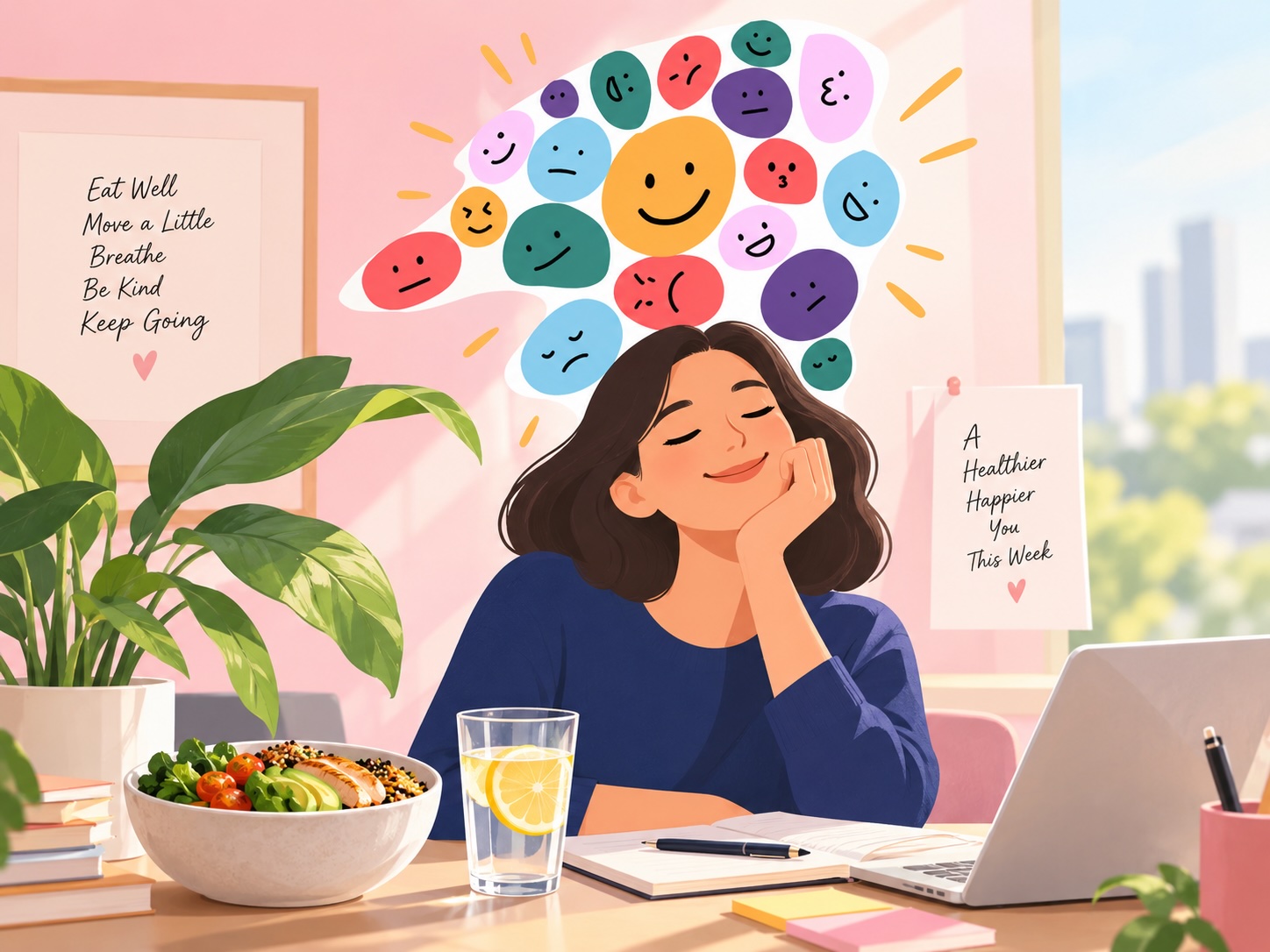
If the Monday blues have followed you past lunch, stay awhile. Here are a few small ways to nourish your body, protect your health and give your mind a gentler afternoon.
It’s Monday, sometime after lunch.
The morning rush is over. The weekend already feels strangely far away. You’re looking at your screen, but your mind is somewhere else—perhaps back at yesterday’s lunch, last week’s holiday, an old photograph, or simply a place where you don’t have the worries you have today.
You may even be wondering: Can I go back and do things all over again?
If that’s where you are, stay with us for a minute.
You’re not failing at Monday.
Mood can naturally vary across the week, and research has found lower average mood and greater fatigue around the beginning of the workweek. Changes in sleep timing between weekends and workdays can add to that feeling, too. PLOS
So let’s not demand too much from ourselves this afternoon.
Let’s simply make the next few hours a little kinder.
READ: “One Day at a Time” May Be a Good Mental Health Strategy
First, Feed Yourself Well
When energy dips, the easiest answer can be another sweet coffee, a pastry or whatever happens to be closest.
There is nothing wrong with enjoying those things. But if you want steadier energy, think beyond the quick fix.
Build your next meal or snack around protein, fiber and nourishing fats: perhaps fruit with yogurt and nuts, whole-grain toast with egg, vegetables with fish or chicken, or a handful of nuts alongside fresh fruit.
A healthy eating pattern matters far more than any single “mood food.” Research increasingly links dietary patterns rich in vegetables, fruit, whole grains, legumes, nuts, fish and other minimally processed foods with better health outcomes, while clinical trials suggest that Mediterranean-style eating may help reduce depressive symptoms—although the evidence is still developing. PubMed
And don’t forget the simplest thing in the room:
Water.
If you’ve been busy all morning, have a glass before reaching for another cup of coffee.
DISCOVER: Healthy Eating: The Nutrition Advice That Has Outlived the Fads
Give Your Body Five Minutes
Now, stand up.
Walk to the other end of the building. Take the stairs if you can. Walk around the block. Stretch beside your desk. Do a few household chores when you get home.
It doesn’t have to be a workout.
Brief movement after a meal can help moderate the rise in blood glucose, and regular physical activity is one of the most reliable things we can do for long-term health. It helps reduce the risk of cardiovascular disease, type 2 diabetes and several cancers, while also supporting mental health and well-being. PubMed
WHO recommends 150–300 minutes of moderate physical activity a week for adults, but there’s an important message tucked inside that recommendation:
Some movement is better than none. World Health Organization
So don’t wait for the perfect gym session.
Take the five-minute walk.
Your future heart may thank you.
EXPLORE: Senior Mobility: How to Stay Strong, Steady and Independent as You Age
And Give Your Mind Somewhere Nice to Go
Chances are you’re not really tired.
Perhaps you’re longing.
For the weekend. Or another city. For a person you used to know. For a version of yourself who had fewer responsibilities.
Nostalgia isn’t necessarily something we need to chase away. Sometimes a memory simply tells us what matters.
So let yourself remember something good, but don’t stay trapped there.
Think of the meal you loved. The sound of someone laughing. A beach. Your child’s small hand in yours. A song from years ago. Your old house. A place where you once felt completely at ease.
Then ask yourself:
How can I bring one small piece of that feeling into today?
Call the person.
Play the song.
Plan the dinner.
Take the walk.
Make the afternoon coffee slowly.
The goal isn’t to escape your life.
It’s to make your present life a little more worth coming back to.

A Gentle Monday Reset
Before the afternoon disappears, try this:
Eat something nourishing.
Choose food that gives you steady fuel rather than chasing an energy spike.
Move a little.
Five minutes counts. Ten is even better. Every bit of movement contributes to your health.
Drink some water.
Especially if you’ve been absorbed in work and forgot.
Look away from the screen.
Give your eyes and attention a brief change of scenery.
Talk to someone.
A good conversation can turn an ordinary afternoon around.
Lower the bar.
Not every Monday needs to be your most productive day.
And tonight, protect your sleep. If your weekends regularly involve very different bedtimes and wake times, try easing the gap. Large shifts between weekend and weekday schedules—sometimes called social jet lag—have been associated with poorer mood and sleep-related difficulties. PubMed
Maybe Monday Doesn’t Need Fixing
Remember that the Monday blues are not a problem to conquer.
Maybe they’re simply a little reminder that we’re human.
We get tired. There are people we miss. We remember other times and lose focus. We have days when we’d rather be anywhere else.
And that’s okay.
You don’t have to love every Monday.
You just have to take care of yourself through it.
The afternoon is not over.
Neither is the week.
And neither, despite what a difficult Monday may whisper, is your capacity for joy.
JOYFUL WELLNESS TAKEAWAY
You don’t have to turn a blue Monday into a brilliant one. Just make it a little kinder—and let tomorrow have its turn.
References
World Health Organization. “Physical activity.” WHO.
World Health Organization. “WHO Guidelines on Physical Activity and Sedentary Behaviour.” 2020.
Engeroff, Tobias et al. “After Dinner Rest a While, After Supper Walk a Mile?” Sports Medicine. 2023.
Bayes, Jemma et al. “The impact of the Mediterranean diet on alleviating depressive symptoms in adults.” Nutrition Reviews. 2024.
Völker, Jan et al. “It is Monday again: Weekend sleep differentially relates to the workweek via reattachment on Monday.” Journal of Organizational Behavior. 2024.
Taylor, Daniel J. et al. “Sleeping-in on the weekend delays circadian phase and increases sleepiness the following week.” Sleep and Biological Rhythms. 2008.