The surprising history of Pilates—and what its original philosophy can teach us about movement today.
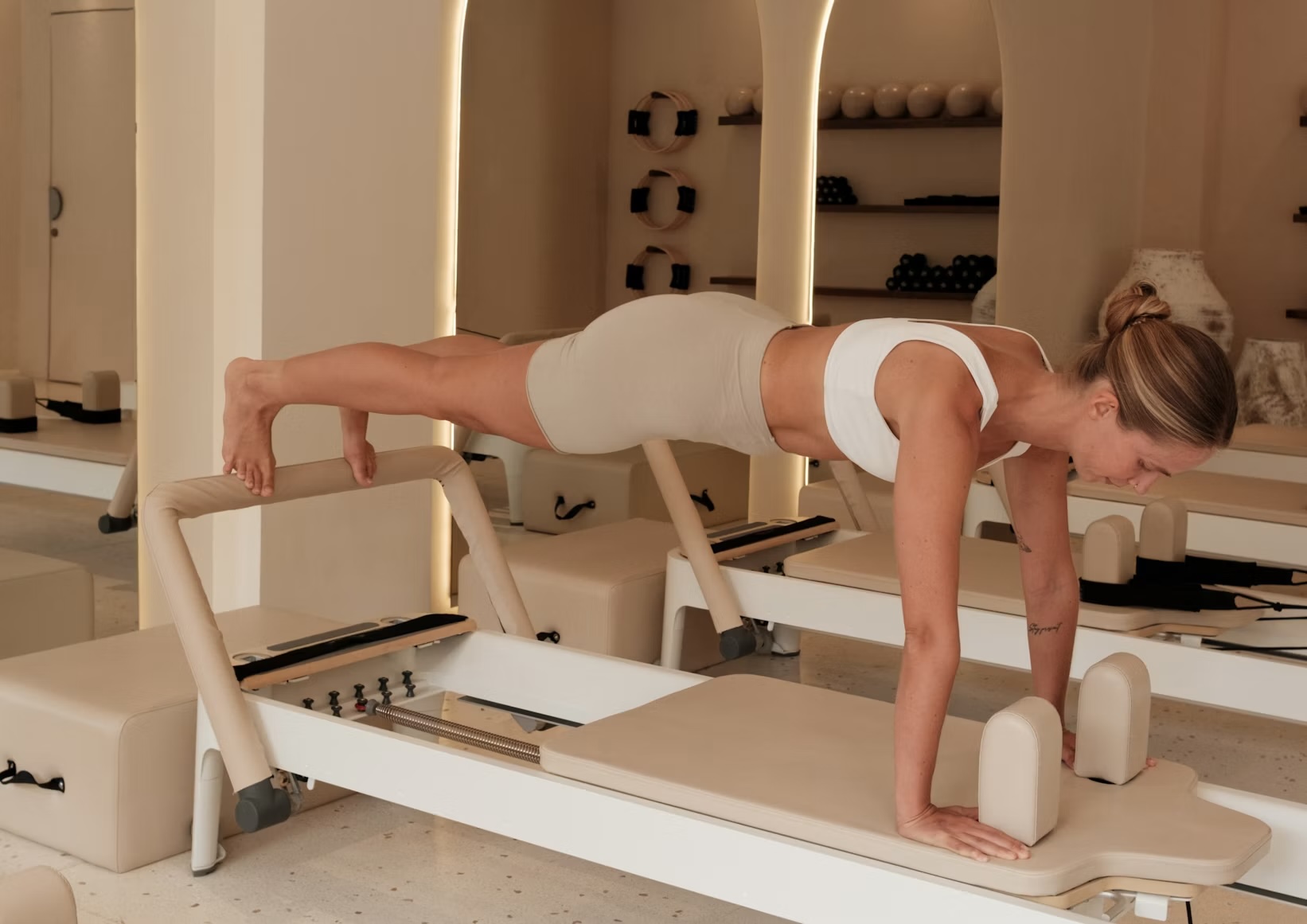
Allow yourself to picture a modern wellness scene: soft ambient lighting, premium gym bags tucked neatly beside polished wooden reformers, stainless steel tumblers lined up on the floor, and the quiet, synchronized rhythm of carefully controlled movements.
Walk into a boutique fitness studio today, and Pilates feels distinctly modern. It has found a highly visible, carefully curated home on social media, complete with matching athletic sets and aesthetic lifestyle vlogs.
Yet, the true origin of this global phenomenon carries a history that feels entirely out of place in this pristine setting.
Pilates was developed during a period of war, when its founder, Joseph Pilates, was an interned German national in Britain. During World War I, he spent time in an internment camp on the Isle of Man, where he continued developing his ideas about physical conditioning and movement.
The method that would eventually become a global wellness practice began with a much simpler idea: the body could be trained, strengthened and restored through deliberate movement.
Before the Reformer
As a child, Joseph Pilates was reported to have struggled with several illnesses, including asthma, rickets and rheumatic fever. He became interested in physical training and studied different forms of movement, including gymnastics, bodybuilding and martial arts, eventually developing a strong belief in the body’s ability to improve through exercise.
That belief became particularly significant during World War I.
While interned on the Isle of Man, Pilates taught physical exercises to fellow internees and continued developing his ideas about conditioning. Historical accounts describe how he worked with physically weakened people, adapting exercises to what their bodies could manage.
The familiar story that he used bed frames and springs to help people exercise while confined to bed has become part of Pilates lore and is often cited as an early inspiration for the equipment that eventually became associated with his method. However, historical evidence for this particular account is uncertain, so it is better understood as part of the story surrounding Pilates rather than established fact.
In 1926, Pilates and his lifetime partner Clara, opened a studio in New York City, where he continued refining his system. Dancers eventually turned to Pilates for conditioning and rehabilitation, helping the method gain a foothold beyond its original circumstances.
From “Contrology” to “Pilates Body”
Joseph Pilates was less concerned with how the body looked than with how it moved. He called his method “Contrology,” reflecting his belief that exercise was not simply about working individual muscles harder, but about teaching the body to move with control, precision and coordination.
That philosophy can feel somewhat different from the way Pilates is often presented today.
On social media, the practice has become closely associated with a particular aesthetic: toned muscles, a defined waist, graceful movements and a carefully curated version of wellness.
There is nothing wrong with wanting to feel stronger or more comfortable in your body. But when an exercise becomes closely tied to how the body is expected to look, it can be easy to overlook the quieter benefits of movement—the strength, stability, coordination and body awareness that happen beneath the surface.
Perhaps this is worth remembering as Pilates continues to grow in popularity:
The body does not have to look a certain way for movement to be doing something meaningful.
READ: Why Showing Up Is Enough: The Real Secret to Fitness Motivation
So, What Is Pilates Actually Doing?
At its simplest, Pilates uses controlled movement to train the body.
On a mat, Pilates uses body weight and gravity; on equipment such as the Reformer, springs and a moving carriage provide resistance.
Rather than performing many repetitions as quickly as possible, Pilates generally emphasizes quality of movement: maintaining control, coordinating the trunk and limbs, breathing deliberately and moving through a controlled range of motion.
One of its major focuses is the body’s core, which includes muscles around the abdomen, pelvis and spine that help stabilize the trunk.
This does not mean that Pilates simply consists of doing abdominal exercises.
Pilates asks you to stabilize your trunk while moving an arm or leg, maintain a particular pelvic position, coordinate your breathing with movement, and stay aware of your spinal alignment.
And there is some evidence behind these principles. Research suggests Pilates can improve certain aspects of flexibility, balance and muscular endurance, although studies comparing Pilates with other forms of exercise generally do not show it to be universally superior. The quality of evidence also varies across outcomes.
A 2026 systematic review and meta-analysis of Pilates programs in adult women found improvements in flexibility and some measures of body composition, while noting considerable variation among the studies and cautioning against treating the findings as a single prescription for everyone.
Beyond the “Pilates Body”
There is a quiet irony in the modern popularity of Pilates.
A method shaped around control, rehabilitation and physical capability has become increasingly associated with having the “Pilates body” social media has been raving about.
But bodies do not respond to exercise in exactly the same way.
Two people can take the same class, practice the same movements and come away with entirely different physical results because of several unrelated factors, including genetics, age, nutrition, sleep and stress.
That does not mean one person did Pilates “better.”
It reminds us that movement can produce far more than one visible outcome.
For someone who spends most of the day at a desk, Pilates can build strength, improve mobility and increase awareness of how the body moves and holds itself.
For someone recovering from an injury, it may form part of a broader rehabilitation program with appropriate professional guidance.
There is value in all of these reasons.
And perhaps that is what makes the history of Pilates worth remembering.
Before it became a studio aesthetic, it was a philosophy about what the body could learn to do.
*Photo by ROXANA POPOVICI on Unsplash
Medical Disclaimer: This article provides general information regarding Pilates and fitness history and is intended for educational purposes only. While Pilates is highly effective for core strengthening and posture support, individuals with pre-existing spinal conditions, disc herniations, severe osteoporosis, or current injuries should consult with a primary care physician or a licensed physical therapist before beginning a new exercise program to ensure safe movement modifications.
References
- Latey P. The Pilates Method: History and Philosophy. Journal of Bodywork and Movement Therapies. 2001.
- Cruz-Ferreira A, et al. A Systematic Review of the Effects of Pilates Method of Exercise in Healthy People. Archives of Physical Medicine and Rehabilitation. 2011.
- Patti A, et al. Is Pilates Better Than Other Exercises at Increasing Muscle Strength? A Systematic Review. Heliyon. 2022.
- Yang KH, et al. Pilates and Multiple Health Outcomes: An Umbrella Review. Journal of Science and Medicine in Sport. 2023.
- Bajčetić C, et al. Effects of Pilates Programs on Body Composition, Flexibility, Muscular Strength, Balance, Functional Performance and Respiratory Function in Adult Women: A Systematic Review and Meta-Analysis. Sports. 2026.
- Pilates Teacher Association. History of Pilates.