
The latest nighttime wellness ritual is crunchy, curious and oddly satisfying. But does standing on Epsom salt actually do anything for your body?
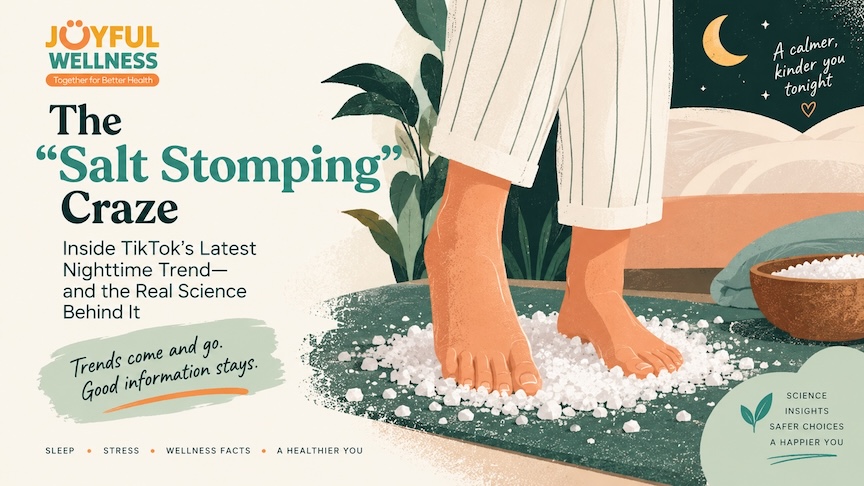
If your TikTok For You Page looks anything like ours lately, you may have come across an unusual nighttime ritual: a towel, tray or bath mat covered with coarse Epsom salt, followed by someone standing barefoot on it, wiggling their toes and slowly shifting their weight.
The practice has been dubbed “salt stomping.”
Videos typically present it as a 10-minute evening ritual, sometimes folded into a skincare or wind-down routine. The claims attached to it are more ambitious: that standing on Epsom salt can lower stress, replenish magnesium, “detox” the body and deliver an exceptionally good night’s sleep.
It is exactly the sort of wellness trend that invites curiosity.
So before you scatter a bag of Epsom salt across the bedroom floor, let’s separate the interesting part from the science.
Because there is something worth understanding here.
First: What is Epsom salt?
Epsom salt is magnesium sulfate, not the sodium chloride we normally call table salt.
Magnesium itself is an essential mineral. The body uses it for hundreds of biochemical processes, including normal nerve and muscle function, energy production and regulation of blood pressure and blood sugar. Good dietary sources include legumes, nuts, seeds, whole grains and green leafy vegetables.
That much is real.
The leap comes when social media suggests that simply standing on dry Epsom salt allows large amounts of magnesium to pass through the soles of the feet and enter the bloodstream.
There is no good evidence for that.
The outermost layer of skin, the stratum corneum, is a formidable protective barrier. Research has explored whether magnesium ions can cross the skin under certain conditions, including through hair follicles, but the amount that may cross, and whether it is clinically meaningful, is another question entirely.
More recent experimental work published in 2026 found that magnesium permeation is strongly limited by the stratum corneum and that delivery from simple water-based solutions is unlikely through intact skin under normal conditions.
So the more accurate verdict is:
Your feet are not a shortcut to correcting a magnesium deficiency.
And dry Epsom salt under your feet certainly has not been shown to deliver a therapeutic dose of magnesium into your body.
What about “detoxing” through your feet?
This is another familiar wellness claim and another one worth putting to rest.
Your body has sophisticated systems for processing and eliminating waste. Your liver and kidneys play central roles in this work.
There is no established physiological process by which standing on Epsom salt causes “toxins” to be pulled out through the soles of your feet.
The feet may be wonderfully responsive to temperature, pressure and texture.
They are not detox organs.
So why might people actually feel better?
Here’s where the trend gets interesting.
Because even when the biological explanation is weak, the ritual itself may still feel good.
Imagine what the practice actually asks you to do.
You stop.
You stand still.
You pay attention to the sensation beneath your feet.
You may put your phone down.
You spend several minutes doing one simple thing instead of moving between messages, videos, work, chores and whatever else followed you into the evening.
Those are meaningful changes.
1. A ritual can help mark the transition to bedtime
A predictable wind-down routine can be useful because it gives your evening some structure. For people struggling with chronic insomnia, behavioral approaches such as stimulus control and cognitive behavioral therapy for insomnia (CBT-I) have considerably stronger evidence than wellness rituals alone.
Salt stomping is not a treatment for insomnia.
But if someone uses those 10 minutes as a consistent signal to stop working, put away the phone and begin winding down, the routine itself may be useful.
2. Sensory attention can interrupt mental noise
There is something wonderfully uncomplicated about feeling a physical sensation and paying attention to it.
The texture beneath your feet.
The pressure as you shift your weight.
And the temperature of the room.
Your breathing.
This resembles the broader principle behind grounding and mindfulness: bringing attention back to immediate sensory experience rather than allowing the mind to race indefinitely into the future.
We don’t need to claim that salt has special neurological powers to understand why a few quiet minutes of sensory attention might feel calming.
3. The real intervention may be the pause
This may be the most interesting part.
If someone normally spends the final 10 minutes before bed scrolling through increasingly stimulating content and instead spends those 10 minutes standing quietly, breathing and preparing for sleep, something has changed.
But it isn’t necessarily the magnesium.
It is the behavior.
But is standing on coarse salt completely harmless?
Not necessarily.
The most obvious issue is friction and irritation.
Coarse crystals can be uncomfortable under body weight, particularly when someone repeatedly shifts or stomps on them. People with dry, cracked or damaged skin may be more vulnerable to irritation.
Dermatologists already recommend protecting cracked heels because breaks in the skin can become painful and, in some circumstances, provide an entry point for infection.
This matters even more for people with conditions that affect foot sensation or healing, including diabetes.
So if the skin on your feet is cracked, irritated, wounded or unusually numb, this is a trend worth skipping.
And there is really no prize for enduring discomfort in the name of wellness.
What about Epsom salt baths?
Here’s where we need another little reality check.
Epsom salt has a long-standing reputation as a relaxing bath additive. But that does not mean that bathing in it reliably raises your body’s magnesium levels.
The scientific literature on transdermal magnesium remains inconclusive, and reviews have found insufficient evidence to support the idea that magnesium absorbed through the skin can meaningfully correct magnesium status.
If what you want is magnesium for nutritional reasons, food is a far more established route.
Think:
malunggay and other leafy greens, monggo and other legumes, nuts, seeds and whole grains.
That is a much more Joyful Wellness kind of magnesium story.
READ: Magnesium for Better Sleep: Which Form Does Science Support?
And there is something else that may help you sleep: warmth
Interestingly, the water in a warm bath or foot bath may be more relevant to sleep than the Epsom salt.
A 2019 systematic review and meta-analysis found that passive body heating through a warm shower or bath before bedtime was associated with improvements in sleep quality and sleep efficiency, and with shorter time to fall asleep. The researchers proposed that warming the body increases blood flow to the skin and is followed by heat loss as the body cools, a process that may help prepare the body for sleep.
But there is an important nuance.
A newer systematic review and meta-analysis of hot foot baths specifically found that the available studies were small and generally of low methodological quality; the overall results were not statistically significant. The researchers concluded that better trials are needed before strong claims can be made.
That is the kind of nuance we want our readers to have.
Warm bathing may be a pleasant part of a bedtime routine. It is not a guaranteed sleep treatment—and Epsom salt does not need to take the credit.
The Joyful Wellness verdict
So, should you try salt stomping?
If you are simply curious about the sensation, the bigger question is whether there is a safer way to get the same calming ritual.
You could stand on a comfortable textured mat.
You could stretch.
Then you could massage your feet.
You could take a warm shower.
You could sit quietly for 10 minutes with your phone somewhere else.
Yes, you could simply breathe.
None of these needs a viral hashtag.
And none needs to promise a “detox.”
The most useful lesson from salt stomping may actually be hiding in plain sight:
Sometimes a wellness trend works because it makes us stop.
Not because it has discovered a secret pathway into the bloodstream.
Not because it pulls toxins through our feet.
And not because the internet has found a magical mineral hack.
Sometimes our bodies simply appreciate being given a few quiet minutes in which nothing is being demanded of them.
That is a wellness practice worth keeping.
Just leave the bag of salt in the cupboard.
A small Joyful Wellness takeaway
Before trying a viral wellness hack, ask three questions:
What is the claim?
What is the trend actually promising your body will do?
What is the evidence?
Has that effect been demonstrated in humans, not just suggested by a plausible-sounding mechanism?
What is the safer part of the ritual?
Can you keep the useful behavior without buying into the unsupported biological promise?
That is how we stay curious without becoming cynical.
And perhaps that is the sweet spot of wellness: being open to something new, while knowing enough science to ask better questions.
References
- Witkowski M, et al. Myth or Reality—Transdermal Magnesium? Nutrients. 2017;9(10):1130.
- Miyazaki Y, et al. Does magnesium permeate the skin? An ex vivo investigation of magnesium ion delivery through intact and barrier-disrupted skin. 2026.
- NIH Office of Dietary Supplements. Magnesium: Health Professional Fact Sheet.
- Haghayegh S, et al. Before-bedtime passive body heating by warm shower or bath to improve sleep: A systematic review and meta-analysis. Sleep Medicine Reviews. 2019;46:124–135. doi:10.1016/j.smrv.2019.04.008.
- Systematic review/meta-analysis of hot foot baths and sleep quality, updated through May 2024; published 2025.
- American Academy of Dermatology. How to care for dry, cracked heels.
- AASM clinical practice guideline on behavioral and psychological treatments for chronic insomnia in adults.