
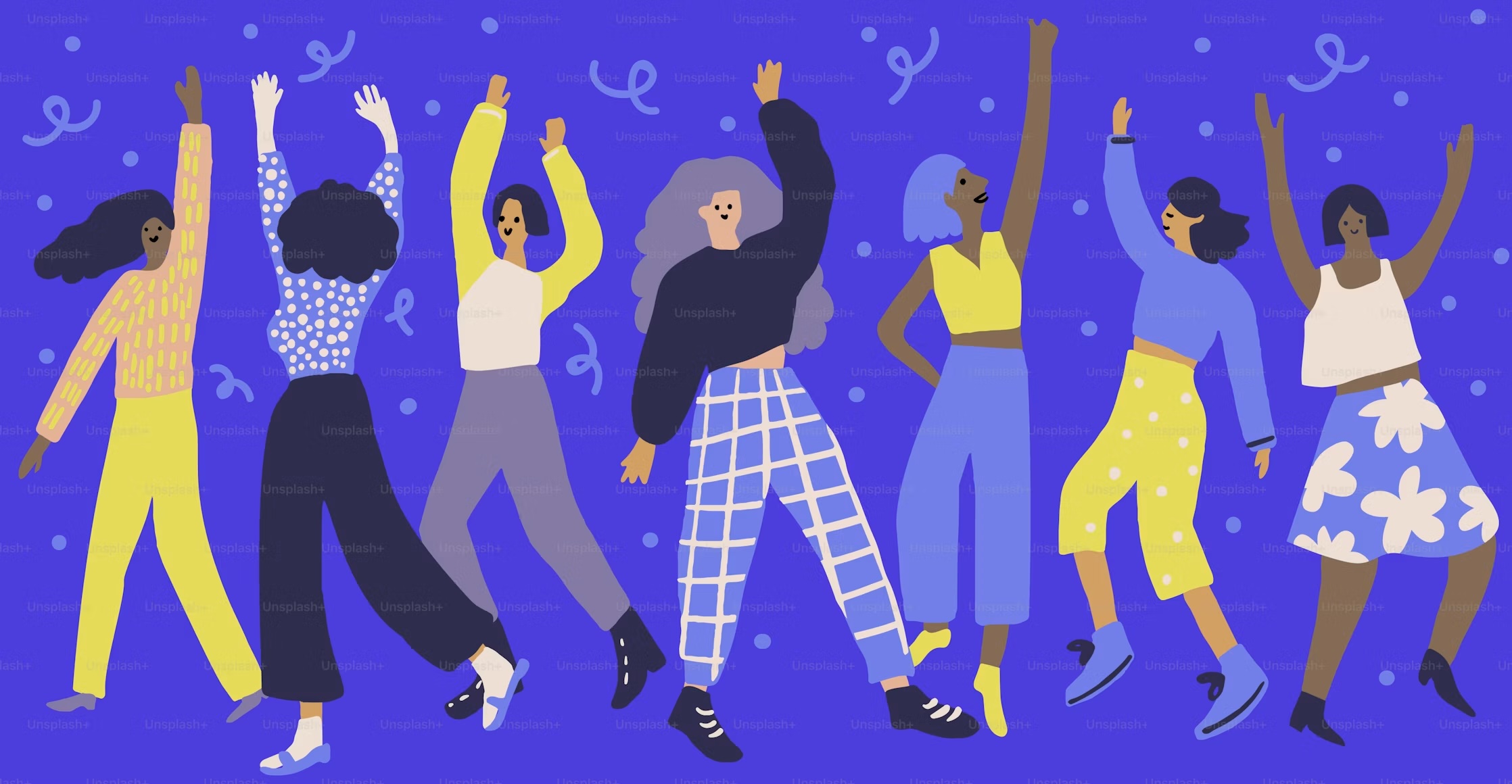
What happens when wellness starts looking like a dance floor?
For years, wellness has had a certain look.
A quiet yoga studio.
A green smoothie.
And a meditation cushion with a candle burning somewhere nearby.
Or a beautiful woman in neutral linen staring serenely into the middle distance.
Now turn the music up.
A new kind of wellness gathering is emerging in which people meet in the morning or during the day, leave the alcohol and drugs behind, and spend their time doing something considerably less solemn:
They dance.
They are being called wellness raves, sober dance parties or morning raves. The format varies, but the basic recipe is wonderfully simple: music, movement, community and an atmosphere of celebration without the traditional expectations of nightlife. Some events add yoga, breathwork or meditation; others are essentially a joyful dance floor that happens to begin before lunch.
It is part of a broader shift sometimes described as the “festivalization” of wellness, experiences that take the energy, social atmosphere and sensory appeal of festivals and nightlife and bring them into health and wellbeing spaces.
And the most interesting thing about the trend is this:
It is about what happens when taking care of ourselves feels like something we actually want to do.
What If Wellness Were Fun?
The wellness industry has become very good at telling us what we should do. You can recite them without coaching.
But even good advice can become another item on a very long list of things we are supposed to be doing correctly.
A wellness rave offers a different proposition.
Come as you are.
Put on music.
Move your body.
Meet people.
Laugh.
Stay for another song.
There is no requirement to become a better version of yourself before you are allowed to enjoy the evening or, in this case, the morning.
That may sound frivolous.
It isn’t necessarily.
There Is Real Science Behind the Dance Floor
We should be careful here.
There is currently no scientific evidence that attending a wellness rave, specifically, prevents disease or treats anxiety or depression. These are relatively new event formats, and they have not been studied as a distinct clinical intervention.
But the individual ingredients are not new at all.
Dance is physical activity. Music influences mood and emotional experience. Group movement can create social connection. And social connection itself is increasingly recognised as an important dimension of health.
A 2024 systematic review and meta-analysis of 27 studies found that structured dance was generally as effective as other forms of structured physical activity for a range of psychological and cognitive outcomes. Preliminary evidence suggested potential advantages for motivation, aspects of memory, social cognition and distress, although the researchers also emphasized that the evidence was not uniformly strong across all outcomes.
A 2023 systematic review of randomized trials involving adults likewise found that dance interventions were associated with reductions in symptoms of depression, anxiety and stress, but limitations in the quality of the evidence were noted by authors.
And a 2026 meta-analysis found significant reductions in depressive symptoms across a range of dance-based interventions in adults, while again calling for better research and more diverse populations.
So, dancing is still waiting for definitive evidence and conclusions.
And yes, it counts more than entertainment.
Our bodies and brains take part in the experience.
Then There Is the Part You Can’t Do Alone
What do you suppose is the most important ingredient in a wellness rave?
It is other people.
The World Health Organization now treats social connection as an important public-health issue. Its Commission on Social Connection reported in 2025 that approximately one in six people worldwide experience loneliness, with consequences for physical health, mental health and longevity.
There, that changes the way we might think about a room full of people dancing together.
People can do things alone. But there is something different about moving in a room full of people who are all listening to the same music, responding to the same beat and sharing the same moment.
Research on group dancing has found that synchronised movement can promote social bonding. In experimental work, both exertion and synchrony were associated with greater in-group bonding, suggesting that moving together may help create a sense of connection.
That doesn’t mean everyone at a rave becomes your new best friend.
It means that shared experience matters.
Sometimes belonging begins with something as uncomplicated as knowing that everyone else is dancing to the same song.
Why Take Alcohol Out of the Equation?
Traditional nightlife often comes with an unwritten script:
Meet at a bar.
Order a drink.
Have another.
Stay late.
Repeat.
For some people, that is enjoyable.
For others, it is increasingly unappealing.
The rise of sober-curious and alcohol-free social spaces suggests that people are looking for ways to socialise that do not require drinking to be the central activity.
Wellness raves offer a simple alternative: keep the music and the people; change the ritual.
The current trend is being framed as an alternative to traditional nightlife for people interested in sobriety, moderation or simply a different kind of social experience.
And there is something rather liberating about that.
You don’t have to explain why you’re not drinking.
You don’t have to be the person holding a glass of sparkling water at a party while everyone else asks whether you’re “okay.”
The premise has already changed.
We’re here to dance.
The Morning Rave Is a Curious Reversal
There is also something deliciously subversive about the timing.
A nightclub traditionally belongs to the night.
A wellness rave may begin at nine in the morning.
Instead of stumbling home as the sun comes up, you might be dancing as the sun comes up.
Instead of spending Sunday recovering from Saturday night, you could spend Saturday morning moving to a DJ set and still have the afternoon ahead of you.
This isn’t saying that morning is morally superior to nighttime.
It is that joy does not need to be scheduled around intoxication.
It can happen in broad daylight.
Could Dancing Actually Count as Exercise?
Absolutely.
But this is where we should resist turning a joyful activity into another fitness test.
Dance can raise the heart rate, challenge balance and coordination, strengthen muscles and contribute to overall physical activity. The exact intensity depends on the style, duration and how vigorously a person moves.
The World Health Organization recommends that adults get 150–300 minutes of moderate-intensity physical activity or 75–150 minutes of vigorous-intensity activity per week, plus muscle-strengthening activities on at least two days a week.
Dancing can contribute toward those goals.
But a person doesn’t need to know their heart-rate zone to benefit from dancing.
Sometimes the most sustainable movement is the kind that makes you forget you’re exercising.
And that may be one of dance’s quiet advantages.
You move because the song is good.
Not because an app told you to.
Wellness Doesn’t Have to Be Quiet
This may be the bigger cultural shift hiding inside the wellness-rave trend.
For a long time, wellness has been associated with stillness.
Quiet.
Control.
Discipline.
The idea that being well means becoming increasingly calm, contained and optimized.
But human wellbeing is bigger than calm.
Sometimes wellbeing is a slow walk through the park, eight hours of sleep, dinner with your family.
And sometimes—
it is dancing ridiculously hard to a song you haven’t heard since college.
Joy is not a distraction from wellness.
Joy can be part of it.
The WHO’s work on social connection makes this especially relevant. Health is not only about preventing disease; social wellbeing and meaningful relationships are part of living a healthy life.
But Let’s Not Turn the Rave Into Another Wellness Prescription
There is a danger in every wellness trend.
The moment something feels good, we start measuring it.
Let’s not.
There is no evidence that wellness raves have a unique clinical effect beyond the established benefits associated with their individual components.
And you don’t have to attend one to be healthy.
You don’t even have to like dancing.
The takeaway is bigger than the trend.
Find forms of movement and social connection that make you want to come back.
That might be dancing.
It might be swimming with friends.
Walking with a neighbour.
Joining a choir.
Playing badminton.
Taking a Zumba class.
Gardening with someone you love.
Or putting music on in your living room and dancing badly with absolutely no audience at all.
The Real Wellness Hack May Be Belonging
Wellness raves feel so timely.
We live in an age in which we can be connected to hundreds of people and still feel alone.
We can spend an entire day communicating without actually being with anyone.
And we can watch thousands of people dance without getting up from the sofa.
The wellness rave reverses that equation.
Put down the phone.
Come into the room.
Hear the music.
Move.
Look at someone’s face.
Laugh.
Stay awhile.
There is nothing technologically revolutionary about it.
And that is precisely the point.
A Different Kind of Self-Care
Self-care has sometimes become synonymous with buying something.
Could be a product.
A retreat, a treatment, or a subscription.
A beautifully packaged solution to the complicated business of being human.
But sometimes self-care is basic.
Like finding your people.
Loving your body.
Laughing until you lose your breath.
It is allowing yourself to experience pleasure without needing to earn it first.
It is discovering that health can contain a little noise, little sweat, a moment of silliness.
A lot of music.
And perhaps, occasionally, a dance floor at nine in the morning.
Maybe the Future of Wellness Is Happier
Wellness raves may eventually prove to be a passing trend. The name may change. Maybe the DJ will not be there anymore. The venues may change.
But the human needs underneath the trend are unlikely to disappear.
We want to move and belong.
We want to feel alive and to have fun.
And we want people around us.
The science may be telling us wellness raves can be something more useful.
Movement can support health.
Dance can support psychological wellbeing.
Music can enrich our experiences.
And meaningful social connection matters deeply to human health.
Should we be asking whether wellness raves are the next big thing?
But what if taking care of ourselves didn’t always feel like work?
What if sometimes, the healthiest thing on the calendar was simply:
Come dance.
*Photo by Anna Kutukova for Unsplash+
References
- Fong Yan A, Nicholson LL, Ward RE, et al. The Effectiveness of Dance Interventions on Psychological and Cognitive Health Outcomes Compared with Other Forms of Physical Activity: A Systematic Review with Meta-analysis. Sports Medicine. 2024;54:1179–1205.
- Xing Z. Effects of dance movement therapy and other dance-related interventions on depressive symptoms: a meta-analysis of evidence in the past decade. European Archives of Psychiatry and Clinical Neuroscience. 2026;276:1505–1519.
- Moratelli JA, et al. Evidence of the Effects of Dance Interventions on Adults Mental Health: A Systematic Review. Journal of Dance Medicine & Science. 2023.
- Liu X, Soh KG, Lu Y. Effect of dance on social physique anxiety and physical self-esteem among adults: a systematic review. Frontiers in Psychology. 2025.
- Tarr B, Launay J, Dunbar RIM. Synchrony and exertion during dance independently raise pain threshold and encourage social bonding. Biology Letters. 2016.
- Promoting wellbeing and health through active participation in music and dance: a systematic review. International Journal of Qualitative Studies on Health and Well-being. 2020.
- World Health Organization Commission on Social Connection. From loneliness to social connection: charting a path to healthier societies. WHO, 30 June 2025.
- World Health Organization. Social connection linked to improved health and reduced risk of early death. 30 June 2025.
- Steinmacher C, Wöllner C. Music making and wellbeing: A systematic review of methods, musical activities, and outcomes. Applied Psychology: Health and Well-Being. 2026;18(4):e70191.
- People Are Trading Clubs and Bars for Feel-Good “Wellness Raves”—Here’s What the Trend Is All About. Real Simple. September 2, 2026. Used here as current trend reporting, not as scientific evidence for health claims.