


Every few years, a new eating pattern captures the public’s attention. Mostly, they promise rapid weight loss, while others claim to slow aging or improve overall health. Among the most talked-about approaches today is intermittent fasting.
Unlike many diet plans, intermittent fasting focuses on when to eat, making it appealing to people who find strict meal plans or constant calorie-counting difficult to sustain. For some, it offers a simple way to build more mindful eating habits and create structure around meals.
The most common approaches include the 16:8 method, where eating is limited to an eight-hour window each day, and the 5:2 approach, in which calorie intake is reduced on two non-consecutive days each week.
But while research suggests intermittent fasting can provide meaningful health benefits, it is best understood as a flexible tool rather than a universal solution.
The cultural side of fasting
Intermittent fasting is often presented as a modern wellness trend, but the idea of limiting when we eat is hardly new.
Food has always been about more than nutrition. It reflects culture, family, celebration, comfort, and the rhythms of everyday life. A lot of cultures and faith traditions have long practiced fasting, whether as an act of reflection, discipline, or community. In the Philippines, our eating habits are also shaped by family dinners, celebrations, work schedules, and even long commutes.
For that reason, a healthy eating pattern should fit the life a person already has instead of asking them to live against it. Mealtimes are often shared with family, friends, or colleagues, and food is closely tied to hospitality and togetherness. A rigid fasting schedule that repeatedly clashes with these moments may become difficult to sustain, while a more flexible approach can support both health and relationships.
At the same time, it’s important to recognize that not everyone has the same relationship with food. For some, intermittent fasting is a deliberate wellness choice; for others, irregular eating is already part of life because of long work hours, shifting schedules, or financial constraints. The same eating pattern can mean self-care in one situation and hardship in another, reminding us that good health advice should always leave room for people’s real lives.
READ: Intermittent Fasting: Your Guide to Safe and Effective Practice
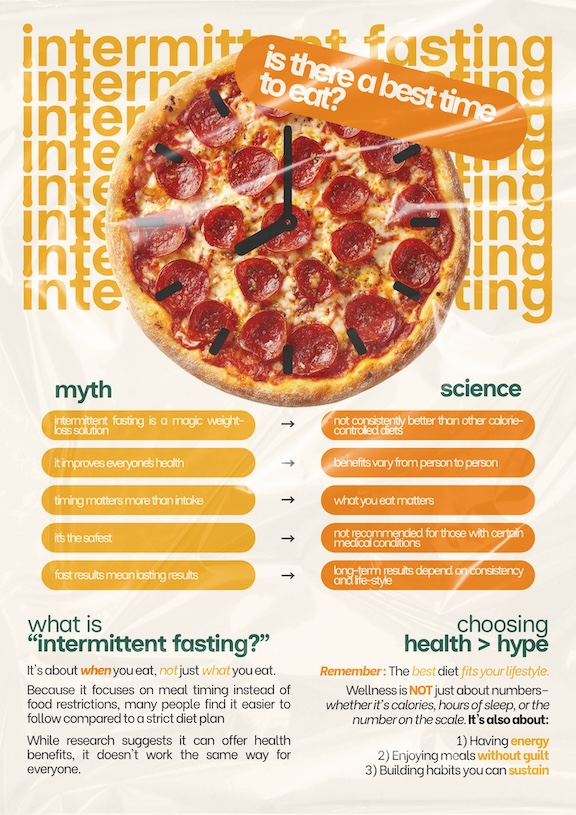
Myths vs. science
| Myth | What the research says |
| Intermittent fasting is a magic fix for weight loss. | It can help some people lose weight, but it is not clearly superior to other calorie-reduction approaches in the long term. |
| Fasting automatically improves overall health in everyone. | Benefits are more selective, often showing up in weight, waist circumference, and some blood sugar or lipid measures. |
| The fasting window itself matters more than food quality. | What people eat during the eating window still matters greatly for nutrition and health. |
| Fasting is always safe because it is “natural.” | It is not appropriate for everyone, especially people with certain medical conditions or a history of eating disorders. |
| If it works fast, it will always work forever. | Long-term success depends on consistency, lifestyle fit, and whether the pattern can be maintained without strain. |
Current research suggests that intermittent fasting may benefit some adults with overweight or obesity, particularly when it leads to a reduction in overall calorie intake. However, leading health experts caution that fasting should not be viewed as appropriate for everyone. Children and adolescents, pregnant or breastfeeding women, people taking certain medications such as insulin, and individuals with a history of eating disorders should speak with a healthcare professional before trying any fasting regimen.
Choosing health without the hype
Like many health habits, intermittent fasting succeeds only if it delivers benefits today and remains sustainable months or years into the future.
Research suggests that some people may experience modest improvements in weight, waist circumference, blood sugar, or heart health markers, particularly when fasting helps them eat more mindfully or reduce excess calories. But intermittent fasting doesn’t guarantee these benefits, nor does it consistently offer greater results than other balanced, sustainable ways of eating.
Long-term wellness is about more than numbers on a scale or results from a blood test. It is also about having enough energy to live well, enough flexibility to share meals with others, and enough peace of mind to enjoy food without guilt.
This drives the more important question: “Does intermittent fasting work for me?” Or “Is this a way of eating I can enjoy, sustain, and build my life around?”
Photo by Diana Polekhina on Unsplash
The Science Behind This Story
Intermittent fasting has become one of the most extensively studied eating patterns in nutrition science. Research suggests that certain forms of intermittent fasting, particularly time-restricted eating, may help some adults reduce calorie intake, lose modest amounts of weight, and improve markers such as insulin sensitivity, blood glucose control, and blood pressure.
However, current evidence also shows that intermittent fasting is generally not consistently superior to other calorie-restricted eating plans when total calorie intake and food quality are similar. In other words, many of its benefits appear to result from eating fewer calories overall and adopting healthier eating habits, rather than from fasting alone.
Major medical organizations also emphasize that intermittent fasting is not appropriate for everyone. It may not be suitable for children and adolescents, pregnant or breastfeeding women, individuals with certain chronic medical conditions, people taking medications that affect blood sugar, or those with a history of eating disorders.
At Joyful Wellness, we believe the goal isn’t to chase the latest eating trend but to build sustainable habits that support long-term health. The best nutrition plan relies on sound scientific evidence, provides balanced nutrition, and fits naturally into everyday life.
References
- American Heart Association. Intermittent Fasting: Is It Safe and Does It Work?
- National Institutes of Health (NIH). Time-Restricted Eating and Metabolic Health.
- de Cabo, R., & Mattson, M. P. (2019). Effects of Intermittent Fasting on Health, Aging, and Disease. New England Journal of Medicine.
- American Diabetes Association. Nutrition Recommendations and Interventions for Diabetes.
- World Health Organization. Healthy Diet Fact Sheet.