
Helping Gen Z and Gen Alpha Understand Dementia
A teenager laughs.
An older woman repeats the same story for the third time at lunch, and someone rolls their eyes.
A grandfather asks the same question he asked ten minutes ago.
A child whispers, “Why does he keep forgetting?”
Then comes the uncomfortable silence that often follows.
Many families know this moment.
Yet surprisingly few know how to explain it.
As populations around the world live longer, more families are encountering dementia, outside hospitals or nursing homes, but around dining tables, during family reunions, and in ordinary conversations. For younger generations, particularly Gen Z and Gen Alpha, these encounters can be confusing. The behavior may seem strange, frustrating, or even funny.
Some may still be unaware what Dementia is, they think it is a personality flaw or stubbornness or simply “getting old.”
Dementia is a disease of the brain.
The Misunderstanding at the Heart of Dementia
Imagine opening your phone one morning and discovering that your photos are still there, but the folders are mixed up.
The search function no longer works.
Files appear in the wrong places.
Some memories are missing entirely.
You know the information exists somewhere, but you cannot reliably find it.
That analogy may be far from perfect, but it comes closer to explaining dementia than many traditional descriptions.
For younger people who have grown up with smartphones, cloud storage, and digital devices, dementia can be understood as a breakdown in the brain’s ability to store, retrieve, organize, and process information.
The person is still there.
The system that helps them access memories is becoming damaged.
READ: Can We Prevent Alzheimer’s Before It Starts?
Dementia Is Not a Normal Part of Aging
This is one of the most important facts every young person should understand.
Many older adults remain mentally sharp well into their eighties, nineties, and beyond.
Occasionally forgetting where you placed your keys is not the same as dementia.
Dementia occurs when diseases such as Alzheimer’s disease, vascular dementia, Lewy body dementia, or frontotemporal dementia damage brain cells and interfere with daily life.
The result can include memory loss, confusion, difficulty communicating, changes in personality, poor judgment, and challenges performing familiar tasks.
These changes are caused by physical changes in the brain and not by a lack of effort or willpower.

The Memory May Fade. The Feelings Often Remain.
It is an act of generosity to impart this lesson for younger generations:
People living with dementia may forget names.
They may forget dates.
They may forget conversations.
But many continue to experience emotions deeply.
Research suggests that emotional memory can remain surprisingly resilient even when factual memory declines.
An older adult may forget exactly what was said.
Yet they may remember how someone made them feel.
Loved.
Safe.
Included.
Embarrassed.
Dismissed.
Ridiculed.
This is why the way we respond matters.
Why We Sometimes Take It Personally
Families often struggle when dementia enters their lives.
A grandmother forgets a birthday.
A grandfather mistakes one grandchild for another.
Or a parent repeats stories that everyone else has heard many times before.
These moments can feel painful.
They can also feel unfair.
Yet dementia asks families to make a difficult shift.
Instead of asking:
“Why is this person acting this way?”
We begin asking:
“What is happening inside this person’s brain?”
That small change in perspective can transform frustration into compassion.
DISCOVER: When Memories Fade: New Frontiers in Alzheimer’s Care and Innovation
The View From Two Generations
Older generations often grew up in cultures where respect for elders was deeply emphasized.
Many younger people, meanwhile, have been raised in a world that values questioning authority, direct communication, and digital connection.
Neither perspective is entirely right or wrong.
But when dementia enters the picture, misunderstanding can emerge.
A blank stare may be interpreted as indifference.
An impatient response may be mistaken for cruelty.
Often, what is missing has nothing to do with kindness.
It is understanding.
Young people are not born knowing what dementia is.
Someone has to teach them.
How Families Can Build Empathy
One of the most effective ways to explain dementia to children and teenagers is through analogy.
For Gen Alpha:
Imagine the brain as a giant network of roads. Dementia causes some roads to become blocked, making it harder for messages to reach their destination.
For Gen Z:
Think of dementia as losing access not only to your device’s hard drive, but also to your cloud storage. The information may still exist somewhere, but retrieving it becomes increasingly difficult.
Families can also encourage connection through:
- Looking through old photo albums together
- Listening to favorite songs from earlier decades
- Sharing family stories
- Creating memory books or scrapbooks
- Working on simple puzzles or activities
These moments help preserve relationships even when memories become fragile.
A Lesson About the Future
One reason dementia makes people uncomfortable is that it forces us to confront something we rarely think about.
Aging.
Most young people cannot imagine becoming old.
Most older adults once felt exactly the same way.
Yet longevity is one of humanity’s greatest achievements. More people are living long enough to become grandparents and great-grandparents than at any point in history.
The challenge now is learning how to care for one another across generations.
The Bridge
Perhaps the goal is to help young people understand dementia without fear.
Because one day the teenager who laughs may become the adult caring for an aging parent.
The child who grows impatient may someday hope for patience in return.
And the family that learns compassion today may discover that empathy, like memory, is something worth preserving.
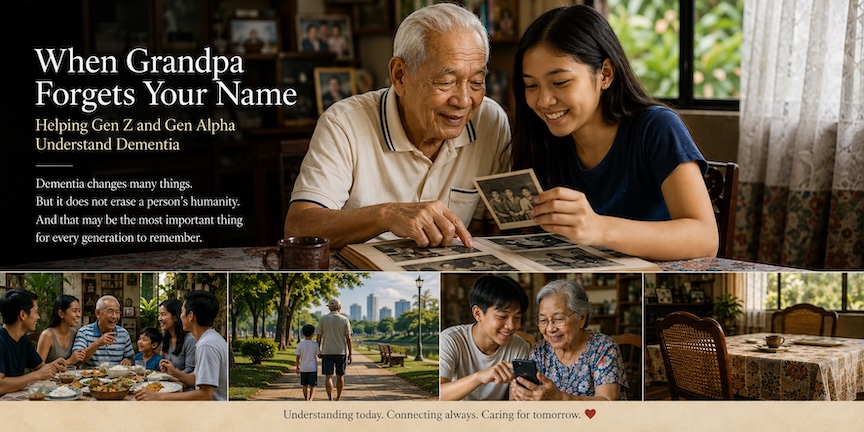
Dementia changes many things.
But it is impossible to erase a person’s humanity.
And that is a priceless thing for every generation to remember.
Editor’s Note
This article is intended for educational purposes and should not be used to diagnose dementia or other cognitive disorders. If you are concerned about memory loss or behavioral changes in yourself or a loved one, consult a qualified healthcare professional.
References
Alzheimer’s Association. (2024). What is Dementia? Retrieved from https://www.alz.org/alzheimers-dementia/what-is-dementia
Alzheimer’s Association. (2024). 10 Early Signs and Symptoms of Alzheimer’s Disease. Retrieved from https://www.alz.org/alzheimers-dementia/10_signs
Alzheimer’s Disease International. (2024). World Alzheimer Report. Retrieved from https://www.alzint.org
Alzheimer’s Foundation of America. (2024). Talking to Children and Teens About Dementia. Retrieved from https://alzfdn.org
Centers for Disease Control and Prevention (CDC). (2024). About Dementia. Retrieved from https://www.cdc.gov/aging/dementia
National Institute on Aging. (2024). What Is Dementia? Symptoms, Types, and Diagnosis. U.S. National Institutes of Health. Retrieved from https://www.nia.nih.gov/health/alzheimers-and-dementia
National Institute on Aging. (2024). Alzheimer’s Disease Fact Sheet. Retrieved from https://www.nia.nih.gov/health/alzheimers-and-dementia/alzheimers-disease-fact-sheet
World Health Organization (WHO). (2023). Dementia Fact Sheet. Retrieved from https://www.who.int/news-room/fact-sheets/detail/dementia
For the Section on Preserved Emotions and Relationships
Boller, F., & Verny, M. (2006). Emotional memory in Alzheimer’s disease. Journal of Neurology.
Guzmán-Vélez, E., & Tranel, D. (2015). Does emotional experience persist despite impaired memory in Alzheimer’s disease? Frontiers in Psychology, 6, 77.
For Activities and Intergenerational Engagement
Playlist for Life. (2024). The Power of Personal Music for Dementia. Retrieved from https://www.playlistforlife.org.uk
Alzheimer’s Association. (2024). Activities for People Living with Dementia. Retrieved from https://www.alz.org/help-support/caregiving/daily-care/activities