
We have all experienced the sudden, mid-week peak of digital overload.
At 10:17 on a Wednesday morning, your laptop chimes with another email. A messaging app flashes in the corner of your screen. Your phone vibrates. A meeting reminder appears just as you’re trying to finish a report that was due an hour ago. Within seconds, your body registers the shift: your breathing grows shallow, a tight knot forms in your stomach, your shoulders rise toward your ears. You reread the same paragraph twice without absorbing a word.
For decades, the default response to this mid-week burnout has been to simply “push through” or reach for another cup of coffee. Yet, forcing an already exhausted nervous system to continue only deepens your mental fatigue.
Fortunately, the frontiers of modern health technology have revealed an elegant, science-backed shortcut to emotional calm. Neuroscientists are increasingly interested: What if your body already possesses a built-in calming system—one that can be gently activated in less than a minute?
The answer may lie in a remarkable structure called the vagus nerve, and in something as simple as sound. We no longer have to spend hours in silent meditation to escape acute stress response. By utilizing targeted digital audio tools, specialized sound frequencies, and bone-conduction vibrations, we may access a powerful biological reset switch.
Welcome to the world of neuro-acoustic biohacking. By activating your vagus nerve in under sixty seconds, you can instantly clear mental fog, down-regulate stress hormones, and reclaim a state of joyful, focused presence right from your desk.
The Biological Superhighway: Meeting the Vagus Nerve
To understand how sound frequencies can change your emotional state, we must look at the primary regulatory highway of your parasympathetic nervous system: the vagus nerve. Deriving its name from the Latin word for “wanderer,” the vagus nerve is the longest cranial nerve in the human body. It originates in the brainstem and travels down through the neck, branching out extensively to touch your heart, lungs, vocal cords, and digestive organs.
The vagus nerve functions as your body’s ultimate internal brake pedal. When it is active and firing, a state known as high vagal tone, it sends an immediate chemical signal to your heart to lower its rate, signals your blood vessels to relax, and tells your adrenal glands to stop pumping cortisol into your bloodstream.
The fascinating breakthrough in modern neuroscience is that the vagus nerve is deeply connected to your auricular branch (the ear) and your vocal cords. Because it sits directly adjacent to your eardrum and passes through your larynx, the vagus nerve is highly sensitive to external mechanical vibrations, sound pressures, and acoustic resonance.
This means we can use targeted sound frequencies to physically vibrate the nerve, sending an immediate message to your brainstem that you are completely safe.
Why Humming Feels Surprisingly Good
Have you ever noticed yourself humming while cooking, driving, or rocking a baby to sleep?
Across cultures, humans have instinctively used humming, chanting, singing, and prayer as sources of comfort long before neuroscience could explain why.
One reason may be mechanical.
Gentle vocal vibrations created during humming stimulate muscles and tissues in the throat through which branches of the vagus nerve travel. At the same time, humming naturally lengthens the exhalation—a breathing pattern already known to encourage parasympathetic activity.
Researchers also believe that slow, controlled breathing itself contributes significantly to the calming response. Together, breathing and vocal vibration may help the body transition away from a stress response toward a more regulated state.
The experience is subtle rather than dramatic.
You are unlikely to feel stress vanish in an instant. More often, people describe a gradual softening: breathing becomes easier, muscles loosen, and scattered thoughts begin to settle.
READ: Music and Wellness: The Science Behind Feeling Better
Can Technology Help?
Ironically, some of the same devices that contribute to information overload are now being used to help people recover from it.
Music therapy apps, guided breathing platforms, soundscapes, and neuro-acoustic programs have become increasingly popular among people looking for quick moments of calm during busy workdays.
Some platforms generate ambient sound environments designed to reduce distraction. Others combine music with breathing cues or meditation guidance. More specialized programs incorporate binaural beats—slightly different tones presented to each ear that create the perception of a third rhythmic beat inside the brain.
Scientists are still investigating how much binaural beats influence mood, attention, or relaxation. Some studies report modest improvements in anxiety and perceived stress, while others find only limited effects. At present, the strongest evidence suggests that they may be helpful for some people when combined with relaxation techniques rather than viewed as a stand-alone treatment.
Claims surrounding specific sound frequencies such as 432 Hz or 528 Hz are even more controversial. While many listeners find these frequencies pleasant or emotionally soothing, researchers have not established that they possess unique healing properties independent of the music itself.
In other words, the sound that helps you relax may matter less than finding music that genuinely helps you slow your breathing and quiet your mind.
The 60-Second Reset
When your day begins to feel overwhelming, put down your phone, put on your favorite pair of stereo headphones, and execute this simple, science-backed 60-second audio reset right now. It isn’t a cure for chronic stress, nor is it a replacement for professional care when anxiety becomes persistent. Think of it instead as a brief interruption—an opportunity to remind your nervous system that not every notification is an emergency.
1. The Audio Selection (0 to 10 Seconds)
Open your preferred streaming app (like Spotify, YouTube, or Insight Timer) or a dedicated neuro-acoustic app (such as Endel or Brain.fm). Search for “432 Hz Alpha Binaural Beats” or “Vagus Nerve Stimulation Soundscape.” Ensure your headphones are on and set to a comfortable, ambient volume.
2. The Laryngeal Humming Resonance (10 to 40 Seconds)
Close your eyes and sit up comfortably. Take a deep, slow inhale through your nose for a count of 4. As you exhale, close your lips and make a deep, low-pitched “Voo” or “Mmm” humming sound in the back of your throat.
Let the vibration roll through your chest and jaw for the entire duration of the exhale. This intentional vocalization creates a physical mechanical resonance that directly stimulates the pharyngeal branch of the vagus nerve, forcing your heart rate to drop instantly.
3. The Sensory Integration (40 to 60 Seconds)
Allow your breathing to find its natural rhythm while letting the audio frequencies flow through your headphones. Focus your attention entirely on the sensation of the sound waves moving through your ears.
Within seconds, you will feel a distinct physical release: a deep drop in your shoulders, a clearing of the tension behind your eyes, and a cool, calm sensation settling into your chest.
The change may be small.
But small is sometimes enough.
Calm Is a Skill, Not a Destination
Stress is not the enemy. It helps us respond to challenges, meet deadlines, and adapt to change. Problems arise when the body forgets how to leave that heightened state.
Learning to regulate the nervous system is becoming an increasingly important part of modern wellness.
Technology alone cannot create inner peace.
Yet, when paired with evidence-based practices such as slow breathing, mindful attention, and soothing sound, it can become something unexpected: a companion that reminds us to pause before stress quietly becomes exhaustion.
Perhaps the real vagus nerve “hack” is the decision to give your nervous system sixty uninterrupted seconds to remember what calm feels like.
Utilizing Technology as a Companion for Peace
Modern technology is often blamed for our collective stress, but innovation is ultimately a mirror of how we choose to use it. Your smartphone and headphones do not have to be continuous sources of digital exhaustion. When used mindfully, they can transform into a highly advanced, portable sanctuary for your nervous system.
This week, when the mid-week hustle begins to feel overwhelming, and your smartwatch tells you your heart rate has climbed or your inbox begins to feel impossible, resist the urge to immediately work harder nor wait for burnout to force a halt. Take control of your biological state. Put on your headphones, hum a low resonance, let the calming frequencies restore your brainwaves, and step back into your day with the clean, unshakeable vitality of a perfectly balanced mind.
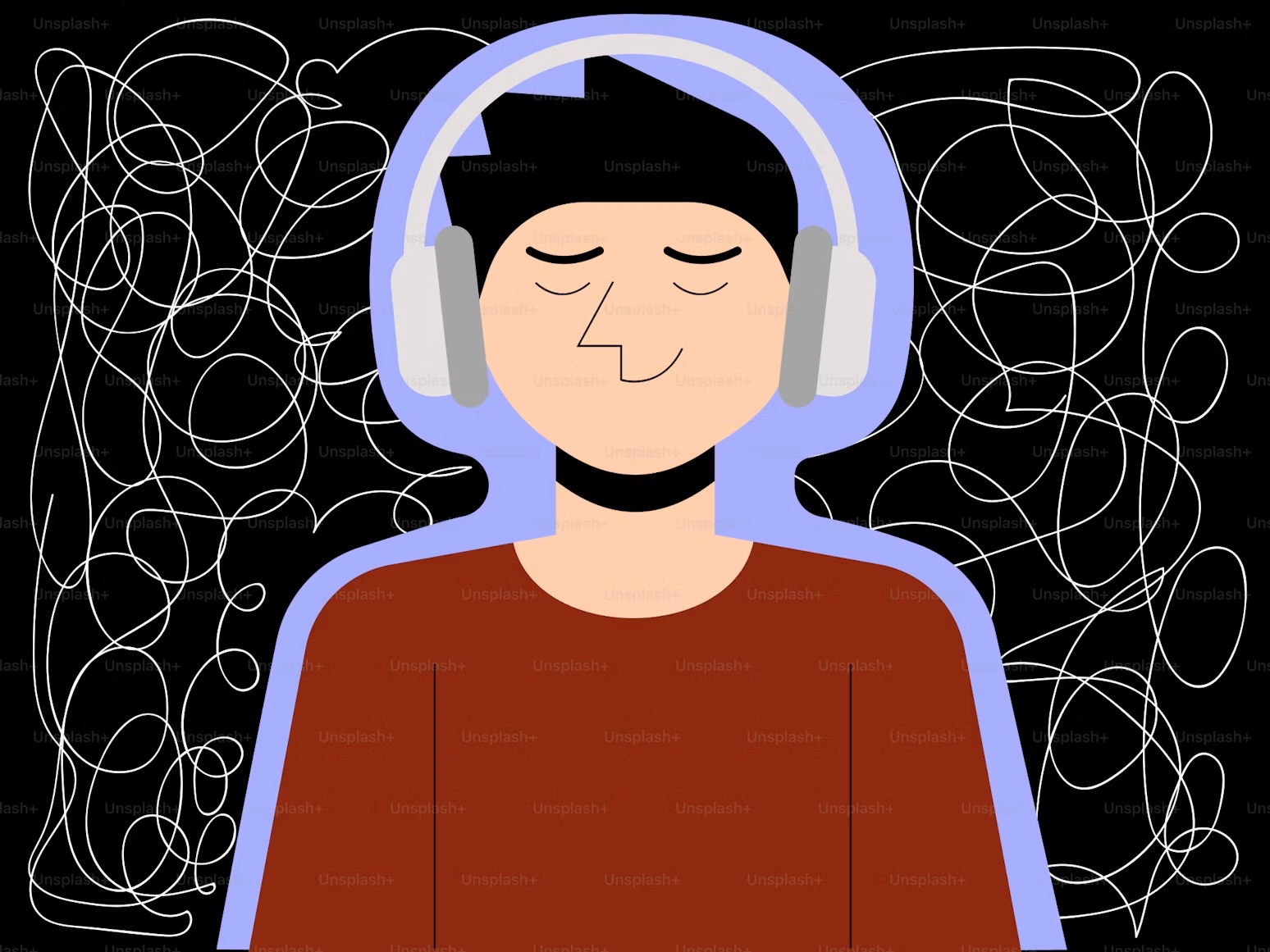
*Photo by Arturo Portillo for Unsplash+
Editorial Note
Joyful Wellness provides general, science-informed health information to help readers make informed decisions about their well-being. Our content is intended for educational purposes and does not replace professional medical advice. For personal health concerns or symptoms, readers are encouraged to consult a licensed healthcare professional.
References
- Vagal Nerve Stimulation via Acoustic Pathways: A clinical study published in the Journal of Neurophysiology establishes that low-frequency mechanical and acoustic vibrations applied to the auricular and laryngeal zones significantly raise vagal tone and heart rate variability (HRV).
- Neurological Effects of Binaural Beats: Research shared by Frontiers in Human Neuroscience confirms that auditory entrainment using Alpha-frequency binaural beats effectively steers the brain out of high-Beta distress and into a calm, focused Alpha brainwave state.
- Solfeggio Frequencies and Autonomic Regulation: A comparative study in the Journal of Addiction Research and Therapy demonstrates that exposure to the 528 Hz sound frequency markedly reduces salivary cortisol levels and lowers systemic tension indicators in highly stressed subjects.
- Vocalizations and Autonomic Stability: Insights from the International Journal of Yoga prove that low-frequency vocal humming (such as the “Om” or “Voo” sound) creates a mechanical resonance that slows the pulse and stabilizes blood pressure through direct vagal feedback loops.