Five Wellness Shifts We’re Watching And Five We’d Love to See More Of
Sunday offers us a chance to pause, to notice.
The world of wellness is changing faster than ever. Every week brings a new superfood, a new supplement, a new fitness trend, or a new promise of better health. Some deserve our attention. Others quietly fade away.
At Joyful Wellness, we’d like to do something a little different.
Instead of chasing every headline, we’d rather help you notice the changes that truly matter, the ones backed by science, shaped by real life, and practical enough to make a difference long after Monday arrives.
Here are five wellness shifts we’re noticing this week, followed by five we’d love to see grow in the months and years ahead.
1. Prevention Is Finally Having The Attention It Deserves
For a long time, many of us only visited a doctor when something hurt.
Today, more people are asking a different question: “How do I stay healthy?”
That’s a quiet but important shift.
Doctors around the world are encouraging people to know their blood pressure, blood sugar, cholesterol, and other health markers before symptoms appear. Many of the world’s leading causes of illness, including heart disease, diabetes, and kidney disease, can develop silently for years. By the time symptoms appear, the condition may already be well established.
One of the most powerful health habits may also be one of the simplest: getting to know your own numbers.
Something you may not know: High blood pressure often causes no warning signs at all. That’s why routine screening matters, even if you feel perfectly well.
2. Exercise Is Becoming Less About Burning Calories and More About Building a Life
Something refreshing is happening in parks, sidewalks, and open spaces.
People are moving together.
Morning walks with friends. Weekend run clubs. Outdoor yoga. Community Pilates. Family bike rides.
The goal isn’t necessarily to become the fastest or strongest person in the group. It’s simply to keep showing up.
Research has consistently found that we’re more likely to stick with physical activity when we enjoy it and when we feel connected to the people doing it with us.
The best exercise is surely about burning the calories, but definitely must be the one you’ll still be doing a year from now.
Something you may not know: Even a short walk after a meal can help your muscles use glucose more efficiently, helping your body regulate blood sugar naturally.
3. Sleep Has Earned Its Place Beside Diet and Exercise
Not long ago, getting by on very little sleep was almost worn like a badge of honor.
Today, scientists know better.
While you sleep, your brain and body remain remarkably busy. Memories are strengthened, hormones are regulated, tissues are repaired, and your immune system carries out important work behind the scenes.
Sleep isn’t simply “doing nothing.”
It’s one of the busiest shifts your body works every day.
Wearable devices that monitor sleep have become increasingly popular because many people are becoming more curious about how well they’re recovering as well as how hard they’re working.
Something you may not know: It’s often the quality of your sleep, along with the number of hours, that influences how rested you feel the next day.
4. Skincare Is Becoming Part of Health, Not Just Beauty
Healthy skin has become more about protecting one of the body’s most remarkable organs.
The skin acts as our first line of defense against the outside world. It helps regulate temperature, prevents excessive water loss, and protects us from harmful microorganisms and environmental damage.
New ingredients and technologies continue to appear in the skincare world, and while some are supported by promising research, dermatologists remind us that the fundamentals remain remarkably consistent.
Gentle cleansing. Daily sun protection. Moisturizing when needed.
Sometimes, the oldest advice remains the most valuable.
Something you may not know: Daily sunscreen is one of the most effective ways to reduce premature skin aging caused by ultraviolet exposure.
5. We’re Finally Talking About Stress Without Calling It Weakness
Perhaps one of the healthiest changes is happening in conversations.
People are becoming more comfortable acknowledging stress, burnout, anxiety, and emotional exhaustion as experiences that deserve care and attention.
Science continues to show that chronic stress lingers in mind and can influence sleep, appetite, blood pressure, concentration, and even immune function.
Managing stress is achievable.
It begins with something as ordinary as taking a walk, calling a friend, stepping outside for a few minutes, or simply allowing yourself to rest without guilt.
Looking after your mental wellbeing isn’t separate from looking after your physical health.
The two are deeply connected.
Something you may not know: Spending time in green spaces has been associated with lower stress levels and improved mood in many studies, even after relatively short visits.
READ: How Healthy Are You, Really? A Science-Based Guide
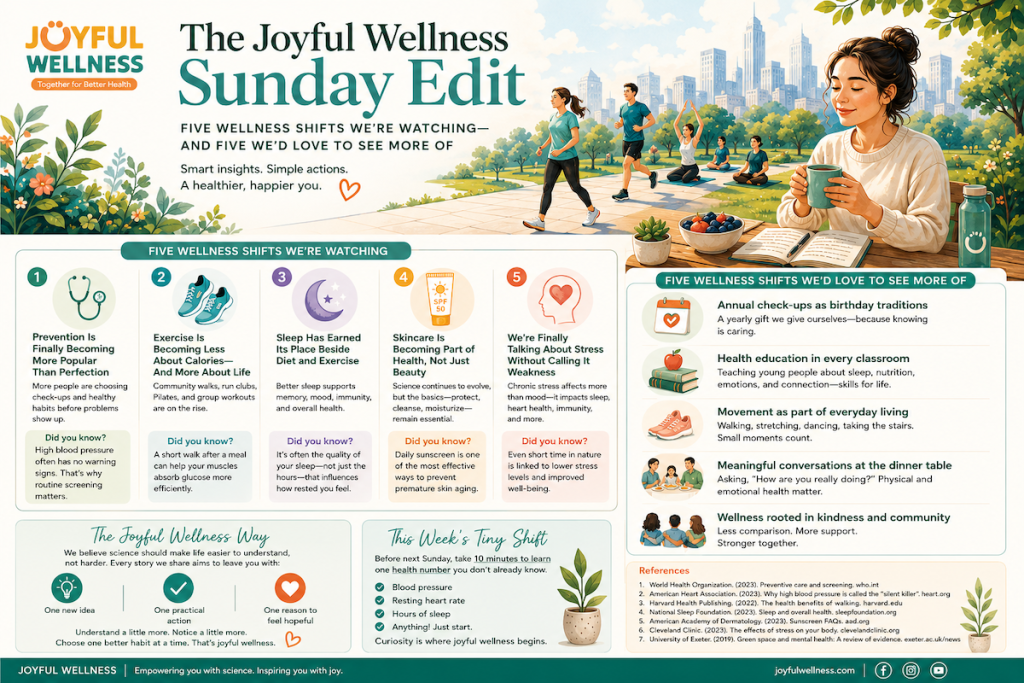
Five Wellness Shifts We’d Love to See Next
As much as we enjoy observing where wellness is heading, we also find ourselves imagining where it could go.
We’d love to see annual health check-ups become as routine as birthday celebrations, a yearly gift we give ourselves instead of something we postpone until we’re unwell.
We’d love to see schools spend more time teaching young people about sleep, nutrition, emotional wellbeing, and healthy relationships alongside academic subjects, because these lessons last a lifetime.
And of course, we’d love to see movement become part of everyday living rather than something reserved for gyms. Walking after dinner. Stretching between meetings. Taking the stairs. Dancing while cooking. Small moments count.
We’d love families to ask one another not only, “How was your day?” but also, “How are you really doing?” Physical health and emotional health deserve equal attention around the dinner table.
And we’d love to see wellness become less about comparison and more about kindness, less pressure to become someone else and more encouragement to become a healthier version of ourselves.
The Joyful Wellness Way
At Joyful Wellness, we believe science should make life easier to understand, not harder.
If an article leaves you feeling overwhelmed, we’ve probably missed the point.
But if you finish reading with one new idea, one practical habit to try, and one reason to feel hopeful about your health, then we’ve done what we set out to do.
Health doesn’t change because we read more.
It changes because we understand a little more, notice a little more, and gently choose one better habit at a time.
That’s the Joyful Wellness way.
This Week’s Tiny Shift
Before next Sunday, take ten minutes to learn one health number you don’t already know.
Maybe it’s your blood pressure.
Or your resting heart rate.
Maybe it’s simply how many hours of sleep you average each night.
Every meaningful health journey begins with curiosity.
And curiosity is where joyful wellness begins too.
Illustration by Wahyu Setyanto on Unsplash
One Thing to Try This Week
Learn one new health number.
Whether it’s your blood pressure, resting heart rate, waist circumference, or average hours of sleep, choose one measure you’ve never paid much attention to before. Curiosity is often the first step toward better health.
The Science Behind This Story
- World Health Organization (WHO). Noncommunicable Diseases Fact Sheet.
https://www.who.int/news-room/fact-sheets/detail/noncommunicable-diseases - World Health Organization (WHO). Physical Activity Fact Sheet.
https://www.who.int/news-room/fact-sheets/detail/physical-activity - World Health Organization (WHO). Mental Health.
https://www.who.int/health-topics/mental-health - American Heart Association. Life’s Essential 8™ for Cardiovascular Health.
https://www.heart.org/en/healthy-living/healthy-lifestyle/lifes-essential-8 - Centers for Disease Control and Prevention (CDC). Preventive Health Care.
https://www.cdc.gov/prevention - National Sleep Foundation. Sleep Health and Healthy Sleep Habits.
https://www.thensf.org - American Academy of Dermatology. Skin Care Basics and Sun Protection.
https://www.aad.org - American College of Sports Medicine (ACSM). Exercise Is Medicine®.
https://www.exerciseismedicine.org - Harvard T.H. Chan School of Public Health. The Nutrition Source.
https://www.hsph.harvard.edu/nutritionsource - Philippine Department of Health. Universal Health Care Program.
https://doh.gov.ph