A Joyful Wellness Fiction, A Short Story on HPV Vaccines, Fear, and the Dangerous Things We Choose to Believe
The first girl died during Holy Week.
At first, it was only the bleeding.
A little blood in the bathroom of a modest apartment in Quezon City. A thin red ribbon curling into drain water while electric fans clicked lazily against the heat of April.
Maribel Navarro folded tissue after tissue into her underwear and told no one.
Women her age often learned silence early.
At thirty-eight, Maribel had perfected it.
Silence during her husband’s drinking.
Silence during gossip from neighbors.
Still silence during the years she spent reposting frightening Facebook videos at three in the morning while insomnia hollowed her eyes into bruised moons.
The videos always arrived after midnight.
Women shaking violently after vaccines.
Teenagers supposedly dying overnight.
Doctors described as devils in white coats.
Conspiracy narrators whispering into microphones like priests of some new digital religion.
The algorithm loved frightened people.
And Maribel had become devoted.
By the time the Department of Health began offering free HPV vaccines at her daughter Angela’s school, Maribel already believed the world was poisoned.
“They’re experimenting on Filipinos,” she warned the other mothers outside the gate.
Rainwater dripped from tangled electrical wires overhead.
“They want our daughters infertile.”
Some mothers ignored her.
Some listened.
Fear spreads faster in heat.
Especially in poor neighborhoods where sickness already feels personal.
Angela was thirteen then. Skinny knees. Ink-stained fingers. The kind of child who still slept clutching stuffed animals though she denied it fiercely.
“Mama, Sister Evelyn said it prevents cancer.”
Maribel slapped the permission form onto the table so hard the soy sauce bottle rattled.
“Cancer?” she hissed. “Or something worse?”
Outside, thunder rolled over the city.
Inside, Angela lowered her eyes.
That became the beginning of everything.
REMINDER: Free Cervical Cancer Screening in QC and Taguig This May
Years passed strangely after that.
Like pages torn from a comic book and taped back incorrectly.
Angela grew quiet.
The apartment grew darker.
Maribel’s fear metastasized into obsession.
She stopped trusting hospitals first. Then medicines. Then doctors altogether.
She boiled guava leaves for infections.
Rubbed coconut oil over fevers.
Prayed over headaches instead of treating them.
Online groups became her church.
Women with usernames like TruthMama88 and WakeUpPinays filled her nights with stories:
vaccines causing paralysis,
microchips,
sterility,
government lies.
Fear gave Maribel something intoxicating:
certainty.
And certainty, when mixed with loneliness, can become a terrible drug.
By forty-five, Maribel had begun hearing things.
At first she thought it was rats inside the ceiling.
Then whispers.
Then girls.
Always girls.
Soft giggling in corners. Tiny footsteps moving through rooms long after midnight.
Sometimes she woke to find Angela standing beside the bed staring at her.
Not angrily.
Worse.
Sadly.
“Mama,” Angela would whisper. “Please stop reading those things.”
But Maribel could not stop.
Because fear had already rewritten her mind.
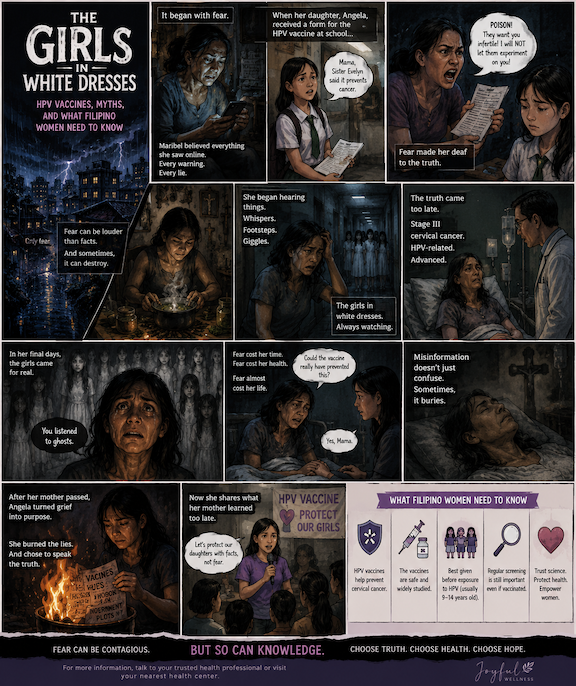
The diagnosis came during typhoon season.
Stage III cervical cancer.
The doctor at Philippine General Hospital spoke gently, but Maribel barely heard him over the rain hammering the windows.
HPV-related.
Advanced.
Treatable, but serious.
The room tilted.
Maribel stared at the posters lining the clinic walls:
women smiling beside words she had spent years mocking online.
Screen early.
Vaccinate young.
Prevent cervical cancer.
She laughed then.
A horrible sound.
The doctor paused.
“Mrs. Navarro?”
But Maribel could only think of Angela.
Angela at thirteen.
Angela holding the school consent form.
Her Angela looking frightened while Maribel ranted about poison.
And suddenly the room filled with girls in white dresses.
Dozens of them.
Standing silently beside the walls.
Hair dripping rainwater.
Skin pale as candle wax.
Watching her.
One stepped forward.
Maribel recognized her instantly.
The little girl from those anti-vaccine videos she had watched for years online.
Except now the girl’s face was peeling slowly downward like wet paper.
“You listened to ghosts,” the child whispered.
Then all the girls began laughing.
Madness creeps insidiously.
It blooms.
Quietly.
Like mold behind walls.
Angela moved her mother into her small apartment after chemotherapy began.
Some nights Maribel wandered hallways muttering warnings about needles and government plots.
Other nights she sat perfectly still staring into mirrors.
“The girls are here again,” she whispered once.
Angela closed the curtains carefully.
“There are no girls, Mama.”
But Maribel shook violently.
“Yes there are.”
And perhaps, in a way, there were.
Not ghosts exactly.
But consequences.
The lingering shapes of fear passed from screen to screen, person to person, until misinformation became almost supernatural in its power.
Because falsehoods confuse people.
Sometimes they bury them.
Near the end, Maribel finally asked the question she had spent years avoiding.
“Could the vaccine really have prevented this?”
Angela sat beside her mother’s hospital bed while monsoon rain battered Manila outside.
The room smelled faintly of antiseptic and sampaguita from flowers left by relatives.
“Yes,” Angela said softly.
Maribel closed her eyes.
All those years wasted fearing the wrong thing.
Not the virus.
Not the cancer.
But science itself.
After Maribel died, Angela found stacks of printed Facebook posts hidden beneath the bed:
warnings,
conspiracies,
grainy screenshots,
fear disguised as truth.
She burned them all one Sunday afternoon.
Smoke curled into the wet Philippine sky.
Then she walked to the barangay health center and volunteered for an HPV awareness drive.
Because grief, she realized, should become something useful whenever possible.
Now when Angela speaks to young girls and mothers, she tells them carefully:
The internet can save lives.
But it can also frighten people into dangerous silence.
HPV vaccines are safe.
Cervical cancer is real.
Fear is powerful.
But prevention is stronger.
And somewhere, in another dark apartment during another rainy season, perhaps one frightened mother will hear her.
Before the whispers do.
🌿 What Filipino Women Need to Know About HPV Vaccines
- HPV vaccines help prevent cervical cancer
- The vaccines are backed by global medical research and monitoring
- Vaccination works best before exposure to HPV, usually during adolescence
- Regular cervical cancer screening remains important
- Trusted medical guidance matters more than viral misinformation
Photo by Steve Busch on Unsplash
Sources & References
- World Health Organization — HPV vaccination guidance
- Department of Health — Cervical cancer awareness campaigns
- Centers for Disease Control and Prevention — HPV vaccine safety information
- Philippine General Hospital — Cervical cancer treatment and screening awareness