
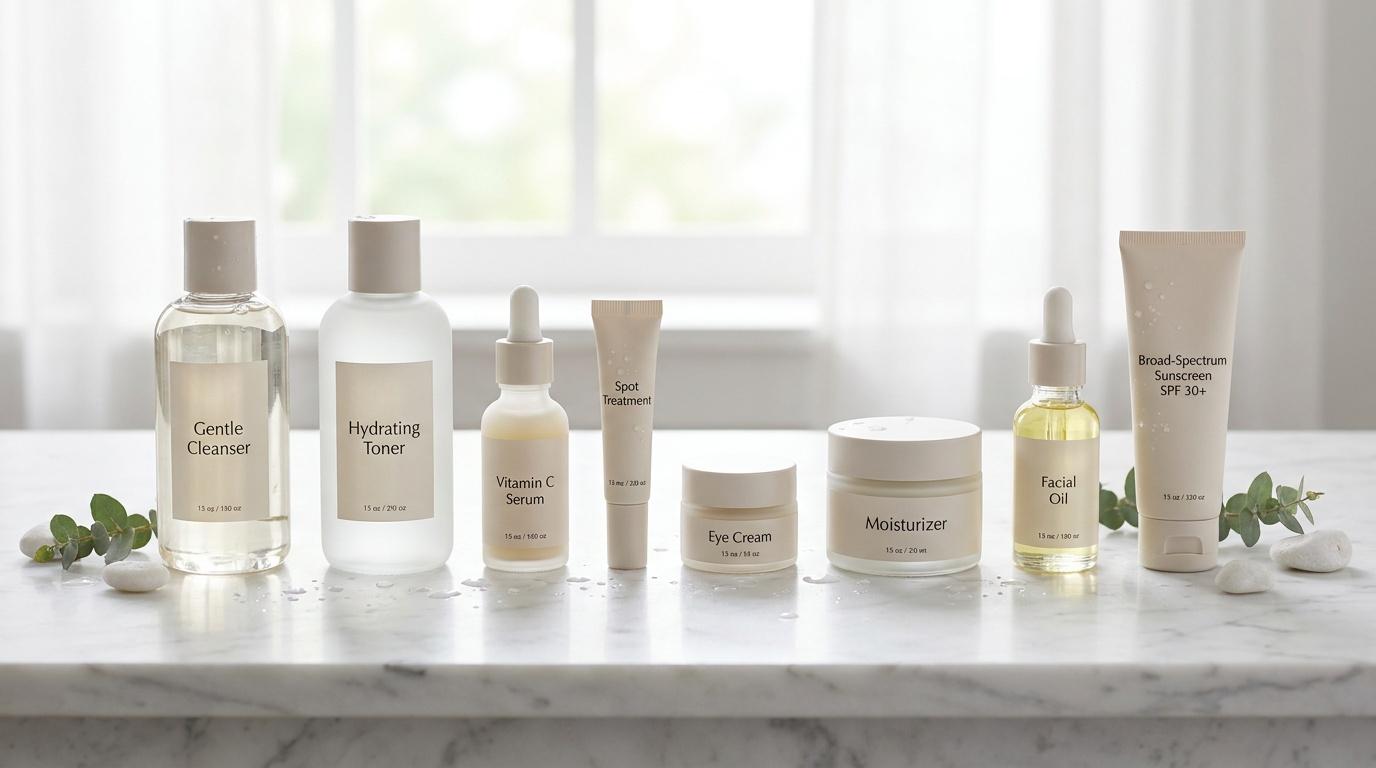
Open any Filipino bathroom cabinet and you can usually guess which era of skincare trends the owner lived through. There’s the ten-step phase: toner, essence, ampoule, serum, sheet mask, eye cream, a half-used snail mucin tube, and something with a label no one can read. And lately, increasingly, there’s the other shelf: a cleanser, a hydrating lotion, a moisturizer, and a sunscreen.
That second shelf has a name: J-beauty. And it’s getting more attention here. Local media have noted that more Filipinas are gravitating toward the Japanese approach to skincare, which prizes simplicity, balance, and long-term skin health over quick fixes. Whether that adds up to a full “pivot” away from Korean beauty is a more interesting question than the headline suggests, and the answer says a lot about what Filipinos actually want from their skin.
K-Beauty vs. J-Beauty: What’s Actually Different
Both traditions place considerable emphasis on hydration and skin health, which is why they’re so often lumped together. The difference is largely in temperament and approach.
K-beauty has historically been the more adventurous of the two: layered routines, steady product innovation, and a willingness to pair exfoliation and treatments with plenty of soothing and repair. Beauty experts quoted by Forbes in January 2026 summarized the contrast neatly: K-beauty is often associated with experimentation and innovation, while J-beauty places greater emphasis on protecting and maintaining the skin. A regional comparison of the two in Vietnam described J-beauty as typically built around three or four products used consistently, a quieter approach that favors long-term care over visible overnight change.
In practice, J-beauty routines often center on gentle cleansing, a watery hydrating lotion applied to the skin, a light moisturizer, and, importantly, daily sun protection. That’s the kind of routine associated with Hada Labo, the Rohto-made brand best known for its hyaluronic acid lotions. When it became available at Watsons in the Philippines, its signature Hydrating Lotion offered an accessible entry point into the category. The brand’s Philippine website says its lotions are free of fragrance, mineral oil, alcohol, and colorants, a claim worth reading as a brand statement rather than independent proof of product performance.
Is It Really a Pivot?
There are real signs that Japanese skincare is gaining ground. A June 2026 Daily Tribune feature on the quiet appeal of J-beauty noted that more beauty lovers are drawn to its emphasis on consistency over trend-chasing, and that local brands such as byfina are adapting Japanese skincare traditions for Filipinas and the country’s humid climate. Industry coverage has also reported that Japanese skincare brands are now much easier to find in the Philippines. Once largely associated with specialty shops, imported selections, and pasalubong from Japan, many are now available through established drugstores and online retail platforms. Greater accessibility has helped introduce more Filipino consumers to the Japanese approach to skincare.
But the data doesn’t support a clean handoff from one trend to the other. South Korea’s cosmetics exports hit a record US$11.43 billion in 2025, up 12.3 percent from the previous year, according to the country’s Ministry of Food and Drug Safety. Exports to the Philippines also grew by about 23 percent to roughly US$112 million, based on Korean trade data. These figures suggest that Korean beauty remains a significant force in the global industry and continues to find a market among Filipino consumers, even as Japanese skincare attracts greater attention locally.
The Philippine beauty and skincare market is also influenced by a much wider range of international and local brands. While some market-research reports suggest that K-beauty holds a substantial share of consumer interest, there is no single, consistently reported figure that establishes its precise share of the Philippine skincare market or measures J-beauty’s growth against it. Retail availability, product launches, and consumer interest offer useful indications of changing preferences, but they do not necessarily translate into market share.
Meanwhile, beauty-retail trend roundups describe K-beauty itself moving toward barrier-first routines and less layering, which further blurs the line between the two camps.
READ: The Beginner’s Guide to Building an Acne Skincare Routine
Why Simplicity Is Winning Here
A few practical forces are pushing Filipino shelves toward restraint.
Dermatologists have been saying it for years. An American Academy of Dermatology (AAD) dermatologist put it plainly: skincare doesn’t have to be complicated to be effective, and consistency matters more than a ten-step routine. The AAD’s basic formula is a gentle cleanser, a moisturizer, and a broad-spectrum, water-resistant sunscreen of SPF 30 or higher. Dermatology guidance on sensitive skin adds a logic that applies to anyone: shorter ingredient lists can mean fewer opportunities for irritation, and fragrance is a common trigger of contact dermatitis, even when it smells “natural.” The AAD also notes that using several different products can irritate the skin and make signs of aging more noticeable. A simple cleanse, moisturize, and protect approach can keep costs down, too.
The climate rewards light textures and sun protection. Heavy layers can feel uncomfortable in Manila’s humidity, while the country’s tropical climate makes sun protection a year-round consideration. The Philippine Dermatological Society advises using a broad-spectrum sunscreen of SPF 30 or higher whenever you’re outdoors, even on cloudy days, and reapplying every two hours when outside, as well as after swimming or sweating. J-beauty’s emphasis on daily sun protection fits that reality well. Heat, humidity, and ultraviolet exposure can also aggravate certain skin concerns, including melasma and other forms of pigmentation, making consistent protection especially important.
It’s easier on the wallet. A routine of three or four products can cost less to maintain than a dozen, and in a price-sensitive market where counterfeit and unregistered products circulate through informal channels, fewer purchases also mean fewer opportunities to buy something dubious.
It’s easier to find. As Japanese brands expanded into drugstores and online marketplaces, the barrier to trying them dropped considerably.
What the Science Says About a Minimal Routine
The case for a short routine isn’t just philosophical. A randomized, investigator-blinded trial published in 2020 involving 52 people with moderate-to-severe dry skin compared gentle cleansing alone with gentle cleansing plus a moisturizer over two weeks. The group using both a cleanser and moisturizer showed greater improvements in redness, scaling, skin fissures, and dryness-related symptoms. The findings support the value of moisturizing alongside gentle cleansing, particularly for people with dry skin.
The strongest evidence, though, backs the step J-beauty emphasizes most.
In the Nambour trial, published in the Annals of Internal Medicine, researchers randomly assigned 903 Australian adults under 55 to daily sunscreen use or to using it at their own discretion. After 4.5 years, the daily-sunscreen group showed no detectable increase in skin aging, and the progression of aging was 24 percent lower than in the discretionary-use group. If any single product earns a permanent spot on the shelf, this is it.
There’s one more sunscreen detail worth knowing, because it’s where Japanese and Korean labels differ from what many Filipino shoppers are used to seeing. Alongside SPF, which primarily measures protection against UVB rays associated with sunburn, many Japanese and Korean sunscreens print a PA rating from PA+ to PA++++, which indicates the level of UVA protection. UVA rays contribute to photoaging and pigmentation. PA++++ is the highest commonly used category. It is a rating category rather than an exact numerical measure, so two products carrying the same label may still differ in their actual UVA protection. Korean sunscreens also use the PA system, so it isn’t a uniquely Japanese advantage. For skin prone to dark marks, a PA+++ or PA++++ label is a reasonable thing to look for.
A caveat belongs here, too. Minimalism isn’t magic, and it isn’t right for everyone. The AAD itself advises using products for specific concerns when needed, and people dealing with persistent acne, melasma, or eczema often require targeted treatment that a three-product routine won’t provide. The point of simplicity is to make each product count, not to deny the skin what it needs.
DISCOVER: SLOWING DOWN THE CLOCK
The Fine Print: “Whitening,” Skin Tone, and Marketing
There’s one aspect of J-beauty that lands differently in the Philippines than in Japan, and it’s worth understanding.
Many Japanese products are labeled “whitening” or “brightening.” In Japan, whitening claims for products approved as quasi-drugs are regulated. Their permitted efficacy claims generally concern preventing pigmented spots and freckles caused by sun exposure, including by inhibiting melanin formation. They are not claims that a product can change a person’s natural skin tone. Japanese scientific reviews describe these quasi-drug ingredients as being formulated to help prevent sun-induced pigment spots and freckles.
Philippine beauty culture, however, has a long history of preferring lighter skin, and local coverage of J-beauty notes that this desire remains deeply embedded. Industry coverage has also reported strong demand here for brightening lines. Those Japanese regulatory definitions don’t automatically govern how the same word is understood or marketed once a product is on a Philippine shelf. So read claims carefully, look for what the product actually says it does, such as fading dark spots or helping prevent new ones, and remember that any brightening routine is undermined without daily sunscreen.
A Simple, Humid-Climate Routine
If you’re curious about trying the quieter shelf, here’s a straightforward way to start.
- Morning: Rinse or cleanse gently, apply a hydrating lotion to slightly damp skin, add a light moisturizer if your skin needs it, and finish with a broad-spectrum SPF 30 or higher sunscreen. Apply it to dry skin about 15 minutes before heading outdoors.
- Evening: Cleanse gently to remove sunscreen and the day’s grime, then hydrate and moisturize. If you wear makeup or water-resistant sunscreen, a cleansing oil or balm followed by a gentle cleanser is reasonable, but avoid scrubbing, since harsh cleansing can strip the skin barrier.
- Add one product at a time. If you want a targeted ingredient, introduce it alone so you can tell what’s helping or causing irritation.
- Skip the fragrance if your skin is reactive.
- Reapply sunscreen every two hours outdoors, and after sweating or swimming.
- See a dermatologist for persistent breakouts, stubborn pigmentation, or any product reaction that doesn’t settle.
The Filipino skincare shelf is getting simpler, and that’s good news, whatever you call the trend. Whether you credit J-beauty, K-beauty’s own course correction, or plain dermatology common sense, the research points in much the same direction: a gentle cleanser, a moisturizer, and daily sunscreen do much of the heavy lifting, and every extra bottle should have to justify its place. Just keep the label-reading habit alive, especially around “whitening” claims, and let sunscreen be the one step you never skip.
A note on this topic: This piece offers general skincare information and isn’t medical advice. If you have persistent acne, pigment changes, or a rash or reaction that doesn’t improve, a dermatologist can recommend treatment suited to your skin.
References
1. Scientific studies and clinical research
1. Hughes, M.C.B., et al. (2013). Sunscreen and Prevention of Skin Aging: A Randomized Trial. Annals of Internal Medicine, 158(11), 781–790.
Read the study – PubMed.
2. A Consistent Skin Care Regimen Leads to Objective and Subjective Improvements in Dry Human Skin: Investigator-Blinded Randomized Clinical Trial. Journal of Dermatological Treatment.
Read the study – PubMed Central.
3. Skin Whitening Products and Their Effects (2019). Journal of Japanese Cosmetic Science Society.
Read the research – J-STAGE.
2. Dermatological guidance and sun protection
4. American Academy of Dermatology. A Dermatologist’s Guide to Skincare.
Read the AAD guidance.
5. American Academy of Dermatology. Skin Care on a Budget.
Read the recommendations.
6. American Academy of Dermatology. Contact Dermatitis: Causes and Common Allergens.
Read the dermatology guidance.
7. Philippine Dermatological Society. Sun Protection.
Read the PDS recommendations.
8. Philippine Dermatological Society. A Guide to Basic Skin Care Routine.
Read the guide.
9. Japan Cosmetic Industry Association. Measurement Standards for UVA Protection Efficacy.
Read the PA rating standards.
3. Industry and consumer trends
10. Ministry of Food and Drug Safety, South Korea (2026). 2025 Cosmetics Export Statistics.
View the official export statistics.
11. Yonhap News Agency (January 9, 2026). Exports of K-beauty Products Hit All-Time High in 2025: Data.
Read the report.
12. Daily Tribune (June 5, 2026). Why Filipinas Are Embracing the Quiet Beauty of J-Beauty.
Read the feature.