
What if Sunday could be more than the day before Monday? A little prayer, a good meal, a family movie, or a walk around the neighborhood can help us slow down, reconnect, and enter a new week with greater intention.
For many of us, Sunday comes with a familiar tug-of-war: catch up on chores, prepare for work or school, squeeze in errands—and somehow find time to rest. But what if we treated Sunday not as the end of the weekend, but as an opportunity to begin again?
Research suggests that simple practices such as mindfulness, gratitude, physical activity, and meaningful social connection can support well-being. They are not magic fixes, and their effects vary from person to person. But together, they can help create a rhythm of life that makes room for both responsibility and joy.
1. Make space for prayer and reflection
For many Filipinos, Sunday means Mass, prayer, or time with a faith community. Prayer can offer comfort, meaning, and a sense of connection for people who find it meaningful. Research on prayer has found encouraging associations with well-being, although outcomes depend on the person’s experience and the kind of spiritual practice involved.
If prayer isn’t part of your life, try a few quiet minutes, mindful breathing, or writing down three things you appreciate. Ask yourself: What gave me energy this week? What drained me? What would I like to do differently next week?
Reflection isn’t about judging yourself. It’s about understanding yourself a little better.
READ: The 5-Minute Morning Reset: Awakening Your Brain Without a Caffeine Spike
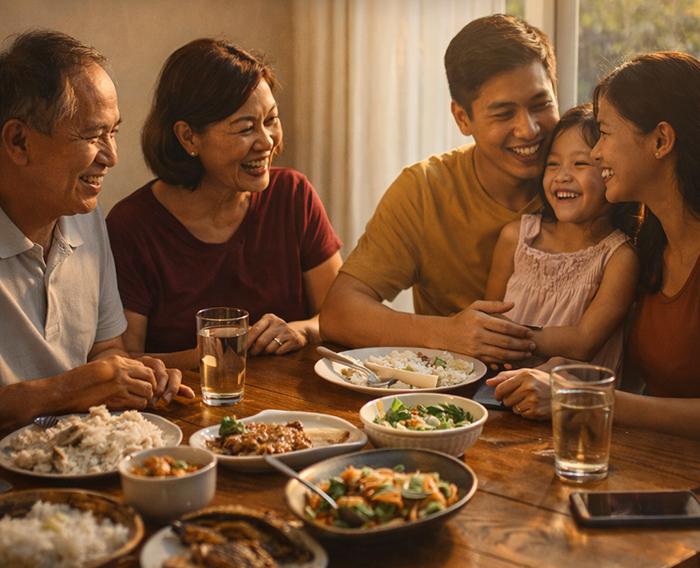
2. Bring everyone to the table
A Sunday meal need not be extravagant. It could be sinigang, a favorite pasta, leftover adobo, or a simple lunch shared with friends.
A University of the Philippines Los Baños review examined research on family mealtimes in the Filipino context. International studies also associate more frequent family meals with better diet quality and psychosocial well-being among children and adolescents. These findings do not prove that meals alone cause better mental health, but they support making space for relaxed, regular connection.
Try this: Put phones aside for one meal. Invite everyone to share a small win, something that challenged them, or one thing they look forward to. Let the conversation wander; not every meal needs to become a family meeting.
3. Make Sunday a day to enjoy one another
Connection doesn’t have to happen around a table. Choose a family activity that feels fun, not obligatory.
- Movie afternoon: Pick a feel-good comedy, an animated film, or a favorite classic. Make popcorn, dim the lights, and let everyone take turns choosing.
- Board-game hour: Bring out the party game. The point isn’t to win; it’s to laugh and spend time together.
- Neighborhood walk: Explore a familiar street, visit a nearby park, or walk to buy merienda. A little movement and time outdoors can be a welcome break from screens.
- Call someone you miss: A grandparent, cousin, or old friend may appreciate a few minutes of conversation.
4. Leave a little room for Monday
Before bedtime, spend ten minutes preparing for the week. Check your calendar, choose one priority, prepare a bag or lunch, and decide when you’ll make time to rest.
Keep it simple. You don’t need to optimize every hour or turn self-care into another performance.
The joy of a slow Sunday is not about having a perfect family, a perfect routine, or a perfect life. It’s about returning to what sustains us: faith or reflection, nourishing food, movement, laughter, and people who help us feel connected.
A new week will bring its own demands. Let Sunday remind you that life is more than getting through them. It’s also about the small moments we share along the way.
Together for Better Health.
References
Chen, Z. J., et al. (2024). Effects of prayer frequency and orientations on distress and well-being: Cross-sectional and longitudinal evidence from Indonesian adults. Psychology of Religion and Spirituality. https://doi.org/10.1037/rel0000527
University of the Philippines Los Baños, Department of Human and Family Development Studies. The Influence of Family Mealtime Frequency on Adolescent Biopsychosocial Development: A Systematic Review and Application to the Filipino Family Context. https://ahead.uplb.edu.ph/ahead-journals/the-influence-of-family-mealtime-frequency-on-adolescent-biopsychosocial-development-a-systematic-review-and-application-to-the-filipino-family-context/
Dallacker, M., et al. (2023). Family Mealtimes: A Systematic Umbrella Review of Characteristics, Correlates, Outcomes and Interventions. https://pubmed.ncbi.nlm.nih.gov/37447168/
Folk, D., & Dunn, E. (2023). A systematic review of the strength of evidence for the most commonly recommended happiness strategies in mainstream media. Nature Human Behaviour. https://doi.org/10.1038/s41562-023-01651-4