When preparedness becomes a privilege, perhaps wellness asks us to look beyond ourselves.
How exactly do we feel about the arrival of a national warning?
The advisory comes out. The infographics follow.
Store drinking water.
Prepare an emergency kit.
Buy medicines.
Keep food on hand.
Stay cool.
Conserve water.
All of this is sensible. All of it matters.
But somewhere between the checklist and the shopping cart, another question deserves to be asked:
What happens to the Filipino family that cannot afford the checklist?
This is the larger story of El Niño.
DOST-PAGASA says a Strong El Niño is already present in the tropical Pacific. Current climate models indicate that it may intensify into a Very Strong El Niño toward the end of 2026 and continue through the first half of 2027. For the Philippines, El Niño generally increases the likelihood of below-normal rainfall, dry spells and drought in many areas, although conditions can vary by location and season. PAGASA
That means the conversation cannot simply be about whether we have enough bottled water in the pantry.
It has to be about who has water in the first place.
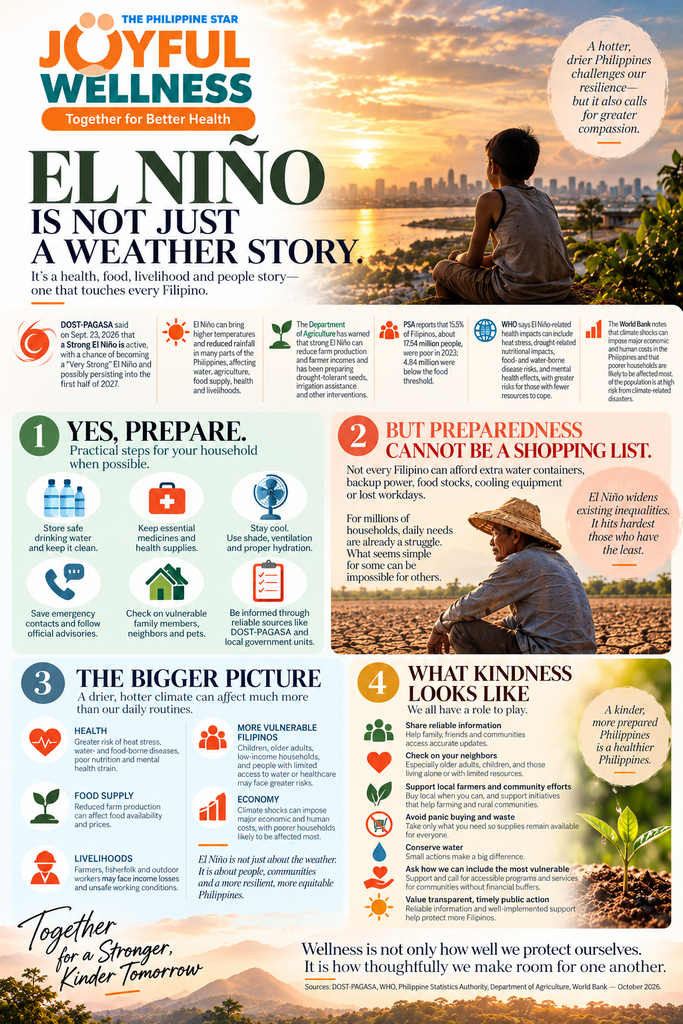
Preparedness is important. But preparedness is not a shopping list.
For households that can afford it, preparing for extreme heat and water interruptions may mean stocking drinking water, medicines, food and other supplies.
But for a daily-wage worker, buying several containers of water may mean giving up money for lunch.
For a farmer, drought preparedness is not a matter of buying a few extra things at the supermarket. It can mean protecting an entire season’s livelihood.
For someone living in a crowded home without reliable water access, “stay hydrated” is useful advice—but access to safe water is the real issue.
For an older person living alone, staying cool may depend on electricity, ventilation, someone checking in, or simply having another person nearby.
The World Health Organization’s 2026 assessment of El Niño specifically calls for attention to vulnerable populations and health-system readiness. El Niño-related hazards can affect heat exposure, water and food security, infectious diseases, nutrition, mental health and access to essential health services. World Health Organization
In other words, resilience is not distributed equally.
And neither is wellness.
The heat does not fall equally on everyone
Extreme heat is not merely uncomfortable.
The body has to work harder to regulate its temperature. Heat stress can worsen cardiovascular, respiratory, kidney, diabetes and mental-health conditions, while severe heat can lead to heat exhaustion and heatstroke. Older adults, infants, outdoor workers and people with certain health conditions are among those at greater risk. World Health Organization
Now imagine experiencing that heat in a home without reliable cooling, while worrying about the next electricity bill.
Or working outdoors because missing one day of work means missing a day’s income.
Or commuting for hours.
Many people care for children while water supplies are intermittent.
The science of heat may be universal.
The experience of heat is not.
And then there is food
When rainfall becomes less predictable and water becomes scarce, agriculture feels the pressure.
PAGASA has advised farmers to conserve water, maintain irrigation systems, consider rainwater harvesting, use drought-tolerant crops and adjust farm activities according to weather and agricultural advisories. PAGASA
This matters to everyone, even those of us who have never planted a crop.
Because the farmer’s field eventually becomes the food on our table.
Climate shocks can affect harvests, livelihoods, food availability and prices. The consequences can travel from a dry field to a public market, from a public market to a family’s grocery budget, and from a grocery budget to what ends up on a child’s plate.
The Philippines already has significant economic vulnerability.
The latest full-year official poverty statistics available from the Philippine Statistics Authority show that 17.54 million Filipinos—15.5% of the population—were living below the poverty threshold in 2023. About 4.84 million were below the food threshold. Philippine Statistics Authority
These are not abstract numbers.
They are families making decisions every day about what can wait until payday.
So what does wellness mean now?
Perhaps this is where we need to expand our definition of wellness.
Wellness cannot mean only the ability to protect ourselves.
It must also include the ability to notice who may be struggling beside us.
If you can afford extra water, perhaps buy what your household reasonably needs, but resist panic-buying. Leave enough on the shelves for others.
Those who have elderly relatives, check on them when the heat becomes intense.
If you know a neighbor who lives alone, send a message or knock on the door.
If you employ household help, drivers, construction workers, gardeners or other outdoor workers, think about the heat they experience while working. Reasonable rest, water and protection from extreme heat are not luxuries.
Consider helping a community pantry, local farmers’ group, relief organization or credible community initiative, if you have the means.
And if you encounter information about El Niño, share reliable information—not fear.
PAGASA remains the country’s authoritative source for official weather and climate advisories. PAGASA
There is also something larger we should ask of ourselves.
Every climate event eventually becomes a question of public health.
Who has access to water?
Who has shade?
Then, who can afford food when harvests are affected?
Who can stop working when the heat becomes dangerous?
Who has a doctor nearby?
Remember to think of who has savings when a livelihood is interrupted?
Who has a home that can withstand another difficult season?
And who doesn’t?
These are not questions that an individual emergency kit can answer.
They belong to communities, institutions and government, too.
The government has announced preparations involving agriculture, irrigation, water management, health and other sectors, including additional support being sought for farmers and fisherfolk. Philippine Coast Guard
That preparation matters.
So does making sure that climate and disaster responses reach the people whose ability to absorb another shock is smallest.
Because a resilient country is not simply one in which some families know how to prepare.
It is one in which fewer families are left to face a crisis alone.
A kinder kind of preparedness
Perhaps this October, as we talk about wellness, we can add another item to our preparedness list:
Look around.
Know the people who may need help.
Share accurate information.
Conserve water without creating scarcity for someone else.
Support farmers and local communities.
Check on the elderly.
Protect outdoor workers.
Think about children.
Be mindful of people living with illness or disability.
And when you have more than you need, consider how a little of that surplus might become someone else’s safety.
This is not charity dressed up as wellness.
It is community health.
The WHO has noted that the health effects of El Niño can be more severe where populations have fewer resources and less capacity to cope with climate shocks. World Health Organization
That gives us an important definition of resilience:
Not simply How well can I survive?
But:
How well can we make sure that others survive, too?
Wellness is bigger than the self
There is nothing wrong with preparing our own homes.
We should.
But perhaps we can resist the idea that wellness ends at our front door.
The water we conserve affects a community.
Information we share affects another family.
The farmer we support feeds a table.
The neighbor we check on may be someone’s mother or father.
Yes, the worker we protect may be supporting an entire household.
And the kindness we offer may travel much farther than we will ever know.
El Niño is a climate phenomenon. It is governed by ocean temperatures, atmospheric circulation and enormous systems beyond any one person’s control.
But what happens between people during a difficult season is partly up to us.
So yes, prepare.
Keep informed.
Keep cool.
Conserve water.
Take care of your health.
But also—
look beyond the shopping list.
Because a healthier Philippines is not one where only the prepared get through the heat.
It is one where we become thoughtful enough to prepare for one another.
And perhaps that is wellness in its bigger, more generous form:
Not simply protecting the life we have—
but helping make life a little safer for the people we share it with.
References
DOST-PAGASA. Climate Advisory: “Very Strong” El Niño. 2026. PAGASA
Philippine Statistics Authority. 2023 Full Year Poverty Statistics. 2024. Philippine Statistics Authority
World Health Organization. Global Public Health Situation Analysis — El Niño 2026. 2026. World Health Organization
World Health Organization. Heat and Health. 2026. World Health Organization
World Health Organization. El Niño Southern Oscillation (ENSO). World Health Organization
Presidential Communications Office. Government braces for “very strong” El Niño, urges public to prepare. September 27, 2026. Philippine Coast Guard