
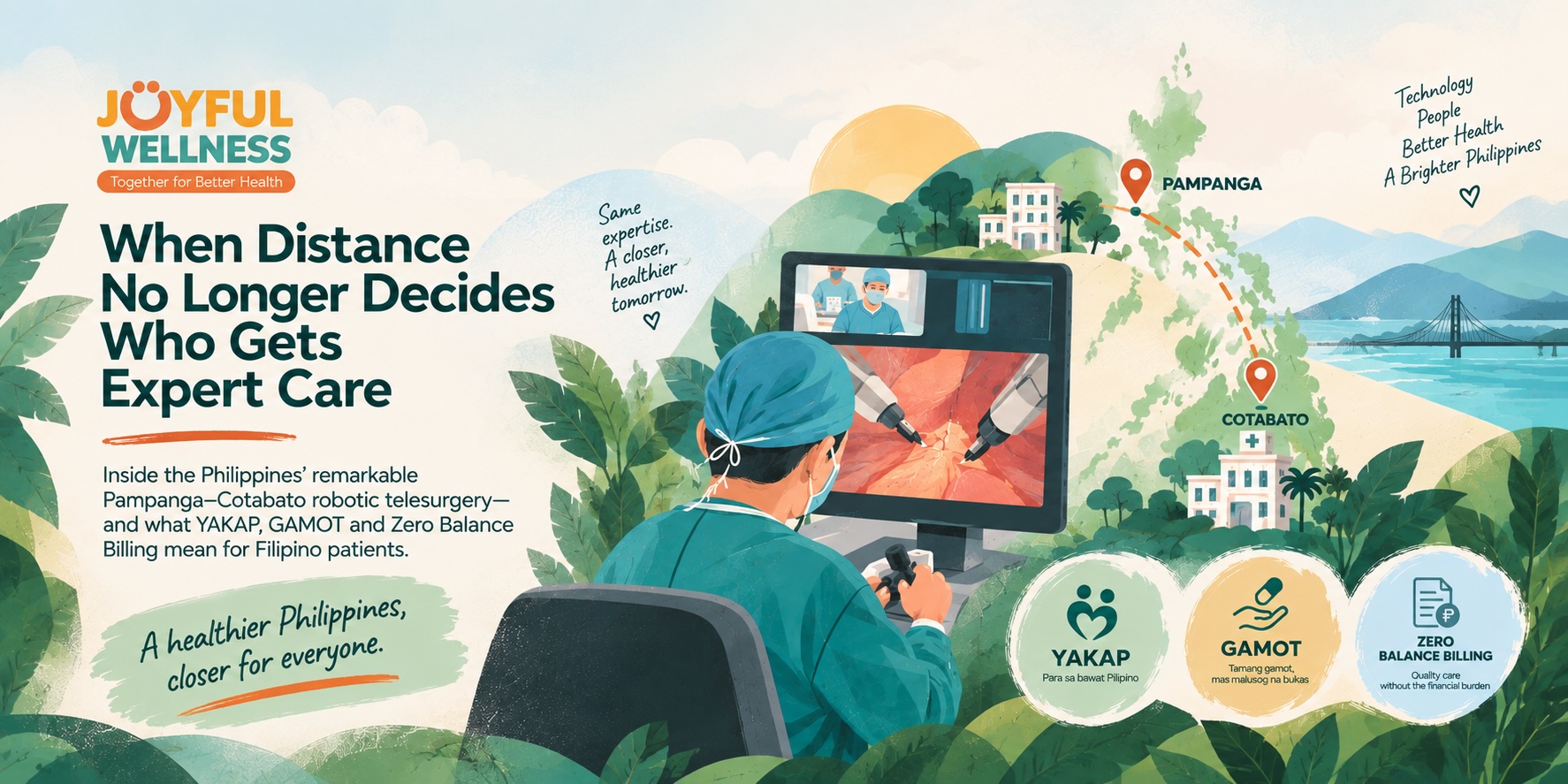
Inside the Philippines’ remarkable Pampanga–Cotabato robotic telesurgery and what Zero Balance Billing means for Filipino patients.
Time to look closely at moments in medicine when the machine is the headline.
And then on moments when the machine makes us think about something much bigger.
On September 5, 2026, a surgeon in Pampanga operated on a patient in Cotabato.
Without flying to Mindanao.
Without putting the patient on a plane to Luzon.
But by controlling a surgical robot remotely, in real time, across approximately 1,712 kilometres.
Two robotic telesurgeries were performed between Jose B. Lingad Memorial General Hospital (JBLMGH) in San Fernando, Pampanga, and Cotabato Regional and Medical Center (CRMC). In one procedure, Dr. Ryan Quiambao of JBLMGH remotely operated on a patient at CRMC. In the reverse procedure, CRMC surgeons Dr. Al-Jazzer M. Angas and Dr. Louis Gerard Agustin remotely operated on a patient at JBLMGH. Both were robotic cholecystectomies—the surgical removal of the gallbladder.
And there is another remarkable part of the story:
The patients were treated at zero cost under the government’s zero-balance-billing policy.
For a country made up of thousands of islands, that makes this more than a story about robots.
It is a story about distance, expertise and the possibility of making advanced healthcare more accessible.
First, what exactly is telesurgery?
The easiest way to understand it is this:
The surgeon moves. The robot moves. The patient does not.
In ordinary robotic-assisted surgery, the surgeon sits at a console in the same hospital as the patient. The surgeon sees the operative field through a high-definition, three-dimensional system and controls robotic instruments that enter the patient’s body through small openings.
With telesurgery, the surgeon’s console and the patient’s robotic system can be in different locations.
The surgeon’s hand movements are translated into movements of the robotic instruments at the patient’s side.
The robot does not decide what to cut.
It does not diagnose the patient.
It does not independently perform the operation.
The surgeon remains in control.
That distinction matters.
The robot is an extraordinarily sophisticated surgical interface, but the clinical decisions, judgment and responsibility remain human.
The latest international clinical guidance on telesurgery makes this particularly clear. Safe remote surgery requires a properly equipped local operating team, reliable communication, advance testing of the connection and a local team capable of responding if communication or technology fails.
So when we say a surgeon in Pampanga operated on someone in Cotabato, it does not mean that the patient was alone in an operating room with a machine.
There was a medical team physically with the patient.
The technology allowed specialist surgical expertise to reach across the distance.
So what did the robot actually do?
In these cases, the procedure was a cholecystectomy, or gallbladder removal.
The gallbladder is a small organ beneath the liver that stores bile, a digestive fluid produced by the liver.
When gallstones or gallbladder disease cause recurrent pain, inflammation or other complications, removing the gallbladder can be an appropriate treatment.
Gallbladder removal is already commonly performed using laparoscopic, minimally invasive surgery. Instead of making one large abdominal incision, surgeons work through several small openings using a camera and specialized instruments.
Robotic surgery uses the same basic minimally invasive principle, but adds a highly articulated robotic system controlled by the surgeon.
The surgeon can work with instruments designed to mimic the flexibility of the human wrist, together with magnified three-dimensional visualization.
That can be particularly useful when working in confined anatomical spaces.
But here’s where science asks us to be careful.
Robotic does not automatically mean “better.”
That is important for patients to understand.
Recent systematic reviews comparing robotic and laparoscopic gallbladder surgery generally find that robotic cholecystectomy is feasible and safe, with outcomes broadly comparable to conventional laparoscopy. Some studies suggest robotic surgery may reduce the likelihood of having to convert to an open operation, while other outcomes, including complications and hospital stay, are often similar.
A 2026 systematic review involving more than 7.5 million patients found clear advantages for laparoscopic surgery over open surgery, while finding no demonstrated clinical advantage of robotic over laparoscopic surgery for mortality or complications.
That is not a criticism of robotic surgery.
It is actually an important lesson in evidence-based medicine.
The exciting part of this Philippine milestone is that robotic technology may make it possible for a surgeon’s expertise to be delivered across geography.
And that could matter enormously in an archipelago like ours.
The most important thing about the robot may be what happens when the connection is tested
Imagine the distance.
One hospital is in Pampanga.
The other is in Cotabato.
Between them is more than a thousand kilometres of geography and an enormous amount of technology.
For remote surgery to work safely, the communication system must transmit the surgeon’s commands and return the surgical images quickly and reliably.
Even tiny delays matter when instruments are being controlled in real time.
This is why telesurgery is not simply a matter of “having fast internet.”
It requires:
- specialized robotic equipment;
- a dependable communications network;
- trained surgeons;
- anesthesiologists, nurses and other medical professionals at the patient’s side;
- technical and biomedical support;
- cybersecurity and data protection;
- careful patient selection;
- rehearsed emergency procedures; and
- a local surgical team capable of responding if the remote connection is interrupted.
The 2026 international clinical guidelines on telesurgery specifically emphasize pre-operative testing of the communication environment and the ability of the local team to safely continue surgery if remote communication or equipment fails.
That is the part of the story that deserves as much attention as the robot itself.
Technology becomes healthcare only when a whole human system is built around it.
Why this matters so much in the Philippines
This is where the story becomes very Filipino.
A specialist may be in Manila, Cebu, Davao or another major medical centre.
A patient may be in an island community, a rural municipality or a province where certain specialists and sophisticated surgical services are simply not available.
For many families, reaching a specialist means transportation, accommodation, food, time away from work and school, and sometimes days of uncertainty.
For some patients, the journey itself can become another burden.
Telesurgery offers a tantalizing possibility:
What if expertise could travel farther than the specialist?
That possibility is still developing.
We should not tell Filipinos that telesurgery is now available everywhere, or that every operation can be performed remotely. The technology requires specialized infrastructure, appropriate procedures, trained teams and strong safety systems. Comparative evidence for remote telesurgery is still limited, and researchers continue to study whether it provides advantages over high-quality local minimally invasive surgery.
But the Philippine demonstration shows something important:
the distance can be crossed.
And then there is the ₱0 bill
Perhaps this is the part Filipino families will care about most.
The reports on the Pampanga–Cotabato telesurgeries state that the procedures were performed at zero cost to the patients under the government’s Zero Balance Billing policy.
But “zero billing” deserves a little explanation because it can easily be misunderstood.
Zero Balance Billing does not mean that healthcare costs nothing.
It means that, for patients who qualify under the applicable government program and facility rules, the patient should not be left paying the remaining balance for covered services after PhilHealth benefits and government support are applied.
The Department of Health has described the 2026 expansion of Zero Balance Billing as a program intended to protect indigent and financially vulnerable patients admitted to government hospitals from out-of-pocket costs beyond what is covered by PhilHealth and government subsidies.
CRMC itself has also publicly described its Zero Balance Billing policy for service patients, including free medicines and professional services in basic accommodation.
Zero balance is a patient-protection policy, not a statement that the medical procedure has no cost.
The operation still requires surgeons, nurses, anesthesiology, medicines, supplies, operating-room staff, equipment, electricity, technology and hospital resources.
Someone pays for healthcare.
Under a zero-balance arrangement, the eligible patient is protected from the covered bill.
That is a very different and much more meaningful way of understanding “free.”
Where do PhilHealth and YAKAP fit into this?
This is where many Filipinos understandably get confused.
YAKAP and Zero Balance Billing are not the same thing.
Think of them as two different parts of the healthcare system.
YAKAP is about staying well and catching illness early.
PhilHealth’s Yaman ng Kalusugan (YAKAP) program is its primary-care program.
Members select or are empaneled with a YAKAP-accredited primary-care facility where they can receive services such as consultations, preventive care, laboratory and diagnostic services and medicines.
As of 2026, PhilHealth says more than 33 million Filipinos were being reached through 4,287 accredited YAKAP clinics.
In simple terms:
YAKAP is where you build your healthcare relationship before you become seriously ill.
It encourages Filipinos to have regular primary care, detect problems earlier and manage conditions before they become emergencies or require expensive hospitalization.
And GAMOT?
This is the part many people may find especially useful.
GAMOT stands for Guaranteed and Accessible Medications for Outpatient Treatment.
It is a component of YAKAP.
Under the 2026 program, eligible beneficiaries can receive up to ₱20,000 worth of outpatient medicines annually, covering 75 therapeutic categories.
The 21 essential medicines available through YAKAP-accredited primary-care facilities remain available in 2026. PhilHealth lists medicines including treatments for hypertension, diabetes, high cholesterol, respiratory conditions and other common conditions.
GAMOT expands the medication benefit through participating pharmacies and facilities.
So, very simply:
YAKAP = your primary-care partner.
GAMOT = medicines you may receive through that primary-care system.
Zero Balance Billing = financial protection for eligible patients receiving covered care under applicable government policies.
They work toward the same larger goal, reducing the amount Filipino families have to pay out of pocket, but they are not interchangeable programs.
What this means for an ordinary Filipino family
The most empowering thing here is that most people will never need robotic surgery nor should go looking for it.
The lesson is that knowing how the health system works can be just as important as knowing what new technology can do.
If you are a PhilHealth member, know your YAKAP clinic.
If you have a chronic condition, ask what medicines may be available through GAMOT.
Then, if you are admitted to a government hospital, ask whether you qualify for Zero Balance Billing and what documentation or patient classification applies.
And if a doctor recommends a procedure, ask questions.
- What is the diagnosis?
- Why is surgery necessary?
- What are the alternatives?
- Why is this particular surgical approach recommended?
- What will PhilHealth cover?
- What, if anything, might I have to pay?
Being informed is part of being cared for.
From Pampanga to Cotabato—and perhaps farther
We see a remarkable milestone here.
A patient did not have to travel 1,712 kilometres to bring a surgeon closer.
Technology brought the surgeon’s hands, eyes and expertise closer to the patient.
The greater promise lies beyond this single operation.
Imagine a future in which a specialist in one part of the country can help a patient in another without requiring the patient to leave home.
Or imagine a young surgeon in a provincial hospital learning directly from an expert hundreds of kilometres away.
Imagine geographically isolated communities gaining access to expertise that once existed only in major medical centres.
That future will arrive with robots but it will require reliable connectivity, investment in public hospitals, training, regulation, cybersecurity, clinical research, strong local surgical teams and, above all, a healthcare system that keeps the patient at the centre.
The Pampanga–Cotabato milestone demonstrated that medicine has found another way to cross geography.
The most hopeful part of this story is that technology is at its best when it does more than amaze us, it brings something good closer to people who need it.
That is innovation becoming health, access becoming empowerment.
And that is, ultimately, what we mean at Joyful Wellness when we say:
Together for Better Health.
✴︎ A JOYFUL WELLNESS CHECKLIST
If you are a PhilHealth member:
1. Find your YAKAP clinic.
Choose/confirm your accredited primary-care provider and make use of preventive and primary-care services. PhilHealth says members can select their YAKAP clinic through the eGovPH app or PhilHealth Member Portal.
2. Ask about GAMOT.
If you need prescription medicines, ask your YAKAP provider whether your medication is covered and where you can obtain it through the GAMOT program. The 2026 benefit provides up to ₱20,000 in outpatient medicines annually for qualified beneficiaries, subject to program rules.
3. If hospitalized in a government facility, ask about Zero Balance Billing.
Do not simply assume that a “PhilHealth-covered” admission automatically means every possible expense is covered. Ask the hospital’s PhilHealth or social-service staff what applies to your case.
4. Ask for an explanation of your bill.
You have every right to understand what is being charged, what PhilHealth covers and what assistance may be available.
5. Don’t wait until you are seriously ill to learn the system.
YAKAP is designed precisely to move healthcare upstream—from treating illness to preventing and detecting it earlier.
References
- Philippine Information Agency, CRMC launches first robotic surgery program in BARMM — confirms CRMC’s robotic program, SSI Mantra system, government-hospital context and stated zero-cost access.
- SS Innovations, September 2026 announcement — details the two Pampanga–Cotabato telesurgeries, the 1,712-km distance, participating surgeons and zero-cost claim.
- Japan Surgical Society, Clinical practice guidelines for telesurgery, 2nd Edition, 2026 — for the science and safety framework surrounding remote surgery.
- Remote Telesurgery Versus Local Minimally Invasive Surgery: A Systematic Review of the Comparative Evidence Base, 2026 — useful evidence that the comparative clinical literature is still limited.
- Clinical outcomes of laparoscopic versus robotic cholecystectomy approaches, Journal of Robotic Surgery, 2025 — large meta-analysis of comparative outcomes.
- Comparison between open, laparoscopic, and robotic cholecystectomy, American Journal of Surgery, 2026 — very recent systematic review/meta-analysis.
- PhilHealth Circular 2026-0002 / Annex D — authoritative source for GAMOT’s ₱20,000 annual outpatient medicine benefit and 75 therapeutic categories.
- PhilHealth Advisory 2026-0007 — authoritative source confirming the 21 YAKAP medicines available in 2026.
- PhilHealth May 2026 — YAKAP expansion to 4,287 clinics and 33.2 million Filipinos.
- DOH Region 1, February 2026 — explanation of the expanded Zero Balance Billing program and its financial-protection objective.
- CRMC official release — confirms CRMC’s own Zero Balance Billing implementation for service patients.