
By the time many Filipinos find a quiet place, the body often gets there before the mind does.
It may happen under a stand of trees, on a hill with a long view, or along a shoreline where the horizon seems to push the noise farther away. The chest loosens. The breathing steadies. The thoughts do not vanish, but they stop pressing in all at once.
For years, that feeling was easy to dismiss as sentimental. Nevertheless, newer research suggests it is measurable.
According to the World Health Organization’s Mental Health Atlas 2024 country profile for the Philippines, the country has a stand-alone mental health policy and law, but both financial and human resources for implementing the policy are only “partially” allocated.
Meanwhile, a 2026 study on Manila’s green spaces found that the city remains dominated by built-up areas with limited nearby vegetation, with at least 90% of land cover unchanged from 2018 to 2024 and less than 2% transitioning between built-up and vegetation classes.
In other words, many Filipinos are trying to protect their mental well-being in places that offer too little room to breathe.
runend-art-wd6aeezIO00-unsplash.jpg
What science now says about stress
The strongest evidence begins with the body’s stress response.
Based on the 2019 study “Urban Nature Experiences Reduce Stress in the Context of Daily Life Based on Salivary Biomarkers,” published in Frontiers in Psychology, 36 urban residents were asked to spend time outdoors in places where they felt a sense of contact with nature.
The researchers found that a nature experience produced a 21.3% per hour drop in salivary cortisol beyond the hormone’s normal daily decline, and that the most efficient window was around 20 to 30 minutes. Cortisol is widely used as a biological marker of stress, so the finding matters because it shows the body responding in ways that can be tracked, not merely described.
Furthermore, a 2025 systematic review in the Journal of Environmental Psychology reported that, in children and young people up to age 25, nature exposure was associated with a more settled nervous system, including lower sympathetic activity and higher parasympathetic activity.
That combination points to a state that is calmer without being mentally switched off.
A shift in the brain, not just the mood
Researchers have also looked directly at the brain.
In a 2022 study published in Molecular Psychiatry, 63 healthy participants took either a one-hour walk in a forest or a one-hour walk along a busy urban street.
According to the study, amygdala activation decreased after the forest walk and remained stable after the urban walk. That matters because the amygdala is deeply involved in stress processing.
The study did not claim that one walk can treat mental illness.
On the other hand, it did show that even a short exposure to nature can affect a brain region linked to vigilance and threat.
Likewise, a landmark 2015 PNAS study found that a 90-minute walk in a natural setting reduced both self-reported rumination and activity in the subgenual prefrontal cortex, a brain area associated with repetitive negative thought. Participants who took the same walk in an urban setting did not show those changes.
Hence, nature seems to do more than simply improve mood for a moment. It may also interrupt the mental loops that keep distress going.
Why open land can feel easing
Part of that effect may come from the way people read landscapes. Environmental psychologists and designers often return to prospect-refuge theory, the idea that people are drawn to places that offer both outlook and shelter.
According to a 2025 study in Frontiers in Psychology on healing landscape design, prospect-refuge balance is a fundamental spatial dimension influencing restorative potential. The authors explain that people tend to prefer environments that combine expansive views with some sense of protection. That helps explain the quiet power of rolling hills, coastlines, grassy ridges and open fields edged by trees.
A 2016 meta-analysis of prospect-refuge theory also found that, in natural environments, both prospect and refuge were associated with comfort, although the balance can vary by setting. In practical terms, the appeal is simple. A place can calm the mind when it feels wide without feeling unsafe, open without feeling exposed.
The pull of water
On the other hand, water seems to work through its own kind of restoration.
dina-gazizova-zXWhNzPjDr4-unsplash.jpg
According to the 2021 Scientific Reports study “Associations Between Green/Blue Spaces and Mental Health Across 18 Countries,” which analyzed responses from 16,307 people in 18 countries, more frequent recreational visits to green spaces, inland-blue spaces and coastal-blue spaces were associated with higher positive well-being and lower mental distress. One important detail in that study is that actual visits mattered. The benefit was not only about living near a park or coast on paper. It was about using those places.
A newer 2024 study in Environmental Research followed 2,743 young adults and found that greater blue-space exposure around the home was associated with fewer depressive symptoms; within a 1,000-meter buffer zone, sleep mediated 21% of that association.
Consequently, the sea may feel mentally clarified not because of one romantic idea alone, but because coastal environments combine view, movement, cooling and sensory relief in ways that may support better rest and emotional recovery.
The sound of recovery
Furthermore, the soundscape matters. Based on the 2024 systematic review and meta-analysis “The Effect of Exposure to Natural Sounds on Stress Reduction,” natural sounds performed significantly better than quiet conditions alone for heart rate, blood pressure and respiratory rate. The evidence was not perfectly consistent for every single measure, but the overall pattern still favored natural sounds for stress relief.
This gives weight to something many people already know from experience: waves, birdsong and moving water do not simply fill silence; they can help reorganize a frayed nervous system. That also helps explain why blue space can feel different from green space. A beach or riverside is not only a view. It is a rhythm.
Nevertheless, researchers are careful not to oversell it. The evidence supports association and restoration, not the claim that ocean air or wave sound by themselves function as a cure.
What Philippine studies now show
The Philippine evidence, while smaller than the global literature, is becoming more specific.
Based on the 2023 Sustainable Cities and Society study “The Impact of Greenspace Proximity on Stress Levels and Travel Behavior among Residents in Pasig City, Philippines during the COVID-19 Pandemic,” 307 residents took part in an online survey.
The researchers found that living near nature parks and community parks was associated with more manageable stress levels, while elderly and unemployed residents near parks experienced greater stress relief and physical activity. The study’s conclusion was straightforward: greenspaces can play a crucial role in well-being and active lifestyles during stressful and uncertain times.
That matters in Metro Manila, where stress is often treated as an individual weakness when it is also shaped by the design of daily life. If proximity to parks changes how manageable stress feels, then urban nature is not just decoration. It is part of social infrastructure.
What young Filipinos looked for in green space
A newer Philippine study adds a more intimate layer.
According to the 2025 paper “Urban Green Spaces During the COVID-19 Pandemic: A Correlational Analysis on Stress and Preferences of Gen Zs and Millennials in Pampanga,” 35.5% of respondents seldom visited urban green spaces during the pandemic, yet 81% said they engaged in social and quiet activities there when they did go.
The same study found that “serene” was the most preferred quality of green space, while stress levels were correlated with refuge, nature, space, prospect and serene dimensions. That is a local reminder that people do not simply want a park because planners say they should. They want places that feel safe, spacious and mentally settling.
Likewise, the study suggests that the emotional value of green space is not accidental. Certain qualities, especially calm and openness, are part of what people are seeking when life feels too compressed.
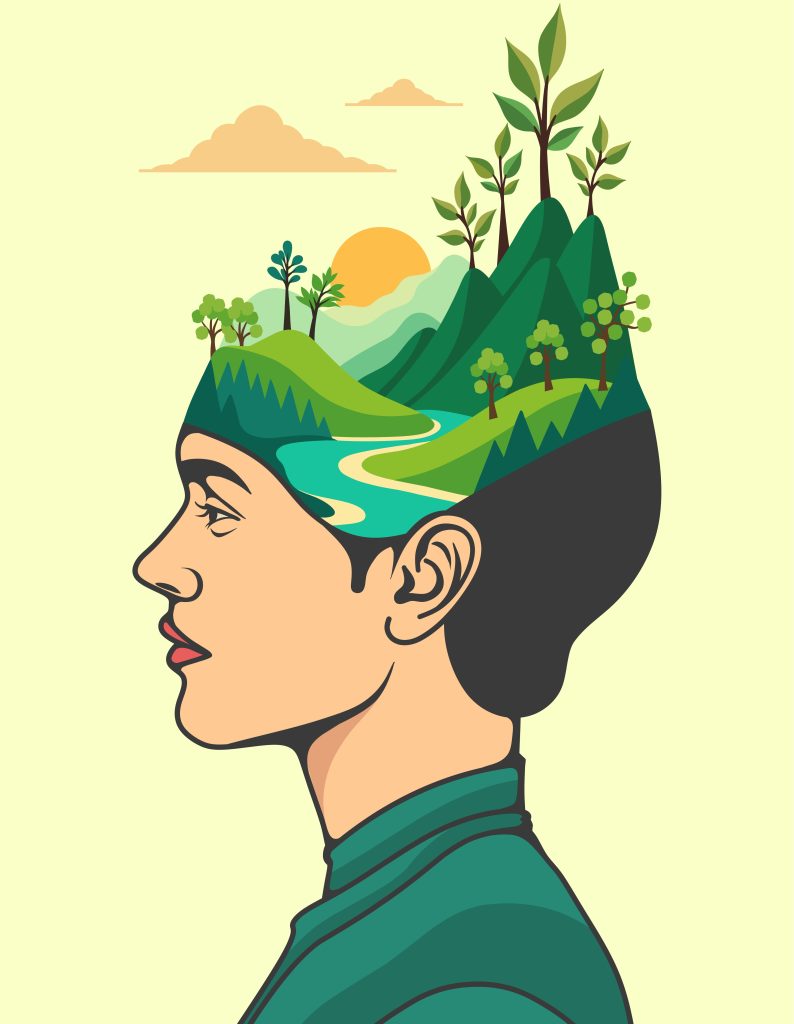
milhad-GxTfntuHMjU-unsplash.jpg (Illustration of a human head merging with a landscape, symbolizing the connection between the mind and nature. It represents harmony, growth, freedom and the influence of nature on our thoughts)
Relief exists, but not equally
Despite all of this, access remains uneven.
The 2026 Manila green-index study found that a substantial portion of the city is mostly built-up, with limited nearby vegetation and predominantly negative green-index values. The researchers said this points to minimal progress in either creating new green spaces or protecting existing ones. Still, pockets of relief remain.
According to the Climate Change Commission’s 2024 report “Urban Forests: The Breathing Life of Metro Manila,” Arroceros Forest Park spans 2.2 hectares and contains more than 3,500 trees and shrubs; UP Diliman’s Arboretum covers 22 hectares; and La Mesa Nature Reserve spans 2,659 hectares.
The same official report said Arroceros was recorded in April 2024 as 5°C cooler than the city’s average temperature.
In a hotter country, cooler air is not just comfort. It changes whether a place feels livable enough to linger in, and whether that pause can become restorative at all.
The larger Philippine mental-health picture
The subject goes beyond simply a lifestyle advice.
According to the WHO’s 2021 mental health investment case for the Philippines, mental health conditions cost the country PHP 68.9 billion each year, equivalent to 0.4% of gross domestic product, and around 96% of that burden comes from lost productivity.
The same WHO-backed report said evidence-based investments could save more than 5,000 lives and generate 700,000 healthy life years over ten years. In 2023, WHO and the Department of Health also reported that the Philippines had 362 access sites nationwide dispensing 30 mental health medicines to 124,246 service users in 2022.
These are important gains, yet they also show how large the need remains.
In addition, a 2024 systematic review in the Asian Journal of Psychiatry found that climate-change outcomes strongly and negatively affect mental health in the Philippines, including through indirect pathways such as sleep problems, migration, conflict and violence. Nature, then, is refuge here. It is also part of a climate-stressed reality.
What can nature give us?
So, can nature reset the Filipino mind? The most honest answer is that it can help steady it.
Based on a 2025 umbrella review in Frontiers in Public Health, green-space exposure is associated with mental-health improvements, while blue spaces are linked to improved psychological well-being.
That is a meaningful context, but it is not a magical one. Nature cannot erase grief, debt, trauma, overwork or clinical depression.
On the other hand, the evidence now strongly supports the idea that contact with trees, open landscapes and water can lower measurable stress, reduce rumination and create better conditions for emotional recovery.
Hence, the real issue may no longer be whether nature matters. It is whether enough Filipinos can still reach safe, accessible natural spaces when they need them most. In a crowded and warm country, that is no small question. It is a public-health question, a planning question, and quietly, a human one.
Editorial Note
Joyful Wellness shares mental health information to encourage awareness, understanding, and self-care. Our content is not a substitute for professional mental health support. If you or someone you know is experiencing emotional distress, seeking help from a licensed mental health professional or trusted healthcare provider is encouraged.
Cover photo modjo-studios-MBYsUnTtB14-unsplash.jpg
References:
Barquilla, C. A. M., Lee, J., & He, S. Y. (2023). The impact of greenspace proximity on stress levels and travel behavior among residents in Pasig City, Philippines during the COVID-19 pandemic. Sustainable Cities and Society, 97, 104782. doi:10.1016/j.scs.2023.104782
Bratman, G. N., Hamilton, J. P., Hahn, K. S., Daily, G. C., & Gross, J. J. (2015). Nature experience reduces rumination and subgenual prefrontal cortex activation. Proceedings of the National Academy of Sciences of the United States of America, 112(28), 8567–8572. doi:10.1073/pnas.1510459112
Climate Change Commission. (2024, June 24). Urban forests: The breathing life of Metro Manila.
Do Carmo, G. Q., Ayotte-Beaudet, J.-P., & Jordan, C. (2025). A systematic review of the impacts of nature exposure on the nervous system in children and youth: Implications for nature-based learning. Journal of Environmental Psychology, 107, 102788. doi:10.1016/j.jenvp.2025.102788
Fan, L., & Baharum, M. R. (2024). The effect of exposure to natural sounds on stress reduction: A systematic review and meta-analysis. Stress, 27(1), 2402519. doi:10.1080/10253890.2024.2402519
Francisco, F. A. F., Gonzales, D. D. O., Narca, A. M. Y., & Medina, J. M. (2026). Multitemporal analysis of green spaces in Manila, Philippines through a green index. ISPRS Annals of the Photogrammetry, Remote Sensing and Spatial Information Sciences, X-5/W4-2025, 237–244. doi:10.5194/isprs-annals-X-5-W4-2025-237-2026
Hunter, M. C. R., Gillespie, B. W., & Chen, S. Y.-P. (2019). Urban nature experiences reduce stress in the context of daily life based on salivary biomarkers. Frontiers in Psychology, 10, Article 722. doi:10.3389/fpsyg.2019.00722
Quinto, A. V., & Lagasca, K. F. A. (2025). Urban green spaces during the COVID-19 pandemic: A correlational analysis on stress and preferences of Gen Zs and millennials in Pampanga. Sukisok, 5(1).
Sudimac, S., Sale, V., & Kühn, S. (2022). How nature nurtures: Amygdala activity decreases as the result of a one-hour walk in nature. Molecular Psychiatry, 27(11), 4446–4452. doi:10.1038/s41380-022-01720-6
Vitale, V., & Bonaiuto, M. (2024). The role of nature in emotion regulation processes: An evidence-based rapid review. Journal of Environmental Psychology, 96, 102325. doi:10.1016/j.jenvp.2024.102325
Wang, X., Feng, B., & Wang, J. (2025). Green spaces, blue spaces and human health: An updated umbrella review of epidemiological meta-analyses. Frontiers in Public Health, 13, 1505292. doi:10.3389/fpubh.2025.1505292
World Health Organization. (2023, October 12). DOH, WHO launch Philippine Council for Mental Health Strategic Framework 2024–2028.
World Health Organization. (2025). Mental Health Atlas 2024: Member state profile—Philippines.
World Health Organization Regional Office for the Western Pacific. (2021). Prevention and management of mental health conditions in the Philippines: The case for investment.