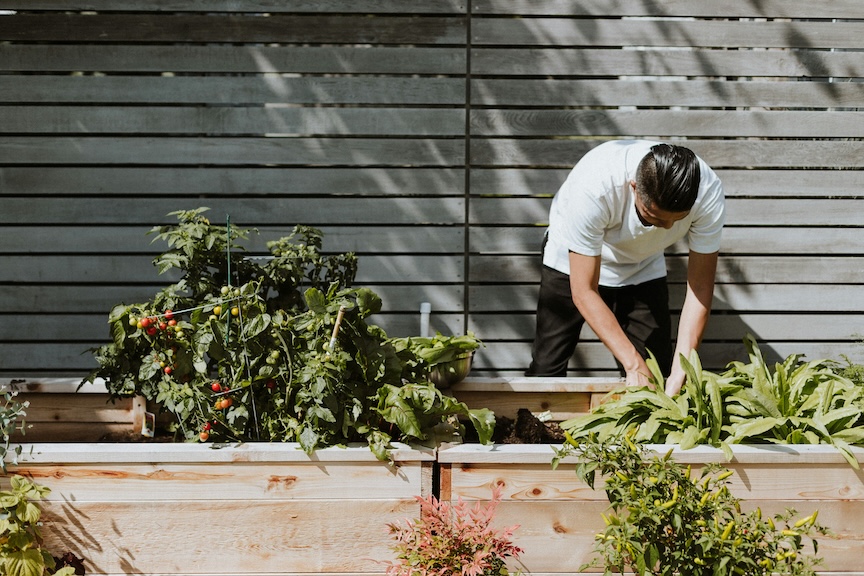
Gardening as nutrition, therapy, and a way back to yourself
There is something quietly radical about growing your own food.
You find it in the small, daily act of tending to something that responds to care. A pot of herbs by the window. A few leafy greens on a balcony. Even a single plant that insists on living, as long as you remember to water it.
In a time where health feels increasingly complex, measured, tracked, optimized gardening offers a simpler entry point.
You plant. You wait. And you grow.
Somewhere in that process, something in you steadies.
More Than a Hobby
Science has long recognized what many people intuitively feel: gardening supports both physical and mental health.
Studies show that regular interaction with plants can:
- reduce stress hormones like cortisol
- improve mood and attention
- encourage healthier eating habits
It is, in many ways, a full-spectrum wellness practice and one that touches nearly every pillar of Joyful Wellness.
DISCOVER: 6 Refreshing New Hobbies To Try
Nutrition, Grown at Home
Let’s begin with the most obvious benefit.
When you grow your own food (even something as simple as kangkong, pechay, or basil), you are more likely to eat it. Research shows that people who grow food tend to consume more fruits and vegetables, improving overall diet quality.
More importantly, freshly harvested produce retains more nutrients compared to items that have traveled long distances.
A handful of herbs can transform a meal and a small harvest can shift habits.
Suddenly, nutrition becomes something personal.
Beauty, From the Ground Up
Healthy skin often begins with what we consume and how we live.
Leafy greens rich in antioxidants, herbs with anti-inflammatory properties, and even hydration from fresh produce all contribute to skin health. But beyond nutrition, gardening itself plays a role.
Exposure to natural light helps regulate circadian rhythms. Contact with soil has been linked to microbial diversity that may support immune and skin health.
Beauty routine? Maybe not exactly.
It is a beauty foundation.
Disease Prevention, One Habit at a Time
Gardening encourages movement, think of bending, lifting, reaching, all forms of low-impact physical activity associated with improved cardiovascular health.
It also promotes consistency.
And in health, consistency pays more than intensity.
Regular exposure to green spaces has been linked to lower risks of chronic disease, improved immune function, and better overall wellbeing.
Small actions. Repeated often.
Mental Health, Quietly Restored
There is a reason gardening feels calming.
Attention Restoration Theory suggests that natural environments allow the brain to recover from mental fatigue. The act of focusing on simple, sensory tasks of watering, pruning, observing, gives the mind a break from constant stimulation.
In practical terms:
It helps you think less and feel more at ease.
Even a few minutes a day can shift mood and reduce anxiety.
Longevity in Everyday Form
In regions known for long life spans, often called “Blue Zones”—gardening is a common, almost unremarkable habit.
Beyond exercise and therapy, it is part of daily living.
And perhaps that is the point.
Longevity is rarely built on grand interventions. It is shaped by small, sustained behaviors that keep the body moving and the mind engaged.
Health & Innovation, Made Accessible
What makes gardening particularly relevant today is how accessible it has become.
Urban gardening kits, vertical planters, hydroponic systems, these innovations allow even small spaces to become productive.
For partners and brands, this is where meaningful collaboration can grow:
- sustainable home solutions
- nutrition-focused products
- wellness tools that support everyday health
Because wellness, when made accessible, becomes scalable.
Joy and Happiness, Unexpectedly Found
There is a quiet satisfaction in watching something grow because of you.
Without needing to be perfect. But consistently enough to matter.
A new leaf.
A small harvest.
Or a plant that survives longer than expected.
These are small victories. But they accumulate. And over time, they create something many people are searching for:
A sense of connection.
Or rhythm.
A reason to pause.
How to Start (Without Overthinking It)
You only need a beginning.
Try this:
- Start with easy plants: basil, mint, pechay, or chili
- Use recycled containers if space is limited
- Water consistently, not excessively
- Place plants where they receive natural light
- Pay attention as plants respond to care
That’s it. No perfection required.
The Takeaway
Wellness begins with a pot of soil and the decision to try.
To grow something.
To care for it.
And to return, each day, even briefly.
In doing so, you may find that what you are cultivating is a way of living that feels, quietly and steadily, well.
Photo by Priscilla Du Preez 🇨🇦 on Unsplash
References:
- Soga, M., Gaston, K. J., & Yamaura, Y. (2017). Gardening is beneficial for health: A meta-analysis. Preventive Medicine Reports.
- Van Den Berg, A. E., & Custers, M. H. G. (2011). Gardening promotes neuroendocrine and affective restoration. Journal of Health Psychology.
- WHO – Urban Green Spaces and Health (2016)
- Kaplan, R. (1995). The restorative benefits of nature. Journal of Environmental Psychology
- CDC – Nutrition and Physical Activity Guidelines
- FAO – Urban Agriculture and Food Security