
The viral trend promises rest, but science suggests there’s a healthier way to recover from burnout.
Last Sunday, we shared one of the wellness shifts we’re watching closely.
People are finally beginning to understand that sleep isn’t wasted time.
It’s one of the most powerful investments we can make in our health.
Ironically, just as science is telling us to take sleep more seriously, social media has popularized a trend that appears to celebrate rest but may actually be doing the opposite.
It’s called bed rotting.
And despite its amusing name, it raises an important question.
Can spending an entire weekend in bed actually leave us more tired than before?
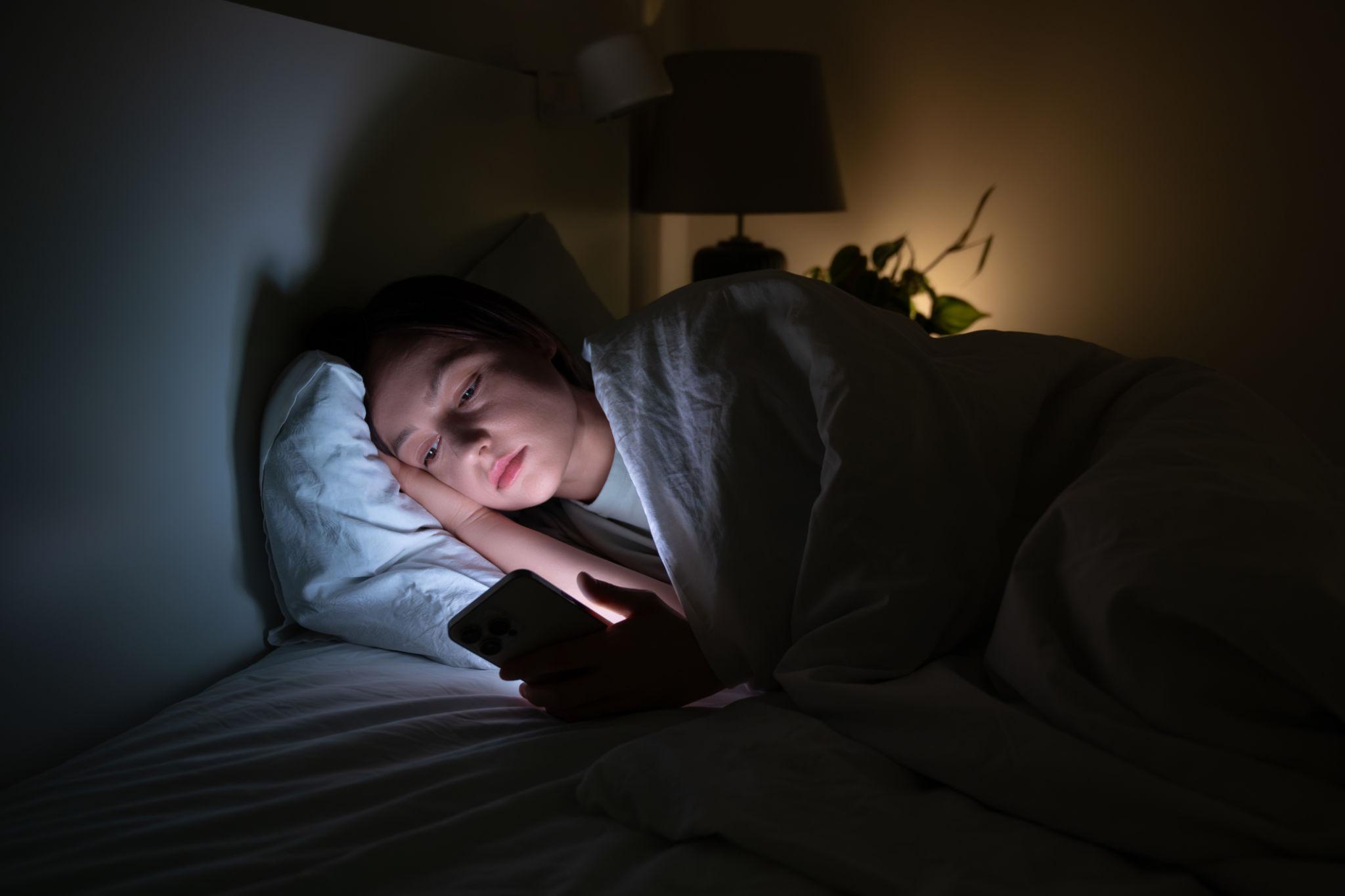
We’ve all been there. The work week ends, the academic deadlines pass, or the relentless noise of our digital and social obligations finally hits a wall. Our brain feels entirely full, our muscles ache with fatigue, and the only logical sanctuary is our bedroom. We dive under the covers, pull out our phone, turn on the television, and decide that for the next 24 to 48 hours, we are not moving. We are going to “rot.”
What started as a humorous, hyper-relatable snippet on TikTok has evolved into a full-fledged cultural phenomenon known as bed rotting. Defined as spending long, continuous hours awake in bed to eat, scroll, and watch shows, it has become the default recovery mode for millions of young adults. Organizations like the American Academy of Sleep Medicine (AASM) note that nearly a quarter of Generation Z explicitly uses this practice to cope with burnout.
At first glance, bed rotting feels like a radical, empowering act of self-care. It looks like a bold rejection of toxic “hustle culture,” a deliberate choice to prioritize mental health over endless productivity. But beneath the cozy blankets lies a profound psychological and biological irony.
By retreating to our beds to escape a hyper-stimulated world, we are accidentally creating a state of chronic exhaustion. We are trapped in The Rest Paradox: the very place we go to find sanctuary is actively hijacking our ability to truly recharge [Why is Gen Z “Bed Rotting”? The Psychology of Burnout…].
READ: The Secret to a Longer Life? It Might Just Be Sleep
The Rest Paradox
Our bodies recover in remarkable ways, but only when we give them the right conditions.
Imagine leaving twenty television sets turned on inside our brain. That’s what endless scrolling often feels like to the nervous system. Our body may be lying perfectly still. But our brain is still working overtime.
During periods of prolonged stress, the body remains in a heightened state of alertness. Stress hormones stay elevated, our minds race, and our brains continue processing information long after the workday has ended.
Real recovery happens when the nervous system finally slows down.
Deep sleep helps regulate emotions, consolidate memories, and support the body’s natural repair processes. Even quiet moments away from constant stimulation allow the brain to reset.
Bed rotting, however, often looks very different.
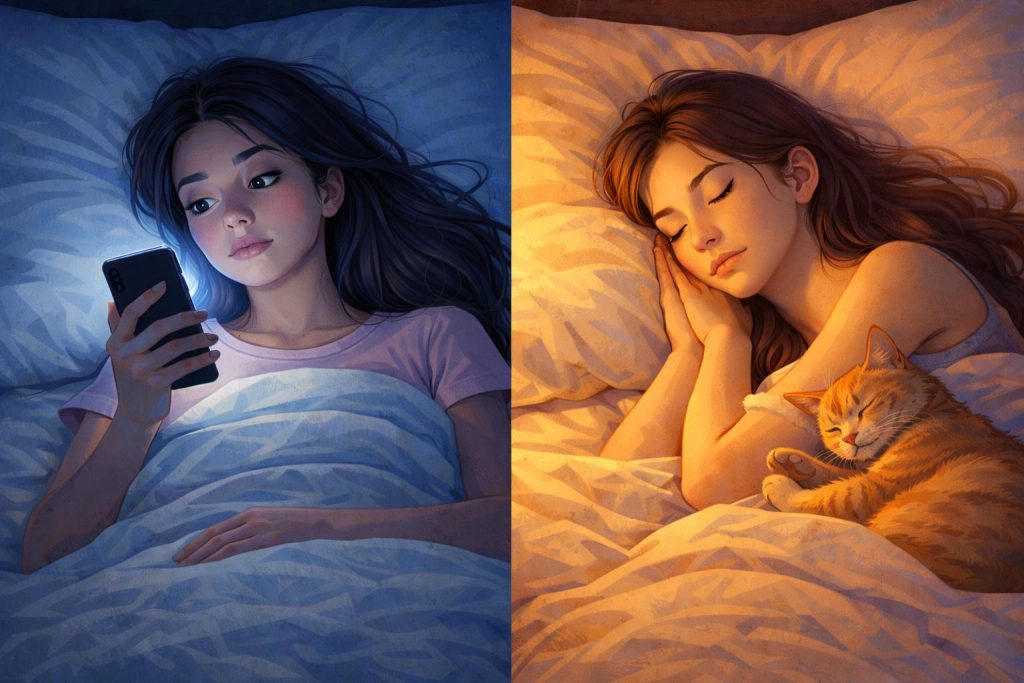
Although the body is lying still, the brain may remain intensely active. Every video, message, notification, or endless scroll feeds the brain fresh information to process. At the same time, the blue light emitted by phones and tablets suppresses melatonin, the hormone that helps prepare the body for sleep.
In other words, the body may appear to be resting while the brain continues to work.
To reverse this, the body needs to enter a parasympathetic state, often referred to as “rest and digest.” This transition requires two critical components:
- Sensory Deprivation: A distinct reduction in external data inputs (light, noise, information).
- Unconsciousness or Mindfulness: Allowing the brain to enter its Default Mode Network (the daydreaming, processing state) or dropping into restorative deep sleep. Put it this way, our brain has its own quiet housekeeping shift. It usually happens when we’re resting deeply or sleeping. That’s when memories are sorted, emotions are processed, and yesterday slowly makes sense.
Bed rotting offers neither. When we lie in bed for twelve hours while actively consuming social media algorithmic feeds, watching intense streaming dramas, or texting friends, our physical body is still, but our mind is running a marathon. Our brain is processing thousands of pieces of visual data, micro-dosing dopamine with every scroll, and keeping our nervous system on high alert.
We aren’t resting. We are simply keeping our brain wired while our body remains trapped in low-gear.
The Biological Blueprint: How the Bed Remembers
The most immediate casualty of prolonged bed lounging is our sleep hygiene. Our brain is an exceptional pattern-recognition machine; it relies heavily on classical conditioning to regulate our biological functions.
If we strictly use our bed for two things—sleep and intimacy—our brain builds a powerful, subconscious association: Bed equals rest. The moment our heads hits the pillow, our brain signals the release of melatonin, our heart rate slows, and we drift off easily.
When we introduce bed rotting into the equation, that association shatters. When we use our bed to cry, eat, work, text, stream, and panic about the future, our brain begins to view the bed as a multi-purpose living room.
Consequently, when we finally turn off the lights at midnight to sleep, our brain remains wide awake, confused as to why the “entertainment zone” is suddenly dark. This confusion creates a vicious cycle of nighttime insomnia, leading to morning sluggishness, which inevitably makes us want to stay in bed and rot the next day.
Furthermore, data published in Diabetes Care highlights that sleep irregularity, unpredictable bedtimes and wake times, is a massive disruptor of cardiometabolic health. The study discovered that even if you technically get “enough” hours of sleep over a weekend, a highly irregular sleep routine significantly harms your metabolic health.
By turning our sleep schedule into a casualty of our weekend lifestyle, bed rotting robs us of our natural circadian rhythm.
The Psychological Slip: From Escape to Avoidance
There is a thin, dangerous line between temporary, intentional comfort and psychological avoidance. An occasional rainy morning spent catching up on a favorite book or enjoying a slow cup of coffee in bed can absolutely be a minor, positive wellness tool.
However, when bed rotting becomes a multi-day habit or a primary coping mechanism, it stops being a shield against stress and begins acting as an anchor for mental health struggles.
As mental health professionals frequently warn via clinical insights from organizations like the Cleveland Clinic, prolonged immobilization facilitates negative thought spirals. When we isolate ourselves physically, we remove the opportunities for micro-achievements, environmental shifts, and serendipitous joy.
Without external stimuli to pull us out of our mind, the brain defaults to rumination, constantly chewing on anxieties, past mistakes, and future fears. What feels like a cozy retreat can quickly spiral into a “false depression,” where our body begins mimicking the exact physical lethargy, low self-esteem, and social withdrawal associated with a clinical depressive episode.
Reclaiming the Sanctuary: A Blueprint for Active Rest
If bed rotting is an ineffective path to recovery, how do we honor our very real need to unplug without destroying our sleep and mental clarity? The answer lies in transitioning from passive avoidance to Active Rest.
To help individuals systematically track and reset habits, we at Joyful Wellness emphasize intentional, daily practices over extreme lifestyle swings. We can protect our well-being while still giving our system the break it craves by implementing a few foundational boundaries:
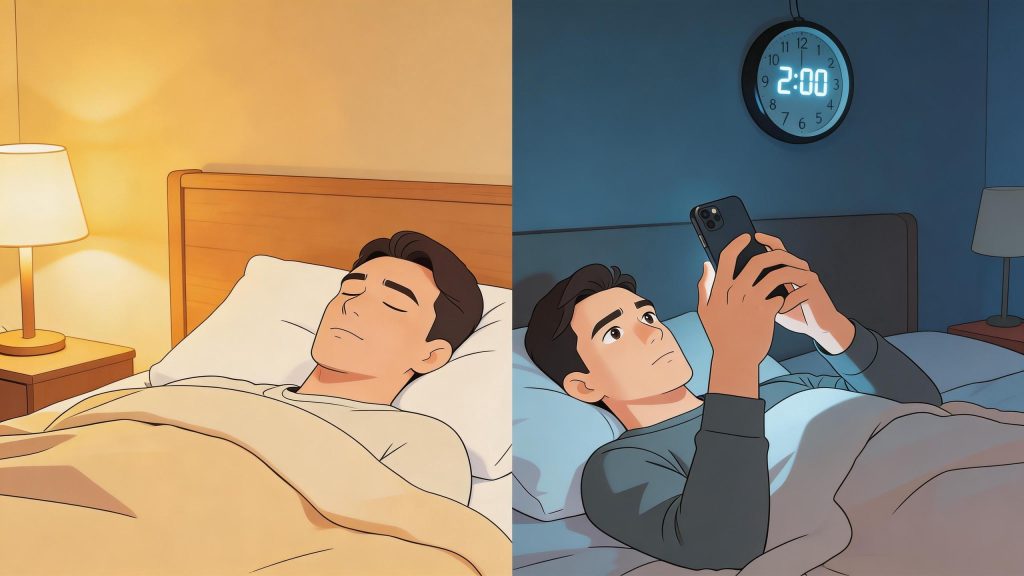
- The Couch Compromise: If we are physically exhausted and need to watch television or scroll mindlessly for an hour, let’s do it on the living room sofa, a comfortable chair, or even a floor cushion. Keep the bedroom strictly segregated as a sacred space for biological sleep.
- The 20-Minute Separation Rule: If we are in bed trying to sleep or rest and find our mind racing, or if we catch ourselves reaching for our phone to scroll, we must get out of bed after 20 minutes. Move to a dimly lit space, do a low-stimulation activity like stretching or reading a physical book, and only return to bed when our eyes are heavy.
- Embrace True Sensory Lowering: Replace digital consumption with genuine sensory decompression. Try a warm bath, five minutes of deep breathing exercises, or listening to a calming ambient soundtrack in total darkness.
- Chasing the Morning Sun: The ultimate antidote to daytime sluggishness is sunlight. Stepping outside for just 10 to 15 minutes within an hour of waking up stops melatonin production, instantly lowering physical sluggishness and anchoring your sleep cycle for the coming night [Why is Gen Z “Bed Rotting”? The Psychology of Burnout…].
SLEEP TIPS: Stress Less, Glow More: A Practical Guide to Better Sleep and Hydration
Blueprint 1: The “Digital Sunset” Ritual
To successfully banish blue-light devices from your bed and protect your circadian rhythm, you need a structured transition period before sleeping. A Digital Sunset means gradually turning down the technological stimulation in your home 60 minutes before your head hits the pillow.
- T-Minus 60 Minutes (The Cut-Off): Plug your smartphone into a charging station completely out of arm’s reach from your bed—ideally across the room or in another room entirely. Switch your device to “Do Not Disturb” mode.
- T-Minus 45 Minutes (Environment Dimming): Turn off bright overhead lights. Turn on low-wattage, warm-toned bedside lamps or amber-tinted salt lamps to signal to your brain that night has arrived.
- T-Minus 30 Minutes (Analog Substitution): Engage in a screen-free hobby. Read a physical fiction book, write down your thoughts in a paper journal, or listen to an audiobook via a smart speaker that doesn’t require a screen to operate.
- T-Minus 10 Minutes (Sensory Drop): Lower your bedroom temperature slightly if possible. Slip into bed with the absolute certainty that your workspace and social network are safely locked away until morning.
Blueprint 2: The 5-Minute “Anti-Rot” Morning Mobility Flow
If we wake up feeling heavy, stiff, or trapped by the magnetic pull of our mattress, let’s use this quick physical sequence. It is specifically designed to safely lubricate our joints, wake up our central nervous system, and flush out the physical lethargy of an extended stay in bed.
- Move 1: Full-Body Morning Tension Release (60 Seconds)
- How to do it: While still lying flat on your back, interlace your fingers and press your palms away from your head, reaching far past your crown. Concurrently, point your toes forward as hard as you can. Tense every single muscle in your body for 5 seconds, then completely exhale and release. Repeat 3 times to get stagnant blood flowing back to your extremities.
- Move 2: Bedside Supine Twist (60 Seconds)
- How to do it: Pull your knees into your chest while lying down. Slowly drop both knees over to the left side of your body while extending your right arm out to the right like a wing. Keep your gaze toward your right hand. Breathe deeply into your lower back and ribs for 30 seconds, then switch sides. This decompresses a spine stiffened by hours of lying flat.
- Move 3: The Edge-of-Bed Cat-Cow (90 Seconds)
- How to do it: Sit up and swing your legs over the edge of the bed, planting your feet firmly on the floor. Rest your hands on your knees. As you inhale, arch your back, pull your shoulders back, and lift your chest toward the ceiling (Cow position). As you exhale, round your spine, tuck your chin to your chest, and push your mid-back behind you (Cat position). Alternate between these fluidly to jump-start your posture and circulation.
- Move 4: Standing Forward Fold to Sky Reach (60 Seconds)
- How to do it: Stand up completely next to your bed. Set your feet hip-width apart and gently hang forward from your hips, letting your arms, neck, and head dangle completely loose toward the floor. Keep a soft bend in your knees. Hang for 30 seconds to let gravity pull fresh oxygen to your brain, then slowly roll up one vertebra at a time, extending your hands all the way to the sky in a final celebratory gesture of wakefulness.

Transitioning Forward
True self-care is not always comfortable, and it rarely looks like a beautifully aesthetic, filtered photo of silk sheets and laptop screens. Sometimes, true self-care means having the discipline to step away from the digital world, get out from under the covers, and give your body the movement, sunlight, and clean environmental boundaries it requires to thrive.
If you are eager to build better daily recovery habits, try utilizing a guided mindfulness resource like the A Better You Journal to clearly track your sleep intervals, log your energy dips, and intentionally design a rest routine that genuinely heals.
This Week’s Tiny Shift
Tonight, leave your phone charging outside your bedroom.
Tomorrow morning, spend 10 minutes in natural sunlight before looking at your screen.
Your brain may thank you before lunchtime.
One Thing We Learned
Sometimes our bodies are lying still while our brains are still working.
True rest begins when both are allowed to slow down.
The Science Behind This Story
At Joyful Wellness, we believe health information should be grounded in credible science. This article draws on current research in sleep medicine, behavioral psychology, and circadian biology to explain why true rest involves more than simply spending time in bed.
References
- American Academy of Sleep Medicine (AASM). Survey on “bed rotting” among Generation Z and attitudes toward sleep.
- Cleveland Clinic. Guidance on stimulus control therapy, sleep hygiene, insomnia, and healthy sleep behaviors.
- American Academy of Sleep Medicine. Sleep hygiene recommendations and behavioral approaches to improving sleep.
- Diabetes Care. Research on sleep irregularity, circadian rhythm, and cardiometabolic health.
- National Institutes of Health (NIH). Sleep, circadian rhythm, and brain health resources.
- Centers for Disease Control and Prevention (CDC). Healthy sleep recommendations for adults.
- Matthew Walker, PhD. Why We Sleep (Penguin Random House). (Excellent for general readers and supported by peer-reviewed sleep science.)