

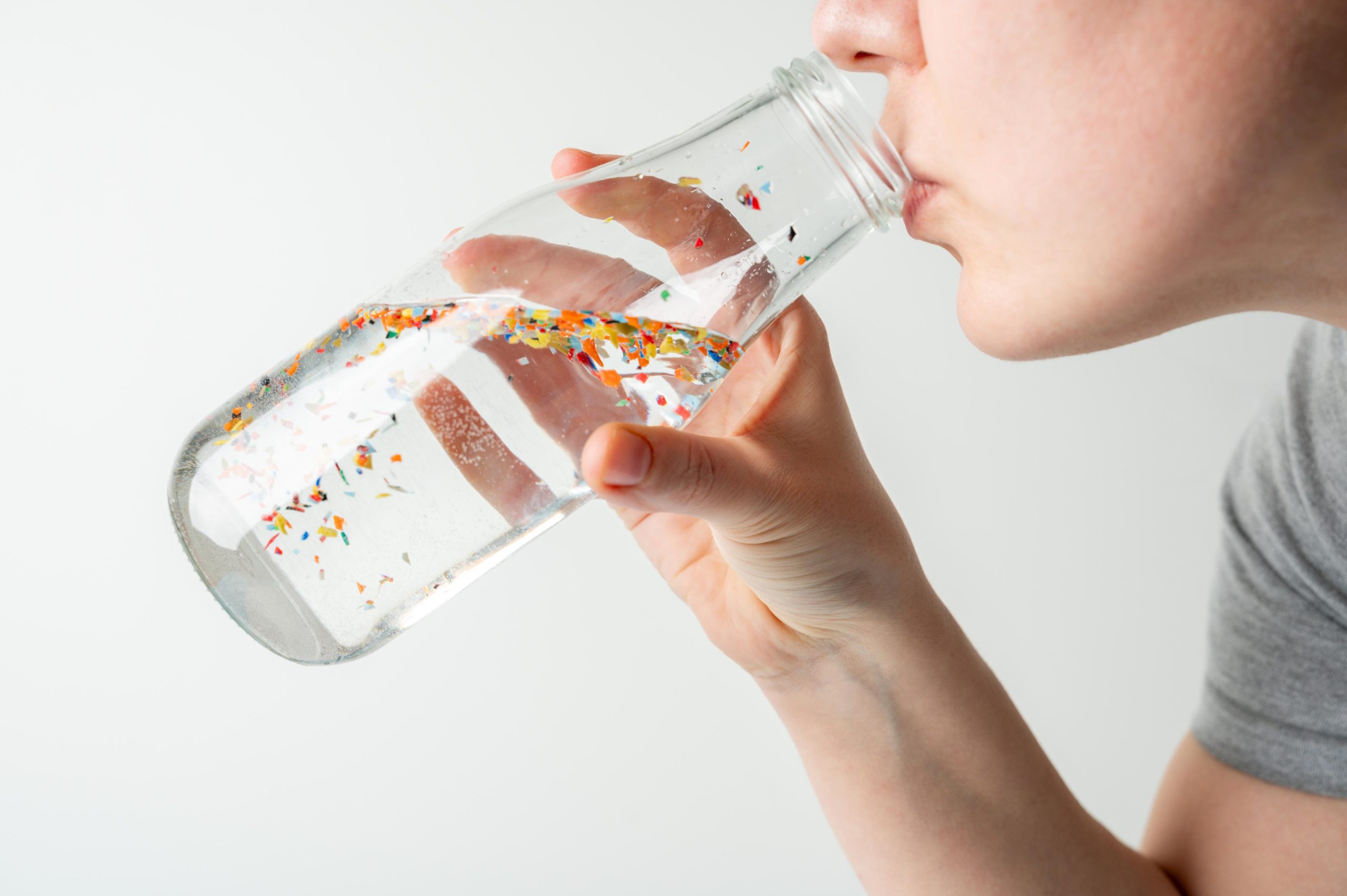
Years ago, “microplastics” was a term mostly confined to marine biology papers and the occasional alarming headline about sea turtles. Lately, it has shown up somewhere a lot closer to home: the water we consume. Scientists have detected microplastics in human blood, placenta and breast milk, and headlines have followed with understandably unsettling framing. PubMed
Two stories intertwine to explain what’s actually happening. One part is well documented: plastic pollution in Philippine water sources is real, measurable and, in some places, significant. The other part is what it actually does to a person’s health. This is still an early and shaky area of science that most coverage lets on. However, both must be taken seriously, but neither deserves to be exaggerated.
What Microplastics Actually Are
Microplastics are plastic particles smaller than 5 millimeters, roughly the size of a grain of rice or smaller. They can form as larger plastic waste breaks down through sunlight, friction and weathering, or they can be manufactured at very small sizes for particular uses. They are persistent by nature: conventional plastics generally do not biodegrade readily like organic waste. Instead, they can fragment into progressively smaller pieces that move through wind, rivers and runoff, eventually settling into soil, sediment and water supplies, including sources that may ultimately be treated for drinking. World Health Organization
What’s Actually Known: The Country Has a Real, Documented Problem
This part of the story is backed by a growing, locally conducted body of research, and the numbers are worth sitting with.
Philippine rivers have been the subject of several microplastic studies, and the findings are difficult to ignore. A study of five river mouths draining into Manila Bay—Cañas, Meycauayan, Parañaque, Pasig and Tullahan—found microplastics throughout all five sampling areas. Concentrations in surface water ranged from 1,580 particles per cubic meter in Cañas River to 57,665 particles per cubic meter in Meycauayan River, with the other rivers also recording thousands of particles per cubic meter. Frontiers
Laguna de Bay has also been found to contain microplastics. More recent Philippine research continues to document their presence across freshwater and marine environments, underscoring that plastic contamination is not confined to the country’s coastlines or to visibly polluted waterways. Frontiers
Until recently, though, much of this research described rivers, lakes and bays, not necessarily the water that actually comes out of a tap.
That is now beginning to change.
A University of the Philippines Manila research team has been studying the detection of microplastics in drinking-water sources in Metro Manila, with work involving sampling sites, methodology and cooperation among local governments, regulators and water concessionaires. The research is part of a broader effort to understand how microplastics can be detected and monitored in drinking-water sources. UP Manila Health Sciences Center
Household-level research has filled in another piece of the picture. A study by researchers from Centro Escolar University examined water collected from refillable water gallon containers used by households in Manila and investigated the presence and characteristics of microplastics in those samples. The study adds another possible entry point to the picture beyond rivers and municipal water sources. ResearchGate
The important distinction is that finding microplastics in an environmental or drinking-water sample tells us that exposure is possible. It does not, by itself, tell us what level of exposure causes illness.
That distinction matters.
Tap, Refilled, or Bottled? What Do Studies Say?
A reasonable next question is whether switching water sources actually helps, and the global research gives a fairly clear, if slightly counterintuitive, answer.
A 2022 review covering 21 international studies found microplastics in both tap and bottled water, but reported that concentrations were generally higher in bottled water than in tap water. The authors noted that drinking-water treatment can remove a substantial proportion of microplastics, while contamination can also be introduced during bottling and through packaging materials. PubMed Central (PMC)
A separate 2024 study examining bottled water in Spain likewise found higher plastic concentrations in bottled water than in tap water in the comparison it made. The researchers estimated that exposure from bottled water alone was probably a negligible health risk based on their measured concentrations, but that conclusion should not be generalized to every brand, country or source of bottled water. PubMed
Put plainly: properly treated tap water appears to be a reasonable baseline, rather than automatically being the riskier option that the “plastic water bottle” instinct might suggest.
But there is an important Philippine qualifier. Studies from other countries cannot tell us exactly what is happening in every Philippine household, and the newer local research into Metro Manila drinking-water sources will be important in filling that gap.
READ: El Niño Philippines 2026: Why Preparedness Must Include Everyone
What’s NOT Yet Known: The Gap in Health Science
Despite the headlines, the U.S. Food and Drug Administration currently states that available scientific evidence does not demonstrate that the levels of microplastics or nanoplastics detected in food pose a risk to human health. It also emphasizes that methods for detecting and measuring these particles are not yet standardized, making comparisons between studies difficult. U.S. Food and Drug Administration
The World Health Organization has similarly identified microplastics as an emerging area of concern while emphasizing the substantial gaps in knowledge about exposure and human-health effects. World Health Organization
That is not the same as saying microplastics are harmless.
It is a more careful and more honest statement: the evidence is not yet strong enough to draw firm conclusions about what typical real-world exposure means for human health.
A growing number of reviews have documented microplastics in human blood, placenta, breast milk and other biological samples. At the same time, much of the evidence about possible harm still comes from laboratory and animal studies rather than large, long-term epidemiological studies of people. PubMed
Potential effects being investigated include inflammation, oxidative stress, hormonal and reproductive effects, changes to the gut and possible cardiovascular or other organ effects. But these findings should be described as potential or suspected effects, not established consequences of everyday exposure in humans. PubMed
Several recent reviews reach a remarkably similar conclusion: there is a legitimate reason for continued research, biological plausibility for concern, and growing evidence that humans are exposed, but not yet enough direct evidence to state specific diseases or health outcomes as settled fact. A 2026 systematic review focused specifically on the Philippines reached much the same conclusion, noting that direct epidemiological evidence linking microplastic exposure to human health outcomes remains limited. Frontiers
One widely repeated estimate suggests that people may ingest the equivalent of a “credit card” of plastic each week. But that memorable figure should not be presented as an established fact. A peer-reviewed reassessment found serious methodological problems with the calculation behind the estimate and concluded that it substantially overestimated the amount of microplastic ingested. ScienceDirect
In other words, the science is concerning enough to warrant attention, but not settled enough to justify turning a dramatic statistic into a medical certainty.
What You Can Do While Science Catches Up
Given that gap between documented exposure and undetermined harm, a measured, proportionate response makes more sense than either dismissal or panic.
- Favor properly treated drinking water where available. International studies generally find lower microplastic concentrations in treated tap water than in bottled water, although local conditions and treatment systems matter. PubMed Central (PMC)
- Use glass or stainless steel when practical, particularly for storing water and for hot liquids. Research shows that temperature and physical wear can increase plastic particle release from some plastic products. PubMed
- Replace heavily scratched or visibly degraded plastic containers. Aging, surface wear and repeated use have been identified as factors that can contribute to particle release, although the amount varies considerably by material and conditions. ScienceDirect
- Support continued local water testing and stronger monitoring. Philippine researchers are already working to improve the detection and understanding of microplastics in drinking-water sources, and the 2026 Philippine evidence review has called for standardized monitoring and stronger policy responses. UP Manila Health Sciences Center
- Keep the response proportionate. Current evidence does not support telling people that expensive filtration systems or dramatic lifestyle overhauls are medically necessary simply because microplastics have been detected in water. It supports reasonable precautions while a genuinely unsettled area of science continues to develop.
The honest answer to “Is there plastic in Philippine drinking water?” is that microplastics have been documented in Philippine water environments, and emerging local research is now looking more closely at drinking-water sources and household water. Frontiers
The honest answer to “Is that plastic making people sick?” is: that has not yet been established, despite how confidently the connection is sometimes asserted online.
Both of those sentences can be true simultaneously.
Treating them as a single settled story—in either direction—misrepresents what the research actually shows.
The responsible move right now is to take plastic contamination seriously, support the local testing and monitoring already underway, make sensible choices where practical, and let the human-health research catch up before treating a worst-case scenario as a confirmed one.
References
World Health Organization. Microplastics in Drinking-water. 2019. World Health Organization
World Health Organization. Dietary and Inhalation Exposure to Nano- and Microplastic Particles and Potential Implications for Human Health. 2022. World Health Organization
Gambino I, Bagordo F, Grassi T, Panico A, De Donno A. Occurrence of Microplastics in Tap and Bottled Water: Current Knowledge. International Journal of Environmental Research and Public Health. 2022. PubMed Central (PMC)
Osorio ED, et al. Microplastics Occurrence in Surface Waters and Sediments in Five River Mouths of Manila Bay. Frontiers in Environmental Science. 2021. Frontiers
Fortaleza JAG, et al. Microplastics and Human Health Risks: Toward Evidence-Based Policy and Regulation in the Philippines. Frontiers in Environmental Science. 2026.
U.S. Food and Drug Administration. Microplastics and Nanoplastics in Foods.