

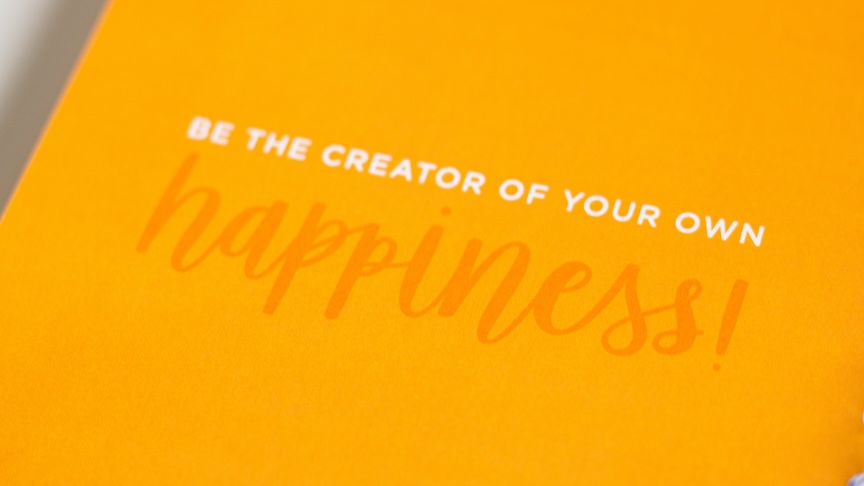
Living beyond likes, labels, and expectations
How do you like the version of happiness many of us have learned to perform?
It looks good in photos. It reads well in captions. Almost always it fits neatly into categories: successful, thriving, fulfilled. It gathers approval, sometimes quickly, sometimes in small, steady increments.
And yet, when the moment passes, something quieter remains:
A question.
Did that actually make me happy?
When Happiness Becomes a Performance
Social platforms have changed how we experience life.
Moments are no longer just lived, they are documented, shared, and, often, measured. A meal becomes content. A trip becomes proof. Even rest can feel like something that needs to be justified.
Psychology has a name for this shift: extrinsic motivation, when behavior is driven by external validation rather than internal satisfaction.
Studies consistently show that when happiness becomes tied to external rewards like approval, recognition, comparison, it becomes less stable. It depends on feedback that is unpredictable and often fleeting.
What follows is a cycle:
We share → we wait → we measure → we repeat.
And somewhere in that loop, the experience itself becomes secondary.
The Cost of Constant Comparison
Human beings are wired to compare.
But today, comparison is constant and often distorted.
We see highlights instead of context. We count milestones and forget the uncertainty behind them. Almost all the time, we focus on outcomes, ignoring the effort, doubt, or failure that preceded them.
Studies in social psychology have linked frequent social comparison to:
- increased anxiety
- lower self-esteem
- reduced life satisfaction
Most people see themselves inadequate or falling behind because they believe others are doing better.
DISCOVER: Why Modern Life Produces Pleasure, but Not Joy
What Real Happiness Looks Like (According to Science)
If external validation does not sustain happiness, what does?
Research in wellbeing points consistently to intrinsic experiences, those that are meaningful in themselves, regardless of who is watching.
These include:
- connection with others
- a sense of purpose
- engagement in simple, enjoyable activities
- moments of presence
Psychologists often describe this as self-determined living, that is when choices align with personal values rather than external expectations.
It is quieter.
Less visible.
But far more enduring.
Living Without an Audience
Should we then withdraw from the world and live without an audience?
Or is it better to look within?
It looks like:
- enjoying a moment without documenting it
- making decisions that do not require explanation
- choosing what feels right, even if it is not impressive
It may even feel unfamiliar at first.
Without the feedback loop of approval, the mind looks for reassurance. But over time, something steadier replaces it:
Clarity.
Practical Ways to Reclaim Your Experience
Shall we do grand exit from social platforms?
No. Just a shift in how we use them.
1. Create Unshared Moments
Do something you do not plan to post.
Let the experience exist fully, without an audience.
2. Notice What You Enjoy in Private
Pay attention to what feels good when no one is watching.
That is often where real preference lives.
3. Limit Passive Scrolling
Research shows that passive consumption increases comparison.
Be intentional about when and how you engage.
4. Define Your Own Markers
Instead of asking “How does this look?”
Ask: “Does this feel right?”
5. Return to the Body
Movement, rest, and real-world experiences help ground attention.
The body responds to what is real.
A Quiet Shift
There is a subtle freedom in stepping out of performance.
In allowing moments to exist without needing to be seen.
In recognizing that a meaningful life has nothing to do with looking impressive.
Honestly, it looks simple.
A conversation that stays with you.
A meal enjoyed slowly.
And yes, a day that passes without needing to be explained.
The Truth
Happiness is there without needing announcement.
It can exist even in the absence of attention or evidence to prove it.
It is in the moments that feel complete, even when no one else is watching.
And perhaps that is the truest kind:
The kind that belongs entirely to you.
Photo by Felicia Buitenwerf on Unsplash
References:
Deci, E. L., & Ryan, R. M. (2000). Self-Determination Theory.
— Differentiates intrinsic vs extrinsic motivation and their impact on wellbeing.
Festinger, L. (1954). Social Comparison Theory.
— Explains how comparison affects self-perception.
Verduyn, P., et al. (2015). Passive Facebook use undermines wellbeing.
— Links passive scrolling to decreased life satisfaction.
Kross, E., et al. (2013). Facebook use predicts declines in subjective wellbeing.
— Shows correlation between social media use and reduced happiness.
American Psychological Association (APA). Social media and mental health.