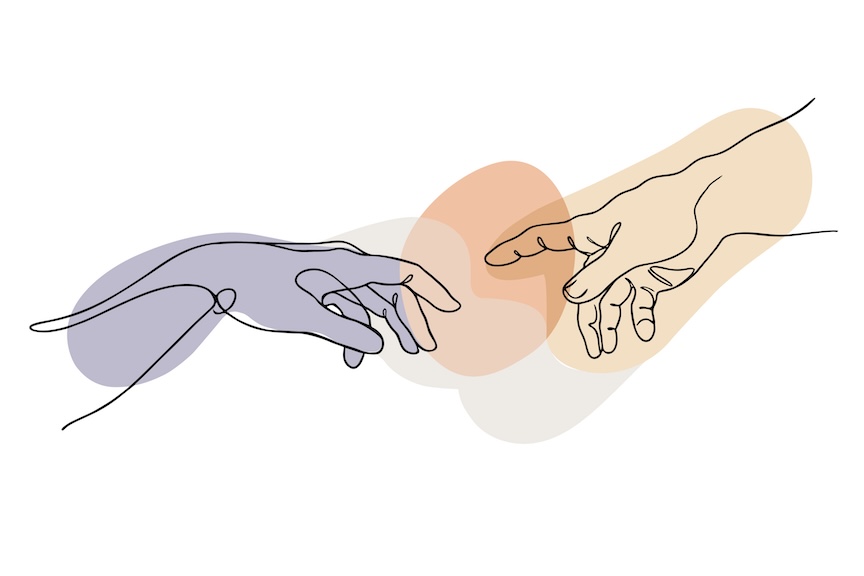
When a quiet ending leaves a lasting imprint
Some losses come quietly, without announcement.
Some have no rituals, condolences, or clear endings. A message fades. The call goes unanswered. A once-familiar presence becomes distant, then absent. What remains is a kind of grief that is difficult to explain because nothing “officially” ended, and yet something undeniably did.
Friendship breakups live in this quiet space.
They are rarely given the language we reserve for romantic loss, yet research in psychology suggests that the brain does not distinguish as neatly as we do. Social bonds, whether romantic or platonic, activate similar neural pathways tied to attachment, safety, and belonging. When those bonds shift or dissolve, the body registers it as disruption.
Studies in social neuroscience show that experiences of rejection or disconnection can activate the same regions associated with physical pain. The nervous system responds with heightened stress signals—subtle at first, then cumulative. Sleep may feel lighter. Thoughts circle more than usual. There is a quiet sense of imbalance, as though something familiar has been removed from the architecture of daily life.
And yet, because friendship loss is often ambiguous, many people move through it without acknowledgment.
They tell themselves it was not serious enough to grieve. That people grow apart. That it is easier not to dwell on it.
But unacknowledged grief does not disappear.
It lingers in the body—in tension, in fatigue, in the small moments when memory surfaces unexpectedly.
What helps is recognition.
To name the experience for what it is: a loss of connection that once mattered.
To understand that friendships, like all meaningful relationships, shape emotional regulation, stress response, even long-term wellbeing. Research continues to show that strong social ties are associated with better mental health, stronger immune function, and greater resilience over time.
Which is why their absence can be felt so deeply.
Healing does not always require reconciliation. Sometimes it begins with allowing the feeling to exist without judgment.
A quiet acknowledgement.
A moment of honesty.
A willingness to let the body process what the mind has tried to minimize.
Friendships, at their best, become part of how we understand ourselves.
When they change, something in us must adjust.
And perhaps the most compassionate thing we can offer ourselves in that process is this:
The understanding that even unspoken endings deserve to be felt.
Editor’s Note:
This article draws from research in social neuroscience and psychology, exploring how emotional loss, particularly in friendships, affects both mental and physical health.
willian-reis-ECLvfM-KZec-unsplash.jpg
References:
Eisenberger, N. I., Lieberman, M. D., & Williams, K. D. (2003). Does rejection hurt? An fMRI study of social exclusion. Science.
— Demonstrates that social rejection activates the same brain regions as physical pain.
Holt-Lunstad, J., Smith, T. B., & Layton, J. B. (2010). Social relationships and mortality risk. PLoS Medicine.
— Shows that strong social relationships significantly improve longevity and overall health outcomes.
Cacioppo, J. T., & Hawkley, L. C. (2003). Social isolation and health. Perspectives in Biology and Medicine.
— Explains how loneliness impacts immune function, stress response, and mental health.
Baumeister, R. F., & Leary, M. R. (1995). The need to belong: Desire for interpersonal attachments. Psychological Bulletin.
— Foundational theory establishing that human beings are biologically wired for connection.
Slavich, G. M., & Irwin, M. R. (2014). From stress to inflammation and major depressive disorder. Psychological Bulletin.
— Links social stress and emotional pain to physiological inflammation and mental health outcomes.
American Psychological Association (APA). The importance of social connection.
— Highlights how relationships influence emotional regulation, resilience, and wellbeing.